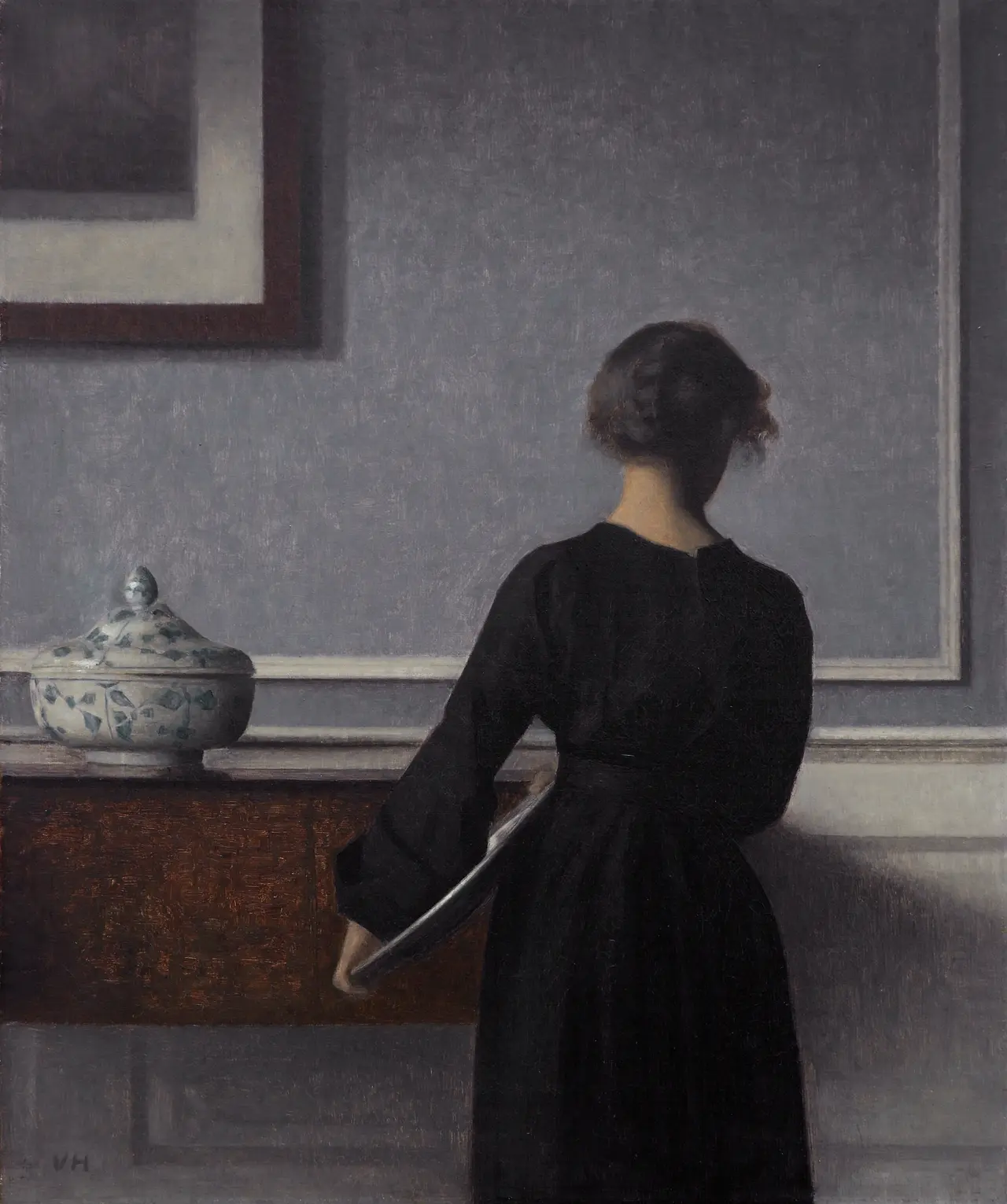
The plate does not rest easily. A woman holds it low against her left hip, gripping its edge while its broad surface leans across the black of her dress. A narrow line of light follows the rim. Her lowered arm and the plate’s awkward angle make its weight legible. The action is ordinary, but it gives her pose a physical demand.

She stands close enough for us to see the loose gathering of her hair, the warm strip of neck below it, and the seams that run down her bodice. Her face is fully turned away. We can study how she occupies the room, yet we cannot see what holds her attention. Vilhelm Hammershøi makes this difference the governing fact of Interior with Young Woman Seen from the Back: the figure is available to sight without becoming available to explanation.

The room strengthens that limit. Its wall moulding, the edge of the dark furniture, the right border, and the cropped frame at upper left form a strict field of vertical and horizontal lines. The woman fits among them but does not become another flat division. Head, shoulders, hip, hand, and plate describe curves. Her body interrupts the room’s geometry even as its lines hold her in place.

Held against the room

Hammershøi painted the small oil on canvas around 1903 or 1904. At 60.5 by 50.5 centimeters, it has the scale of a close encounter rather than a public scene. The composition offers almost no depth through which the eye can travel. Dark furniture crosses the lower left, the wall rises directly behind the figure, and the right edge cuts close to her dress. Even the furniture legs and floor fall outside the frame.

This shallow arrangement changes the turned back. In a deeper room, the woman might appear to be leaving or moving toward an unseen task. Here there is scarcely anywhere for her to go. The painting suspends her between the dark horizontal of the furniture and the pale moulding behind her. Her position reads less like a step in a story than a relation among weights and edges.

The largest empty area is the grey wall, but Hammershøi does not treat it as blank. Cool and warm greys shift across its surface. Pale outlines run around the recessed panel, while the broad frame at upper left brings in dark brown, cream, and a dense interior field. We see only a lower corner of whatever the frame contains. It behaves as architecture before it can behave as an image.

Below it, a covered porcelain vessel rests on the dark furniture. Blue leaves move across its white body. Its lid rises to a pointed handle, and its bowl swells outward before narrowing at the base. The object is the most intricately described thing in the painting. Hammershøi places its cool brightness against the furniture’s red-brown surface, where it answers the woman’s exposed neck and the thin light on the plate.

The vessel also establishes a different kind of presence. It sits securely, its rounded body contained and fully visible. The plate is rounded too, but it is seen at an angle and held under strain. One object is settled; the other depends on the figure’s hand. Their relation keeps the composition from becoming an arrangement of quiet tones alone. Stillness contains effort.

That effort does not disclose a mood. The lowered hand might belong to a pause before the plate is set down, or to the instant after it has been lifted. Nothing in the image chooses between these possibilities. Hammershøi gives the body enough specificity to make the action credible while withholding the sequence that would explain it. The visible gesture has weight, not a fixed meaning.

A familiar figure, withheld

The room belonged to the home that Vilhelm and Ida Hammershøi shared at Strandgade 30 in Copenhagen. The woman is Ida, the artist’s wife and a repeated presence in his interiors. This knowledge brings the scene nearer to domestic life, but it does not convert the painting into a private report about their marriage. Familiarity is part of how the image was made. It is not permission to turn posture into testimony.

Hammershøi produced more than seventy paintings of domestic interiors, about half of them with Ida. Across these works, she often appears turned aside, absorbed in a task, or seen from behind. Repetition changes the force of this pose. It is not a single expressive incident from which a hidden feeling can be recovered. It is one of the ways Hammershøi repeatedly tested the relation between a figure and a room.

Art historian Bridget Alsdorf has argued that these indirect views make Ida’s inner state inaccessible rather than knowable. The distinction is important. A concealed face can easily gather borrowed emotions. Melancholy, loneliness, passivity, or marital strain may be assigned to the figure because the painting does not openly contradict them. But absence of contradiction is not evidence. The turned back closes one route into the work and directs attention toward what remains visible.

What remains is exact. Ida’s neck rises as the painting’s warmest unbroken passage. Her dark hair spreads to either side and leaves a few loose ends near the ear. The black dress is not one flat mass. Its sleeves, fitted back, and fuller skirt receive different degrees of grey light. A vertical seam follows the spine, while the left arm bends away from it to meet the plate. Hammershøi makes a body present through structure rather than expression.

He also gives the viewer an unusual position. We stand behind Ida, near enough to inspect details she cannot see, but we do not share her view. The painting shows us the person who sees and hides the thing seen. This is not the open intimacy of a returned gaze. Nor is it complete exclusion. We are admitted into the room and held at the distance of her turned head.

Privacy here is therefore not the same as solitude. Ida is not absent, lost in a distant room, or reduced to a trace. She occupies much of the canvas. Her body covers the wall panel and interrupts the furniture; her hand controls the picture’s most unstable object. What stays private is not her physical presence but the direction of her attention. The painting lets that boundary remain intact.

The strict geometry might seem to confine her. The right edge nearly touches her shoulder and skirt. The moulding runs behind her as though it could measure the height of her body, and the furniture sets a hard level beside her hand. Yet the room does not fully absorb her. Every important curve resists its rectangles: the vessel’s bowl, the plate’s rim, the slope of the shoulders, the gathered hair, the outward turn of the hip.

The plate holds these pressures together. It first appears as a burden or a task, something that asks the hand to keep working. It is also a tilted oval, a bright line carried through the darkest part of the picture. The curve begins at Ida’s fingers and rises along her body, joining object to gesture without revealing what will happen next. Hammershøi does not need her face to establish agency. The hand already shows a person managing weight.

At the left, the covered vessel holds its place with a different composure. Between its settled volume and the plate’s slanting edge, Ida’s body becomes neither a symbol of enclosure nor a clue to an unseen drama. She is the living interruption in a room made of measured lines. We can see the care with which Hammershøi placed her there. We cannot cross the small distance made by the turn of her head.