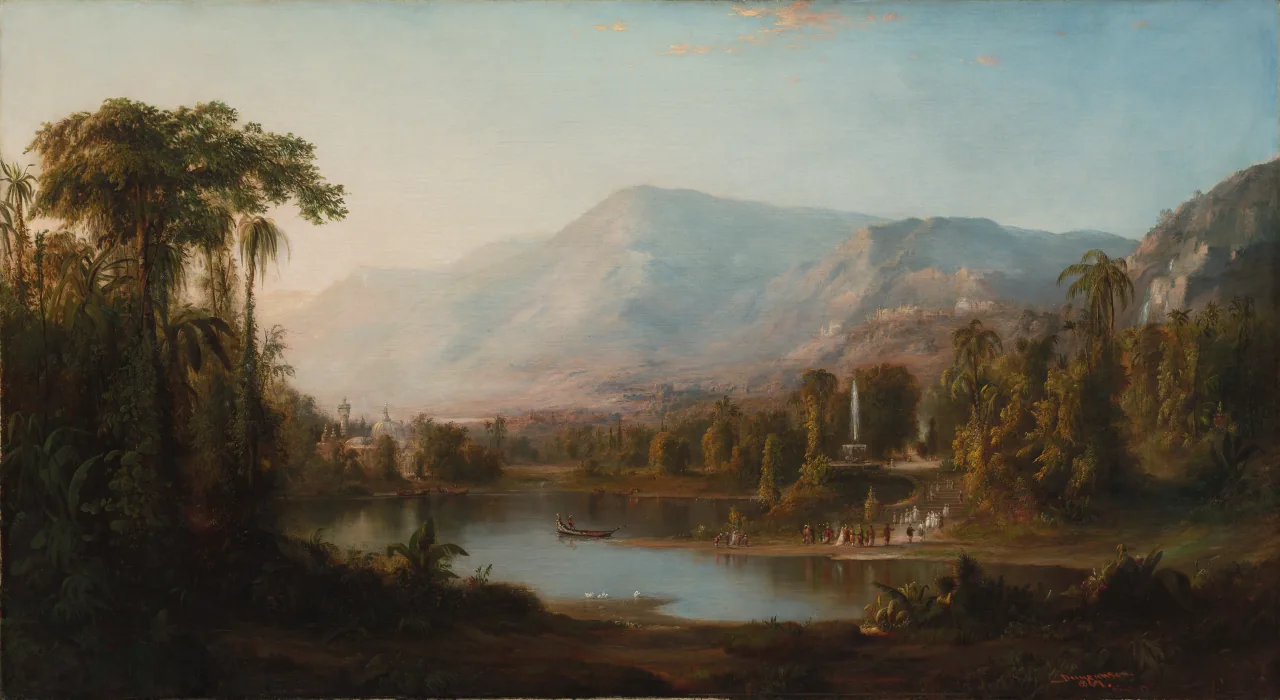
The fountain in Robert S. Duncanson’s Vale of Kashmir rises from a small plaza near the right bank as one pale, unwavering stroke. Its jet clears the broad-leaved trees and nearly matches the palms in height. The lake lies flat, and the mountains settle into blue haze. Against those horizontal reaches, the column of water fixes a vertical point above the shore.
Below the fountain, a group of travelers moves toward the terrace. They have crossed the lake by boat and gathered on a narrow strip of land. Several figures wait at the landing; others climb the curved staircase beyond it. Their bodies are red, white, and brown flecks. The jet rises many times their height, so the destination becomes visible before any person or building there can be understood.
The painting is wide, 132.4 centimeters across and 73 high, and Duncanson spends that width on delay. A dark bank occupies the foreground. Dense growth closes the left edge, where a canopy leans over the water like a curtain that has stopped midway through opening. The palace stands across the lake, partly lost among trees. Between palace and stairs, boats move through a band of reflected sky. Beyond all of it, mountain ridges withdraw in long, cool intervals.
Nearly every part of the scene suggests passage, yet the passage belongs to the minute figures. There is no painted path from the foreground into their route. The eye can follow the boat, landing, and stairs, but the dark earth at the bottom keeps the body outside. Duncanson supplies an excellent view of the reception and no admission to it.
Across this separation, the fountain locates the reception. Its white line stands above the travelers and the curved stairs, holding their destination in view from the far side of the water. Around it, the valley starts to look furnished. Trees frame prospects. The lake carries the guests. A staircase connects shore and terrace. Even the mountains seem placed behind the proceedings as magnificent scenery.
The courtly party could easily disappear in such breadth. Duncanson makes it legible by breaking it into stages. A boat remains on the lake. A cluster has reached land. A bright file stretches toward the first steps. More figures rise on the curve. The sequence is clear enough to read as movement, but no face is large enough to hold an expression. Arrival has become a pattern of positions.
That is a peculiar choice because the literary journey behind the painting ends with a face suddenly becoming knowable.
The climax becomes scenery
Vale of Kashmir takes its subject from Thomas Moore’s Lalla Rookh, published in 1817. Moore’s frame story sends a Mughal princess from Delhi toward Kashmir for an arranged marriage with the young king of Bukhara. Along the journey, a poet named Feramorz joins her company and performs four long tales. Lalla Rookh falls in love with him, which makes the approach to her intended husband increasingly miserable.
The final arrival is built for spectacle. The princess enters the canal leading from the lake to Shalimar. Gardens rise on both banks. Jets shoot from the canal in smooth, brilliant columns. Her barge passes beneath a succession of halls and reaches marble steps covered for her ascent. Inside, the king waits. He comes forward, and she recognizes Feramorz. The poet and the prospective husband are the same man. Travel, mistaken identity, romantic danger, and architectural display all close at once.
Duncanson keeps the display and suspends the closure. His entourage is still outside, scattered between boat and staircase. The great recognition cannot be painted on any of these tiny faces. The king is not identifiable. Neither is the princess. A reader of Moore can supply the destination, but the canvas offers only its approach.
The change is more than a decision to illustrate an earlier moment. Moore drives the reader toward an answer. Duncanson distributes the journey over land and water, then makes distance pleasurable enough to compete with the answer. The palace, fountain, stairs, boats, and procession all perform their narrative duties, though none takes command of the canvas. The eye keeps leaving the route for a sunlit slope, a reflection, a fringe of palms, or the far settlement resting on the mountainside.
Moore gives Duncanson many fountains. They rise from the center of a canal and accompany the royal barge into Shalimar. Duncanson appears to compress their effect into the single plume. He shifts the hydraulic display away from the route and places it high on the terrace, where its force can be seen across the valley. The column stands above the procession and fixes the point toward which its stages converge.
Nothing around the fountain is equally straight or equally white. The palace breaks into domes and narrow towers. The stairs curl. Shorelines bend and foliage frays. From the raised terrace, the pressurized water crosses those irregular forms as a sustained vertical line, set at the far end of the travelers’ ascent.
Duncanson had long practiced the assembly of imaginary terrain. In the early 1850s, he covered the entrance hall of Nicholas Longworth’s Cincinnati home with landscapes that the Taft Museum describes as invented rather than particular places. His training joined the study of European prints with sketches from nature. By the time he painted Vale of Kashmir in 1867, a scene could be imagined without becoming spatially vague. Trees overlap architecture, warm slopes yield to cool ridges, and reflected light holds the lake in its basin. Fantasy receives the discipline of landscape painting.
Here that discipline serves a place reached through another artist’s book. Moore had not written a travel account. In a later preface, he described a slow process of gathering small facts for his romance. His Kashmir arrives already arranged for a European reader: palace, perfume, royal love, dazzling water, and a revelation timed to the threshold. Duncanson inherits that literary construction rather than a neutral description of the valley.
Its artifice remains visible, made beautiful in operation. Monumental stairs dwarf the bodies climbing them. The palace remains partly hidden, and that concealment extends the journey. These elements work less like a record of Kashmir than like devices in an enormous theater of reception.
Yet the theater has no privileged seat. The foreground gives darkness and vegetation rather than a terrace for the spectator. The broad water preserves the interval between looking and joining. Even the procession does not possess the view in the way we do; its members face the next boat, the next step, the next patch of land. Their itinerary crosses the panorama without mastering it.
This may be why the human scale matters more than the human story. The courtly figures are not merely overwhelmed by nature. They activate a landscape built to prolong their arrival. Their bright clothes give the eye a route, their smallness enlarges every structure they pass, and their slow dispersal prevents Moore’s ending from taking place.
Above the scattered figures, the fountain still fixes the height of the terrace. Moore’s bride reaches the king. Duncanson’s party remains beside the water, distributed between landing and steps, still approaching the recognition that the canvas has placed beyond its reach.