A newspaper caption had already reduced the affair to one breath. On its cover dated 29 March 1914, Le Petit Journal announced a “tragic epilogue to a political quarrel,” then named the wife of the French finance minister, her revolver, Gaston Calmette, and Le Figaro. The illustration above the words supplied the useful poses. Henriette Caillaux entered from the right. Calmette fell at the left. A crowded political scandal became a woman, a man, and the instant between them.
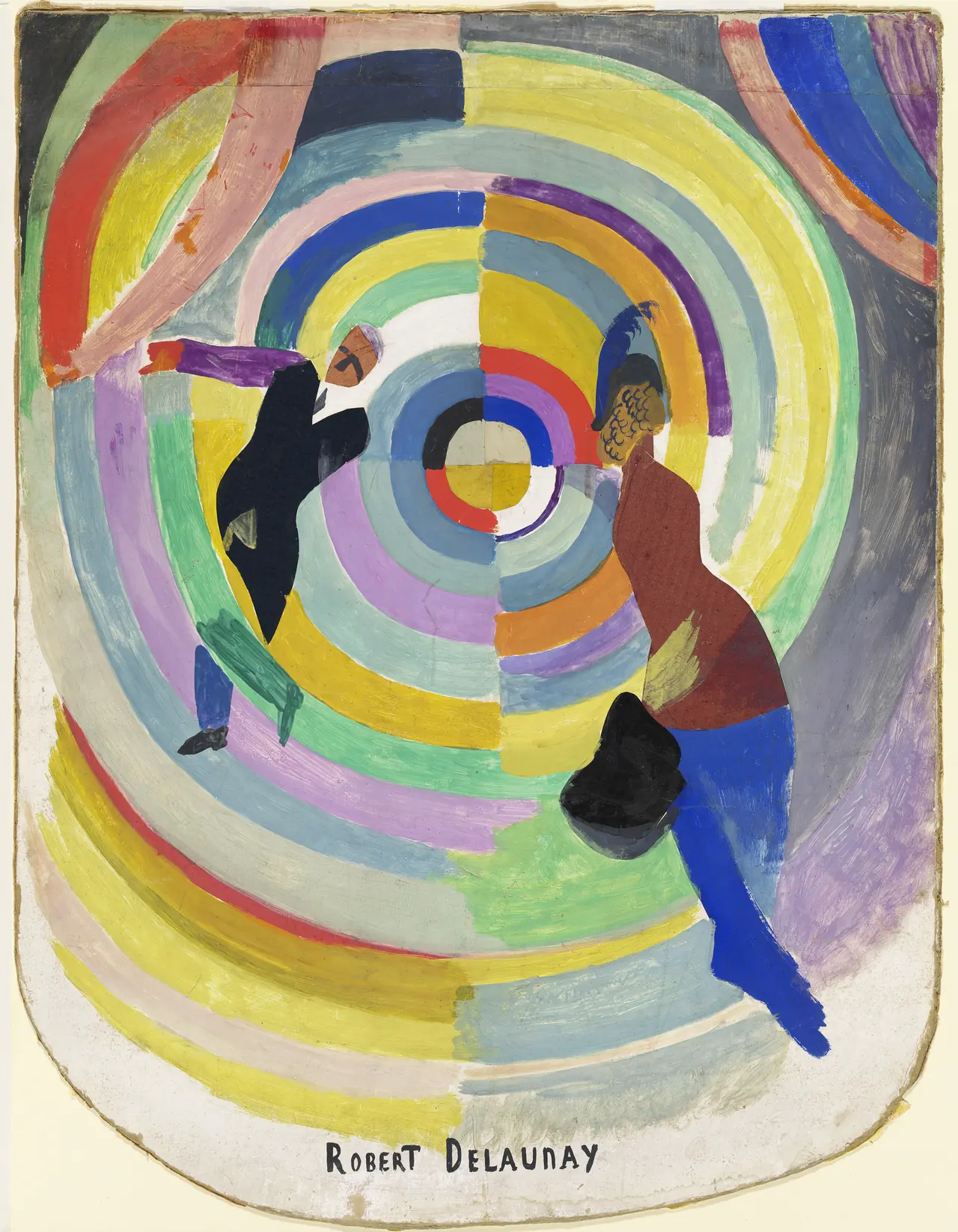
Robert Delaunay performed another compression. His title, Political Drama, discarded both names, the newspaper, and the quarrel. His painting discarded the office, the witnesses, and the gun. Its surviving actors occupy an expanse of segmented rings: lemon beside violet, blue beside orange, red beside green, all widening from a small quartered disc. The event has almost no facts left. It has excellent circulation.
This is the painting’s peculiar intelligence. It preserves the operation of a sensational image more faithfully than it preserves the story. A scandal takes separate lives and fixes them to a few positions, then sends those positions outward through repetition. Delaunay’s rings make that process visible. They do not behave like a neutral setting around Caillaux and Calmette. They carry the pair across the whole sheet until the violence becomes atmosphere.
The source illustration and the painting share a simple directional sentence. Caillaux advances in profile beneath a large hat. Calmette recoils with his chest exposed and one arm raised. In the newspaper, furniture and perspective hold those gestures inside a room. Delaunay gives them no floor. The man’s purple arm reaches almost horizontally into a band of color; his narrow black body bends along the curve below it. The woman’s brown torso pitches forward while one bright blue leg extends toward the lower edge. Their poses have enough descriptive force to survive the loss of nearly everything around them.
The center does not record where a bullet entered a body. It sits in the open interval between the figures, below their hands and apart from Calmette’s white shirtfront. Its geometry offers several quick associations: target, gunsight, flash. None quite fits. The disc is divided into four faded paper quarters and enclosed by rings that change color as they cross a vertical seam. It looks less like an object within the event than a device for enlarging the event, a tiny switch that turns one confrontation into the organizing principle of the picture.
Delaunay had prepared this device through his circular paintings. His study of Michel-Eugène Chevreul’s simultaneous contrast concerned the way one color changes the perception of the color beside it. In Political Drama, adjacency keeps revising the rings. A blue section presses forward near orange and recedes beside violet; yellow brightens against purple, then thins into chalky green. The hand-painted boundaries wobble, so the circles never settle into the cool exactness of a diagram. They spread with the uneven insistence of something copied, retold, and made vivid again.
The strongest colors gather near the actors. Toward the outside, the rings turn pale, scraped, and grey. This gives the picture a strange model of reach. Information fades as it travels, while the pattern of transmission grows larger. Far from the center, the names are already gone, but a red arc still cuts across a yellow band and the motion continues. Sensation has outlasted explanation before the eye reaches the edge.
Paper makes the compression physical. Calmette’s head and jacket, Caillaux’s jacket and muff, and the four central quarters are cut-and-pasted elements. It would make a satisfying story if Delaunay had built the scandal from clippings of the newspaper that spread it. The evidence does not identify the pieces that way. What can be seen is more awkward and more interesting: the people and the point between them are separate surfaces, fitted into the painting like movable units. The bodies that the press turned into a compact narrative have become literal patches.
Those patches never blend fully with the colored field. Caillaux’s brown jacket has a firm outer edge against yellow and pale green. Calmette’s black coat cuts through blue, lilac, and mint. Paint slips over some seams and stops at others. The scene has the provisional construction of a layout, as if figure, caption, and color could still be rearranged before publication. Delaunay signed it in irregular black capitals along the bottom, close to where a newspaper might place a credit or masthead.
Once the caption is absent, the two figures acquire another kind of publicity. Calmette’s raised arm can read as a flourish. Caillaux, with her towering blue plume and forward step, can seem to meet a partner. During 1912 to 1914, the Delaunays often went to the Bal Bullier dance hall, and the National Gallery notes the possible dance in the picture. The resemblance does not offer an escape from the killing. It shows how readily a pose changes genre when its names are removed. Recoil becomes choreography without moving a limb.
The painting’s own name once guarded against that drift. An early photograph shows the words of the title inscribed across the top of the sheet, balancing ROBERT DELAUNAY at the bottom. At some later point, the upper portion was cut away. No surviving evidence identifies the person responsible or the reason. The present object therefore carries an asymmetry that Delaunay did not originally give it: the maker remains written into the image, while the phrase that classified the event has disappeared.
The crop did more than make the work look more abstract. It changed the order in which the painting releases knowledge. With Political Drama written above the rings, color, figures, and title would have arrived together. In the surviving sheet, the eye gets a pair of unstable actors and an immense mechanism of amplification. The historical title must come later, from a label or a page outside the work. Context now has to catch up with impact.
That delay belongs uncannily well to the picture, even though it was produced by an undocumented alteration. Caillaux and Calmette have become easier to circulate than to know. Their clothing, directions, and collision remain immediate; the political quarrel that made them news requires reconstruction. Political Drama now shows the durable remainder of a scandal: authorship at the bottom, force everywhere, and the explanatory words beyond the cut edge.