On 9 May 1905, René Beeh entered the Academy of Fine Arts in Munich. Born in Strasbourg in 1886, he was nineteen when the academy placed him in Peter von Halm’s drawing school. Drawing was his stated field. The choice would matter eleven years later, when pen lines had to locate three bodies within a landscape broken by war.
War entered Beeh’s published work by September 1914. A lithograph of French cavalrymen appeared under his name in Zeit-Echo. Ein Kriegs-Tagebuch der Künstler, a wartime periodical made by artists. The print put a military subject into circulation soon after the conflict began. Beeh then worked as a surveyor at Ypres. An exhibition guide from the Musées de Strasbourg places him among artists who knew the front lines and rendered the conflict’s brutal reality.
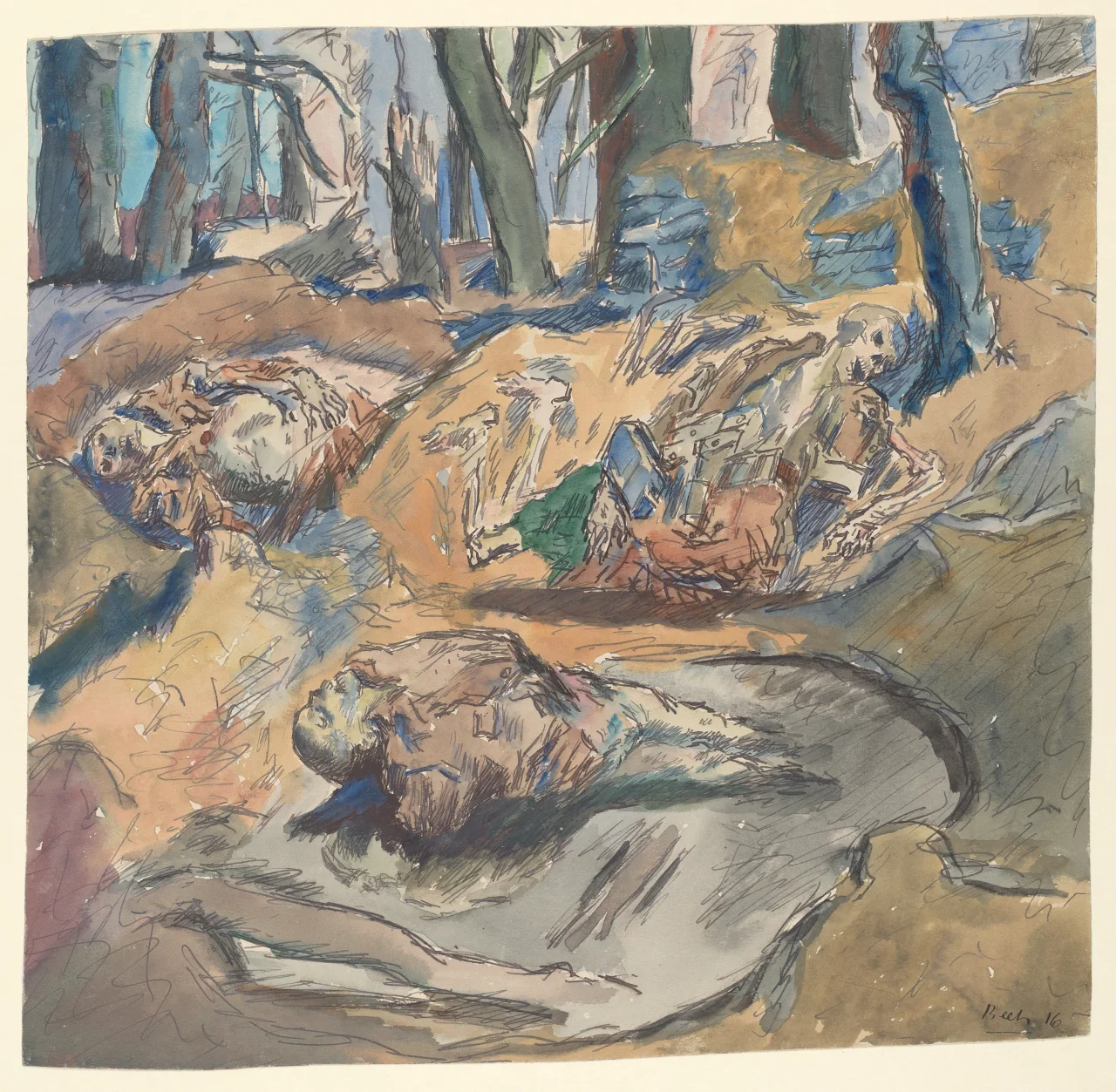
In 1916, Beeh made the watercolor now called Dead Scottish Soldiers on the Battlefield near Ypres. The work combines watercolor with pen and black ink on wove paper. Its sheet is close to a square, 33.5 by 35 centimeters, and carries “Beeh 16” at the lower right. An unpainted border remains around the scene. Inside it, blue, ochre, green, gray, and muted red spread under quick black lines. Short hooks, long slants, knots, and scratches run through trees, uniforms, faces, and damaged ground.
Three bodies emerge from those marks. The largest extends along the bottom, with his face turned upward and one arm near his torso. Another figure curls into the left side. The third reclines at the right against a dark blue trunk. The action that put them there is absent. Beeh starts with aftermath, then makes recognition proceed body by body.
Tree trunks rise through the scene and divide it into narrow vertical intervals. The figures cross that upright order at different angles: one curls inward, one lies diagonally, and the foreground body stretches almost horizontally. Pen identifies a hand, the fold of clothing, or the turn of a jaw, then continues into bark and churned soil with the same pressure. Blue passes from shadow into clothing and trees. Ochre moves through earth and uniform. Each man occupies a position, while his colors and outlines enter the terrain around him.
The pen does more than draw contours. Dense strokes darken the foreground figure’s face and chest, then gather under his body as shadow. Around the two smaller men, the same line breaks into loose clusters. Those clusters delay identification. The eye first meets a wooded slope full of abrupt marks, then finds an arm, a bent leg, or a head inside them. Watercolor carries a slower movement. Broad ochre ground flows around the figures, while blue pools under bodies and along trunks. The materials make the battlefield continuous without smoothing its damage.
Beeh’s survey work makes this placement historically charged. A surveyor turns terrain into positions and distances; the watercolor turns positions back into a difficult act of seeing. That connection remains an interpretation rather than a documented account of his method. The available sources identify his role at Ypres, his earlier war print, and the date on the sheet. They do not identify a regiment or battle, locate the moment of painting, or show that Beeh witnessed these deaths. The drawing carries the conditions of his wartime work without becoming a complete eyewitness report.
The title adds what the image cannot specify. The three figures are motionless, yet their Scottish identity and the location near Ypres come through words. On the reverse, a graphite inscription reads “Beeh: Schlachfelder bei Ypres,” or “Beeh: Battlefields near Ypres.” Its writer is unknown. That shorter phrase supplies a place and a broad subject. The English title used by the NGA narrows the field to three dead soldiers, and the watercolor makes the count slowly through tangled lines and shared color.
After 1916, the sheet moved away from the circumstances named on its reverse. Its known provenance begins with Rose Béeh, then passes to Hans Bosshardt. It later entered the Swiss art market and reached the dealer Jörg Maass. Beeh died in Strasbourg in 1922, only six years after the date on the watercolor. The sheet continued through these later hands. Each transfer carried forward the image, its date, and the wording that connected it to Ypres, even as the immediate history of the depicted men remained unavailable.
The National Gallery of Art purchased the watercolor in 2012 with the Ruth and Jacob Kainen Memorial Fund. The acquisition brought Beeh’s small sheet into a public collection after nearly a century in private hands and the market. There, the 1905 student of drawing, the 1914 maker of a published war image, and the wartime surveyor at Ypres meet in one dated object. Its three bodies can now be seen with the title, inscriptions, and ownership history that carried them into public view in Washington.