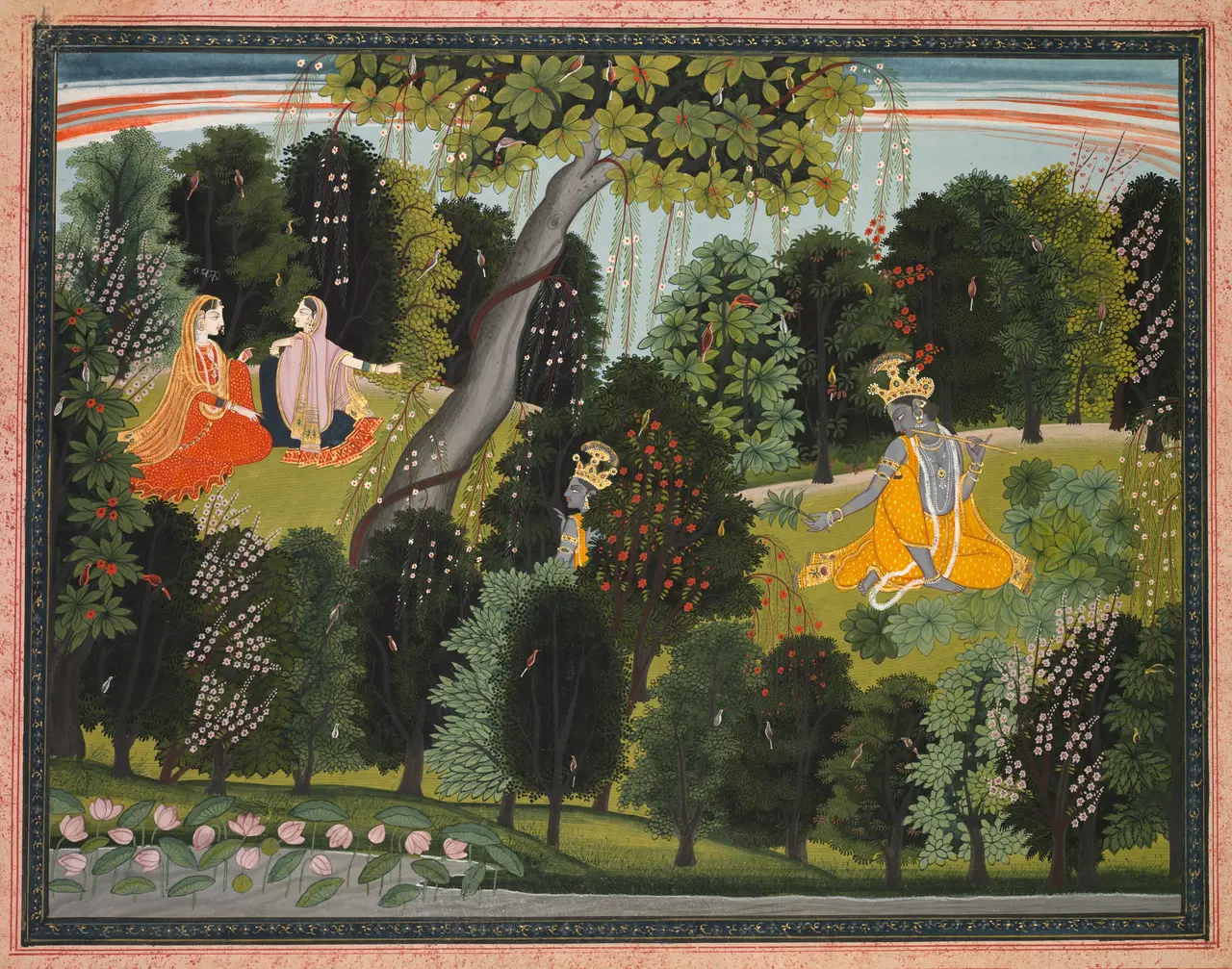
Krishna is in this painting twice. At the middle of the page, a crowned head with blue skin rises out of a bush hung with red flowers, shoulders visible, eyes turned toward two women on a distant terrace. At the right, the same crowned blue figure sits on a yellow cushion in a cleared patch of grass, a flute at his mouth, one hand reaching down to spread a leafy branch across the ground. His yellow cushion sits on close-cropped grass, a clearing made ready rather than found. Nothing marks either appearance as a vision or a reflection. The painter lets one man occupy two actions at once, and expects the page to be read the way a story is read.
The page comes from a series illustrating the Gita Govinda, the Song of the Cowherd, a Sanskrit poem composed by Jayadeva in the twelfth century. This leaf is dated around 1820 to 1825 and attributed to Purkhu, a leading master of the court workshop at Kangra, a hill kingdom in the Himalayan foothills of what is now Himachal Pradesh. It is painted in gum tempera with gold on paper, and the sheet itself is small, 24.1 by 32.1 centimeters, a thing for two hands rather than a wall. Around the scene runs a deep navy border worked with gold vines, and outside that a rose-coloured margin flecked like unpolished stone; the vines repeat the scrolling foliage of the scene itself, a hedge outside the hedge. The Cleveland Museum of Art received the leaf in 1989 in the bequest of Mrs. Severance A. Millikin, and a number written on the verso suggests it was the nineteenth folio of a set that had passed through the estate of the Raja of Lambagraon before leaving India.
The two women hold the highest ground in the picture, a grassy terrace at the upper left where pale flowering shrubs grow tall enough to shade them. One sits wrapped in orange-red, the brilliant centre of her skirt edged with gold, pearls at her throat and wrists, her head turned toward her companion, her posture composed enough to suggest someone deliberately staying where she is. An orange veil covers her hair, and gold bands circle both wrists, so even her stillness is dressed. The other leans toward her in a pale pink shawl over a dark skirt, her own head covered in the same pale silk, one hand lifted in speech, while her other arm stretches out across nearly the whole width of the painting, past the trunk of a great tree, toward the flute player in his clearing below. The museum's description identifies the seated woman as Radha, the cowherd girl the poem loves best, and the standing figure as her sakhi, her confidante and messenger, urging her to go to him because he pines. Between the terrace and the clearing the undergrowth never opens. Bushes lock together, trees shoulder each other, and no road interrupts them. The sakhi's pointing arm measures a distance that feet in this picture cannot easily cross.
Beside the women's heads, small lines of Devanagari script float above the foliage. The page carries the words of the scene it shows. On the museum's record the passage is printed in full and translated twice, once in rhymed Victorian verse and once in plain modern prose, and both versions agree on what is being said and by whom. The text even names its own music: these words follow the melodic mode called Gurjjari and the rhythmic cycle called Ekatali, which Jayadeva supplied for his songs so that they could be sung. Radha sits directly beside the argument being used on her; the painter put the spoken words within reach of the woman they mean to move.
The case the sakhi makes runs like this. Krishna waits in the same grove where the two lovers met before, on the bank of the river Yamuna, wearing his garland of forest flowers. He plays softly, weaving her name into the melody. Every slight sound undoes him: hearing the least stir of a bird or a falling leaf, he imagines she is coming, and twenty times, in the verse translation's phrase, he recomposes the flower-seat he has spread. So come, the sakhi says, but come quietly. Remove your ankle-bells, those enemies that betray you with their chatter; draw your dark braids lower over your face. And go quickly, because the night is ending. In her crossing, the prose translation promises, Radha will shine against his dark body like a streak of lightning on a raincloud, and when the stars are setting is precisely the hour she must move.
Jayadeva built his poem as twelve chapters holding twenty-four songs, each song set in eight-verse stanzas and given its own mode and rhythm. Its story is narrow and immense at once: Krishna and Radha desire each other, quarrel, separate, sicken with longing, and reunite, and the poem treats that course as something the soul does with God. Between the estranged lovers the sakhi goes back and forth, telling each about the other, pressing each toward the mercy of returning. Jayadeva closes the song by naming himself in its final verse, a habit the text on this page preserves. Painters working for courts that treasured the poem illustrated it song by song, so a set like this one moved through the whole romance one sung page at a time, made for patrons who could hear the melody in their heads as they looked. This leaf belongs to the reconciliation. The quarrel has happened; the surrender has not.
Now the doubled figure makes sense as a method. The sakhi speaks of Krishna in the present tense: he waits, listens, plays, and spreads the bed of leaves. A single moment cannot contain all of that, so the painter split the figure instead of freezing it. The Krishna hidden behind the red blossoms is the listener of the text, startled by imagined footsteps, watching the path toward the women; the same tall gold crown on both heads says that watcher and player are one person. The Krishna seated on the cushion is the host, flute at his lips, spreading the bed of leaves the museum's description says he prepares for the encounter. Waiting and preparing stand together on one page, which is how the song itself holds them.
One tree spans the distance between them. Its trunk enters at the lower middle of the page and climbs diagonally toward the upper right, grey-green bark crossed by a single twisting vine in darker red-brown, until its canopy opens over every figure group: the women at the left edge, the hidden watcher at centre, the flute player at right. The trunk rises closest to the women's terrace, as if it grew from their ground, and leans away across the page toward Krishna without ever reaching him. It joins the three figures in one plant and still gives the lovers nothing to walk on.
Everything the sakhi warns about is present in paint. The text frets over sound: bells, birds, stirred leaves, anything alive enough to give Radha away or to mock her lover with false hope. The painter answers with a canopy full of birds, dozens of them, several perched bill to bill in matched pairs, some high in the crown and others low among the trunks, scattered through individually studied trees: conifers, broad-leaved shade trees, weeping strands hung with white flowers, shrubs burdened with red blossom ready to drop. Under all of it the grass stays bright where figures sit and darkens into shaded hollows where nobody stands, so the clearings glow against the wood. At the bottom edge a grey river runs under rows of lotus buds rising on thick stems, the Yamuna bank of the song moved to the foot of the page, some buds still closed tight. The grove itself makes the sakhi's case: the meeting place looks worth reaching, and the hour is late.
Vegetation crowds almost the entire frame, and daylight enters only through two wedge-shaped openings at the top corners, striped with horizontal bands of orange-red lying against grey-white. Those streaks are the setting stars of the text, lying where the night is leaving the sky. The bands also repeat the orange-red of Radha's dress at the far side of the page, so that her colour and the ending night share one hue. The painting keeps its urgency at the margins, where the eye arrives last and stays.
Kangra's ruler in these years, Raja Sansar Chand, reigned from 1775 to 1823 and kept painters at work on long series of courtly and sacred subjects; religious cycles credited to Purkhu include a Gita Govinda of his own. The Cleveland leaf is attributed to Purkhu, counted among the leading masters of that shop; attribution in this tradition names a guiding hand and a standard of finish, and other brushes may well have shared the page. Whatever the division of labour, the quality holds. Gum tempera, pigment bound and sealed in gum rather than oil, dries quickly and forgives little, so every petal, pearl, and feather had to be decided before the brush touched down. Faces are drawn in profile with elongated eyes. Each kind of tree keeps its own leaf shape. Gold runs through crowns, jewellery, hem lines, and the border's scrolling vines, catching light the way metal does on paper. The finest brushes went to small things: the veined leaves overhead and the white flowers scattered through the grass.
The page also carries the history of its survival. From the Raja of Lambagraon it passed to a dealer in New Delhi, B. R. Sharma, and from him to Severance and Greta Millikin of Cleveland, collectors whose bequest reached the museum in 1989. Two companion leaves from the same gift survive nearby in the collection, one showing Krishna longing for Radha, another a heroine reading omens in a crow's flight. A set that once moved intact through the songs of a poem now persists as scattered pages held apart in different hands, and Cleveland keeps at least three moments of one continuous argument within its vaults. The museum's 1990 catalogue of the Millikin collection recorded this leaf as entry one hundred fifty-six, and it returned to view in the exhibition Life and Exploits of Krishna in Indian Paintings, which ran from September 2021 into February 2022. It remains a work known mostly to specialists, usually reproduced small if it is reproduced at all.
Held in two hands, the page turns attention back and forth: from the words beside Radha's head out into the grove, and back again to the words. Radha has not moved, and the leaf will not let her arrive. A meeting always about to happen, at an hour already running out, is the condition the poem requires of her, and the painter found a way to hang it on a single small page.