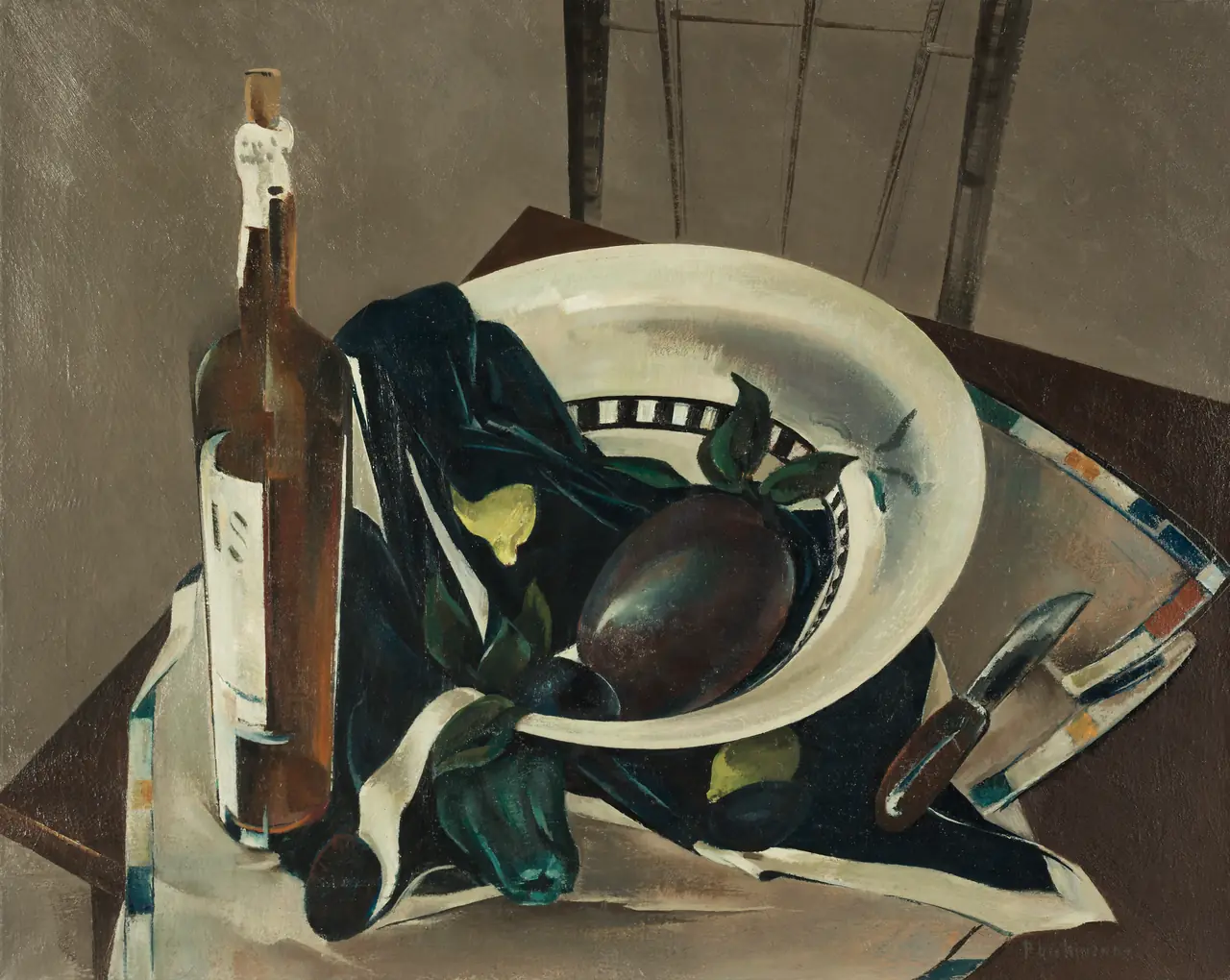
The knife at the right of Preston Dickinson’s Still Life rests on a surface that will not explain itself. Its brown handle points down and inward. Its blade rises toward a narrow border made from blue, white, orange, and muted red blocks. Blade and border nearly agree on a direction, then separate. The knife seems secure enough to be picked up, but the plane beneath it pitches toward the front of the canvas. Dickinson has placed an ordinary tool where it can measure how quickly a tabletop stops behaving like furniture.
The large white bowl makes the disagreement harder to ignore. We look into it from above, across an oval rim that opens toward us. Behind it, a chairback rises almost straight against a gray-brown wall. The bottle at the left also stands frontally, with its base planted and its neck climbing through an open patch of wall. Bowl, chair, and bottle each offer a plausible position. Taken together, they do not settle into one viewpoint. The painting coordinates several local truths rather than submitting the whole table to a single recessional system.
That coordination gives the still life its pressure. The bowl occupies the center like a broad white brace. Its rim emerges beside the bottle, disappears behind dark cloth, encircles fruit, then descends toward the knife. A black-and-white band follows part of the inner curve. The regular pattern makes the bowl’s tilt easy to read, while the fruits complicate its depth. One eggplant lies heavily across the front. Another dark form presses behind it. Lemons and green stems enter the gaps. Their overlaps create a crowded volume that the bowl appears barely wide enough to contain.
The arrangement continues beyond the vessel. Deep blue-green cloth rises behind the fruit, folds into the bowl, and pours over the front of the table. White cloth turns around the bottle and returns beneath the knife. At several points, fabric makes the route from one object to the next. It separates bottle from fruit with a pale strip, joins the dark eggplants into a larger mass, and supplies a ledge under the knife. The cloth is both material and connective tissue. Its folds give the objects somewhere to sit even as the table’s geometry becomes uncertain.
Dickinson does not flatten the objects to solve that uncertainty. The largest eggplant has a rounded, resistant body. Brown-black skin changes to green-blue along a band of illumination, then darkens near the stem. The lemons carry dull yellow against the cooler fabric. The bottle’s glass moves through amber, black, and a narrow orange flare. A pale label wraps its lower section, and white paint gathers around the neck. Each thing receives enough modeling to claim physical weight. The unstable space must accommodate that weight instead of replacing it with a decorative diagram.
The bottle makes this especially clear. Its outline is firm, yet its body is assembled from adjacent vertical planes. A dark core runs up the center. Brown broadens on either side. White cuts into the shoulder and climbs toward a cork that sits visibly high in the mouth. That loose closure keeps the bottle from becoming a sealed geometric emblem. It has been handled, stopped, and placed on the cloth, even while its painted structure answers the vertical chair posts across the canvas.
The chair is much less substantial. Two dark uprights and several thin crossbars occupy the upper right. Dickinson leaves much of it as a set of drawn lines over the wall. The seat disappears behind the table, and no figure is present to establish a domestic scene. The chairback still changes the room. It fixes an upright scale behind the tipped bowl and identifies this compressed field as a place where a person could sit, work, or arrange things. Its sparseness also keeps it subordinate. The objects advance; the furniture remains a scaffold.
Dickinson painted the canvas around 1924, when still life had become a sustained part of his work. He had studied in Paris before the First World War and encountered the modern painting exhibited there. National Gallery of Art scholarship identifies Juan Gris as a lasting source for his use of modeled planes and sharp contrasts. The connection is visible here without requiring the canvas to imitate a particular Gris. Dickinson keeps the legibility of bottle, fruit, bowl, knife, and chair while letting their planes, contours, and viewpoints build a second order across the recognizable scene.
The objects also carry a history within Cubism. Bottles, knives, and lemons had appeared repeatedly in early Cubist still lifes, often with the public sociability of the café close at hand. In related Dickinson works, especially The Artist’s Table and the pastel Hospitality, those objects enter the private studio. A palette in The Artist’s Table makes the shift explicit. The Cleveland painting has no visible palette, so it cannot be given the same exact reading. Its bottle, knife, lemon, and empty chair nevertheless belong to the same practical vocabulary, staged within an interior stripped of anecdote.
That historical movement from café table to studio table changes the sense of privacy in the painting. Privacy here is not intimacy disclosed through a person’s belongings. The label cannot be read, the room cannot be identified, and the arrangement yields no meal or episode. The private world consists of controlled access to forms. A bottle can be turned until its amber and white planes align. A bowl can be tipped until its rim cuts a strong oval. Fruit, fabric, and steel can be moved until each contour alters the next. The studio is where ordinary objects become available for exact adjustment.
In April 1924, the Daniel Gallery in New York opened Dickinson’s second one-man exhibition. Several still lifes appeared in it, and contemporary critics admired their finish, color, and compositional force. The Cleveland canvas is dated approximately, and the available record does not establish that it hung in that exhibition. It belongs securely to the same phase of concentrated still-life work. A scholarly catalogue later placed it among paintings of about 1923 and 1924 that combined smoothly modeled forms with shifting perspectives and abstract elements.
The praise came with an objection. Duncan Phillips, writing about Dickinson’s repeated still-life subjects in the 1920s, admired their edges and refracted color but thought them too obviously arranged. The criticism names a real quality. Nothing on this table looks casually abandoned. The bowl has been tipped for display. The fruit forms a compact dark mound. The cloth winds through the setup with useful changes of color. The knife takes a clean diagonal beside the rim. Even the loose cork has the conspicuous isolation of a selected detail.
Obvious arrangement can make a still life inert when every object merely fills its assigned place. Dickinson avoids that result because placement never becomes rest. The knife’s diagonal presses against the border. The bowl’s oval pushes forward while its bright rim pulls the fruit into a circuit. The bottle rises beside a dark fold that narrows it. Leaves and stems interrupt the larger eggplants with hooked points. Each decision affects another object, and the conflicting viewpoints keep those decisions active. Arrangement is visible as labor still occurring inside the finished image.
The painted surfaces prevent this labor from becoming an exercise in line alone. Brushstrokes remain visible in the wall, where short diagonal touches disturb the flat gray-brown field. The bowl’s interior moves from warm ivory to cooler gray, with a faint brown haze near its base. On the eggplant, blended color produces a dense skin that seems capable of reflecting the bowl. The knife blade is comparatively thin and cool. Bottle, ceramic, vegetable, fabric, metal, and wall do not share one finish. Dickinson makes their material differences participate in the structure.
Light also behaves as a set of placements rather than as a fully described source. The bowl is the dominant bright mass, but its illumination is uneven. White gathers along the rim and thins into cream. The bottle catches a narrow flare, while its left side remains brown. A lemon appears from the dark cloth as a yellow interruption. The knife blade carries a dull gray glint. These accents do not map a window or lamp with certainty. They travel where the arrangement needs separation, and they give the most compressed objects room to keep their distinct skins.
This is where Dickinson’s precision becomes more interesting than the usual idea of a clean, hard-edged Precisionist scene. The term often gathers him with American painters who ordered factories, streets, and machinery through sharp geometry. His association with that tendency is useful history, but the Cleveland painting is neither impersonal nor mechanically calm. Its contours flex. Its fruit swells. The cork sits awkwardly. Brushwork roughens the wall. Precision names the care of the relationships, not a polished removal of bodily irregularity.
The large bowl carries both sides of that achievement. Seen as a design, it is an oval and a sequence of concentric bands, an efficient device for organizing the middle of a horizontal rectangle. Seen as an object, it has thickness, stains, changes of temperature, and a cavity deep enough to receive fruit and cloth. Its rim appears to pass in front of some forms and behind others, yet the dark mass repeatedly obscures those relations. The bowl does not simply contain the arrangement. It sets a curved limit that the arrangement tests.
At the front, one eggplant has crossed that limit. Its broad body projects over the rim, followed below by another dark fruit and a fold of cloth. A lemon sits farther right, outside the bowl but still within the white fabric. These displacements give the central mound a direction. It does not collapse randomly toward us. The objects descend by stages, from the stems near the bowl’s inner band to the large fruit at the rim, then through the smaller dark oval and fabric toward the table’s front. Weight becomes a compositional route.
The colored border interrupts that route. It appears along the right side and returns at the lower left, but it does not form a complete, stable rectangle. Its alternating blocks resemble decoration on a tray, cloth, or table edge; the image does not permit a firm identification. What it provides is a second scale of order, small colored units set against the large forms. The border can measure the knife and bowl, yet its own direction changes as the supporting planes shift. A pattern that ought to clarify the furniture instead records another break in its logic.
Such breaks do not make the painting chaotic. The objects remain unusually coherent. Dickinson controls the density by placing broad intervals around it: open wall beside the bottle, gray wall within the chairback, and the pale bowl around the dark fruit. These quieter fields keep the central compression readable. They also show how little literal room the arrangement occupies. Nearly everything that defines this private world has been brought to one tabletop. Beyond the chair and wall, the painting offers no extension into a larger house.