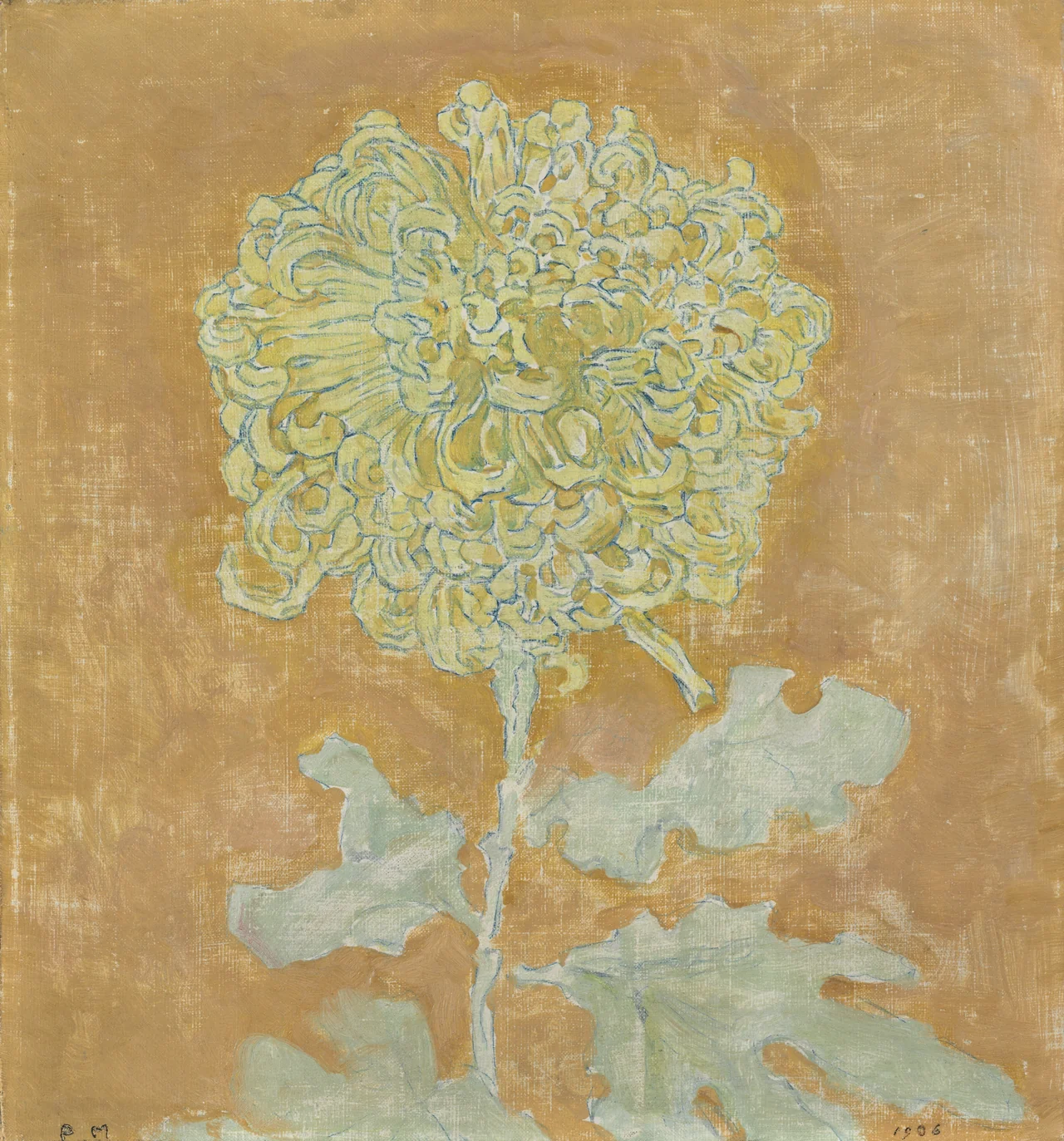
The ground comes first. Before the flower declares itself, the surface behind it has already set a condition. Piet Mondrian’s Chrysanthemum in Cleveland measures 41.5 by 38.5 centimeters without its frame, a nearly square field of oil on canvas where a pale bloom sits at center and a thin green stem drops to the bottom edge. The field is ochre, not sky, not wall, and it is made with short, visible strokes that run mostly vertical and horizontal. Some strokes are dry and broken, their bristles skipping across canvas weave; others are slightly loaded, leaving a soft ridge at one end. They do not blend into an even tone. They stay as marks that sit beside one another and form a textile. You register texture before you register depth, and that order matters. Mondrian has built a kind of low grid without announcing it, a ground that holds the flower the way a ruled page holds writing, not the way air holds a flower.
The flower itself is quiet. Its head is cream tinged toward pale yellow, each petal separated by a thin line of gray brown that keeps the layers readable. The petals are not symmetrical. One side pulls slightly longer, another curls inward, a few overlap to make a denser center where the cream deepens by a fraction. No highlight snaps. Light spreads evenly, as if the bloom were seen at close range on a table in diffuse daylight. Below the head, a single stem rises on center, thin, straight, painted in a muted green that is closer to olive than to spring. About midway it carries two broad lobed leaves, one to each side, their edges cut with soft points, their surfaces modulated with slightly darker veining. The leaves are not filler. Their width anchors the vertical, and their dull green cools the warmth of the petals and the ochre field at once. At the lower corners sit the initials P M at left and the date 1906 at right, both a touch glossier than the field, sitting on top of the ground as if the picture were handled again after its first completion.
A chrysanthemum holds attention because of how it packs. Its head is not a single ring but many, petals overlapping to make a dense, regular structure that never quite repeats. That packing rewards a painter who cares about how often a vertical can meet a horizontal before a surface goes quiet, how much repetition a form can carry before it loses particularity and how much variation before it loses coherence. The bloom stays recognisable while posing a structural question that has little to do with likeness. The head here recalls the stylized chrysanthemums made for flat fields, where petals are reduced to a clear rhythm, a stem to a line, leaves to a weight that steadies the rhythm. Mondrian leans toward that flatness. Its petals are not shaded toward relief. They are held as flat, slightly modulated light shapes separated by lines, and their layering does the work that shading once did. The stem does not taper as a cylinder in light. It keeps a consistent width, like a drawn line that has been given a color, and the leaves are edged to read as silhouettes first and as planes second. The ground cooperates with this flatness. By keeping its strokes short and directional, Mondrian stops the ochre from softening into atmosphere. It stays a surface you could touch, and against it the flower stays a thing that has been placed, not a thing that grows in space.
That placement is worth following stroke by stroke. Around the bloom, the ochre strokes tend vertical near the center and horizontal near the edges, as if the brush were keeping time with the rectangle itself. The verticals elongate slightly as they approach the bloom, then shorten again past the leaves. Their color is not one ochre but two or three ochres close in value, with occasional cooler threads where the canvas weave shows through a thin pass. The horizontal strokes are often drier. They skip, leaving little ticks of canvas. Crossing a vertical with a horizontal does not make a grid intersection in the later abstract sense, there is no black line, no precise meeting. It makes a texture where a vertical touch is partially covered by a horizontal one and the weave below records both. The effect is a field that seems calm from two steps away and active from one step closer. The flower benefits from that activity without needing to supply it. Its quiet cream can stay quiet because the ground already carries the movement.
When Mondrian turned to chrysanthemums he was learning to build place without horizon, sky, or shadow. A single bloom against a worked ground asks a simpler version of that question than a distant landscape. With only three colors to adjust, cream, green, ochre, and a few linear weights, he could test how far a picture could go toward abstraction while remaining legible as a thing. The Cleveland picture pushes that test further than its modest size suggests. The petals are handled like bands that could be read as count and order, the leaves like planes that could be read as balance, the ground like a system of parallel marks that could be read as structure. None of these readings removes the flower. They sit on top of it. You can see the bloom as a bloom and, at the same time, see it as an arrangement of moves that would later be separated from any bloom at all.
The two leaves make the negotiation visible. Each leaf is a single broad shape with a few pointed lobes. Mondrian could have detailed their serration, but he does not. He keeps the perimeter simple and puts the energy into placement. The left leaf sits a little higher than the right, so the horizontal formed by the pair is not even. That unevenness prevents the flower from becoming heraldic. It also keeps the ochre field from dividing into equal halves. A slightly higher left weight pulls the eye a fraction left of center, and the stem, which is itself perfectly vertical, then reads as a quiet adjustment. The stem does not lean to compensate, it stays plumb, and the leaves hover as two small off level platforms that the vertical passes between. That relation, a plumb line between two unequal horizontals, is the kind of interval that would later become the substance of Mondrian’s grids. Here it still has a name, chrysanthemum, and it behaves like an interval you can measure with your eyes.
The paint itself supports this in-between state. The bloom is built with thin, fairly fluid paint, lightly brushed so the canvas tooth remains present under the cream. The outlines are not heavy contours but thin, slightly darker lines where a touch more pigment has been drawn along the petal edge. In a few places the line is discontinuous, stopping where two petals overlap and resuming where the edge becomes visible again. That intermittence keeps the line from becoming a border that seals the form. The leaves and stem are a little more loaded, their green a fraction more pasty, so they sit forward of the petals by material weight rather than by perspective. The ochre ground is the thinnest of all, almost a stain in places, more like a tinted priming that has been worked over with dry strokes. Because the ground is thin, its weave stays present, and because it is dryly repassed, it holds light without shine. The whole object stays matte, even in reproduction where glare can mislead. That matte evenness is not accidental. It lets the picture be read as a surface first, a depth second, which is exactly the condition that abstraction requires and that a naturalistic flower often resists.
The habit that outlasted the manifesto
He returned to flowers across many years, as a steady habit alongside the longer move from observation toward abstraction. The same hand that drew grids kept a blossom at center and made a ground to hold it, to sustain looking for its own sake. The care given to the ochre field, the calibration of the leaves, the restraint of petal modeling all point to attention given for its own sake.
That habit was private. The grids were public, reproduced, discussed, carried into other media. The flowers were smaller, kept in the studio, shown at close range. That privacy shapes how the picture asks to be seen. It does not expand to fill a wall. It asks for the distance at which you notice that the right leaf is lower, that a horizontal stroke has been dragged across a vertical one, that the initials sit a little glossier than the ground. The picture teaches slowness because it is easy to misread at speed and only reveals its adjustments on closer looking. At speed you see a flower study by a painter known for grids, a curiosity. Slowly you see a solution to a problem his larger paintings were also solving, how to keep a surface alive while keeping its order legible.
Seeing the flower beside the later abstractions does not diminish either. The grids make a harmony that does not depend on a bloom, and they come from a hand that still knew how to make a blossom feel settled without a system. The continuity is manual, in the way a vertical is kept true, a horizontal is kept uneven, and a surface is kept active by small directional touches.
Many visitors meet Mondrian first through the well known late canvases and assume the small floral oils are a minor earlier self. At its modest scale the picture holds its wall through completeness. From a middle distance the bloom reads as a single pale shape against a warm ground. From close range the pale shape resolves into layered petals with intermittent edges, and the warm ground resolves into a directed field. Both distances reward attention. The bloom and the field stay two things set in a relation precise enough to feel inevitable.
Look once more. The petals, each edged just enough to separate, layer toward a center that is not a point but a density where cream thickens and warmer shadows gather between overlapping layers. The stem keeps its width as it descends, a line given body. The leaves hold the middle horizontal that the ground’s strokes answer. The ground carries the overt structure in the picture, a field of parallels that never becomes a system but always suggests it. The signatures sit at the bottom edge, not as a closure but as a note that the picture was handled again. At center is a single bloom held steady; around it is a built field that stays active. The two keep their separate character and the relation between them holds.