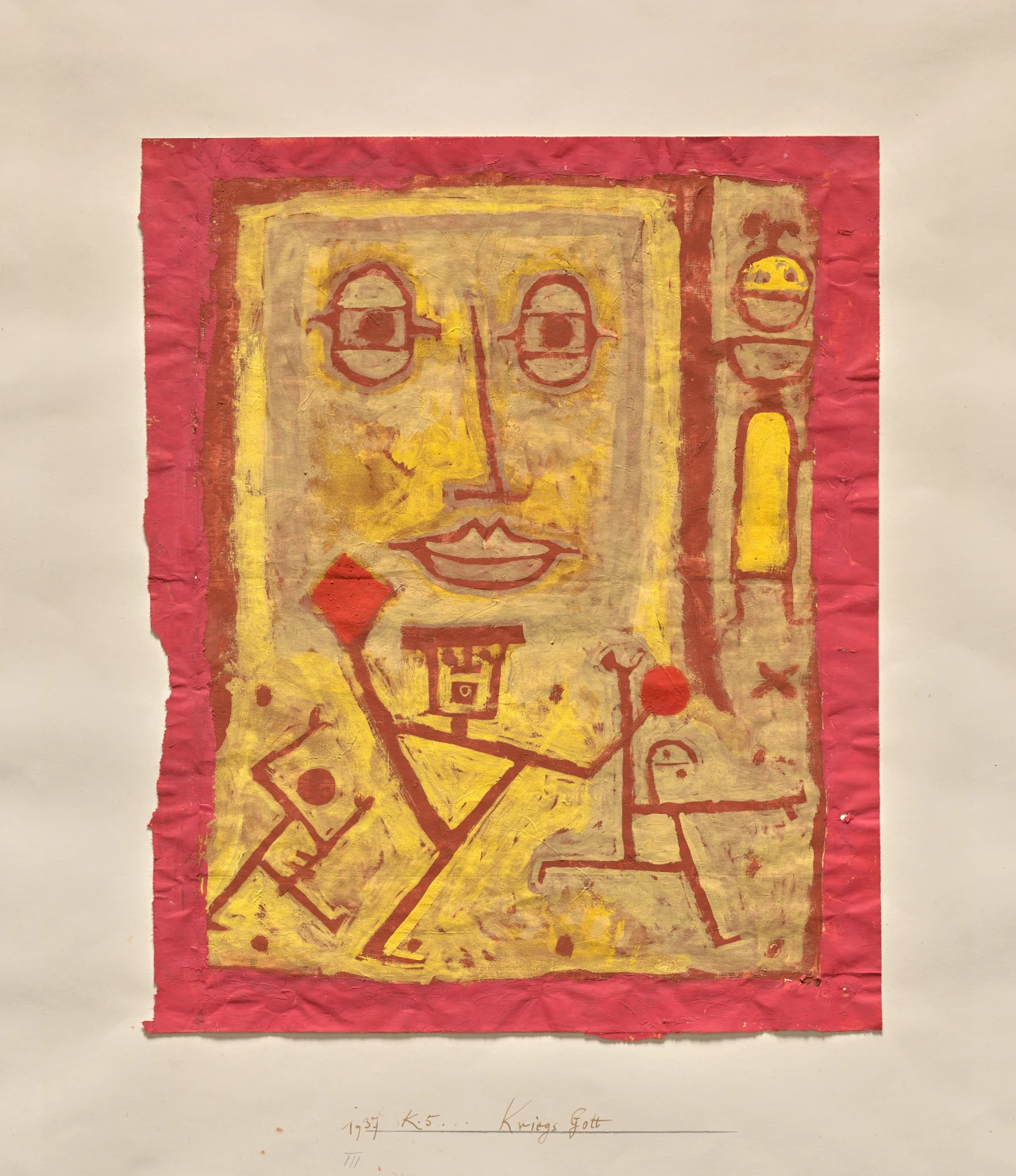
Paul Klee’s God of War first looks as if it has already decided the matter. A face fills the upper half of a small vertical sheet. Its eyes are huge, its nose drops through the middle of the picture in two red strokes, and its mouth sits wide below, divided into pale bands. The face has the scale of an emblem on a banner or a badly printed poster. It is enclosed by a red-pink border that declares a separate territory around it. Even the title appears to settle its identity: here is a god, and this is war.
The face has little dignity. Its eyes are round, striped, and slightly off in their placement, as though their parts have been put back in the wrong order. The long nose reaches down only to stop abruptly above a mouth that might be smiling, grimacing, or simply remaining open. Its red outline thickens, disappears, and returns. The apparent mask is a loose construction of strokes, washes, and gaps.
Klee made the work in 1937, in gouache and tempera on newsprint. A newspaper article on the Spanish Civil War remains visible within the image. Much of its type is now hard to make out beneath the paint, and that difficulty is part of the object’s pressure. The printed page supplies fragments rather than a stable historical caption. They surface, then sink beneath yellow and brown pigment.
The support cuts the title down to size. The painted rectangle has uneven edges. Its pink-red surround is a rough field, thin in places and dense in others. At the lower left, the edge breaks into a ragged run of paper and paint. Creases and exposed ground remain visible. This god occupies a vulnerable piece of paper, one that wrinkles, tears, absorbs paint, and carries yesterday’s report.
The large face reads as a sign laid over a makeshift field. Its scale gives it force, while the wrinkled newsprint and unstable outline keep that force physical and limited. War appears here as a broad image that has to be held in place by a damaged surface.
The object has two scales that a screen reproduction can flatten. The painted sheet is only 35.2 by 29 centimetres, close enough to a page or a hand-held sign for its roughness to remain physical. The secondary support is much larger, 64.6 by 49.3 centimetres. Around the painted area, the pale margin leaves the original sheet visibly finite. The red-pink surround becomes a frame within a frame, with irregular borders and exposed edges that keep the central image open to the paper beneath it.
This distinction helps explain Klee’s choice of a face rather than a complete figure. A face can occupy a field like a printed seal, an insignia, or a stamp of approval. Klee gives it enough anatomy to be recognized, yet keeps it close to the surface. The pale cheeks are broad and uneven. The forehead has no durable contour. The eyes seem placed on the paper rather than set within a skull. The title supplies a role, while the paint gives it a deliberately thin body.
Every part of the sign shows the labor of maintaining it: red circles the eyes again and again; yellow shores up the central field; pale gaps interrupt the face. In a work about war, these ordinary repairs make power look procedural rather than eternal.
The active lower half
Below the mouth, the picture becomes busier and less certain. Several thin red figures occupy the lower register. At left, one seems to lean out from a tilted diamond shape with a red disk at its centre. Near the middle, a narrow figure lifts or braces a horizontal bar. At right, another figure bends beside a red circle. A tall form stands in a narrow compartment along the edge of the central field. Its small round head, divided by a dark horizontal stroke, resembles a smaller and more compressed version of the face above.
None of these marks has the outline needed for a secure narrative. They do not tell us who has arrived, who is fleeing, or what task is under way. Yet they have the motion the large god lacks. Their limbs angle outward. Their lines cross, stop, and start again. The lower half looks like a population of signals trying to communicate in a cramped space. Where the face is broad and fixed, these figures are provisional. They seem to have been drawn while the paper was moving.
The figure named in the title gets the most territory, but very little life. The small figures receive almost no individual detail and possess the picture’s energy. They squat, reach, lean, and pull its line downward. Their agitation may be frightened, foolish, urgent, theatrical, or all of these at once.
The lower signs make an unusual order of command. A god of war might stand at the centre, lift a weapon, or command a clear field. Here the central face has no arms, and its most legible feature is a mouth that gives no audible order. The diagram gives size to the face and movement to the forms below.
Its humour sharpens the political force. The face is funny because it is an inadequate instrument for the role it names. Its immense eyes seem unable to see. Its smile settles into neither pleasure nor menace. The features have the stubbornness of a child’s drawing, while the red lines and bruised yellow field prevent innocence from becoming comfort. Klee uses awkwardness to show authority as hollow rather than majestic.
Klee had returned to Bern in 1933 after the National Socialists removed him from his position at the Düsseldorf Academy. Serious illness marked his late years. In 1937, exile, illness, and political upheaval formed the conditions in which he worked. They give the thin lines, torn paper, and repeated pictographs in God of War a particular gravity without turning the work into a coded self-portrait.
The period’s history enters the work through the newspaper rather than an illustrative battle. There are no uniforms, artillery pieces, or mapped fronts. Paint and print remain in contact: pigment covers the type, while lines of text return through it. The combination has the pressure of collage, even though the page itself is the support. The newspaper’s present tense remains lodged inside an image that has become difficult to read.
This overlap makes the title more uneasy. “God of War” comes from an old vocabulary, while its face sits on a contemporary report. The image gives no fixed name to the god. It establishes a relation: public catastrophe creates signs too large for the people and materials beneath them, while those materials still record what the signs cannot contain.
Paint that will not seal the page
The colour in God of War has a similar unsettled force. At a distance, yellow, red, and pink make the work seem almost festive. Yellow rings the face, pools around the lower figures, and flares in the tall right-hand form. Red becomes border, outline, eye, mouth, limb, and scattered spot. Brown-grey dirties these bright colours across the central ground. The paint seems rubbed, layered, and interrupted.
Colour makes the figures hard to place. Yellow can turn a patch into flesh, a beam of light, a painted wall, or a bare gap in the design. Red outlines the forms and also cuts across an area like a correction. When red makes the face’s mouth and then becomes the limbs of the figures below, it links their forms without making them equivalent. The same line belongs to an oversized head and to bodies that scarcely hold together.
The eyes show how sparingly Klee builds the face. Each is a red loop with a horizontal band through it. The pale upper half of each loop sits close to the yellow ground, while a darker red patch fills its centre. The forms feel less like eyes with lids and pupils than like signs painted onto a face-shaped surface. Their slight mismatch matters. The left loop tilts toward the nose; the right sits higher and seems to lean back into the surrounding yellow. Between them, the red nose descends as two narrow strokes that fail to meet the mouth cleanly. Klee leaves a pale, broken space between nose and lips, making the features appear assembled from separate parts. This construction keeps the face from becoming a portrait. It has the frontality of an emblem, but the emblem is full of small misalignments.
The mouth carries the same mixture of clarity and disturbance. Its wide red rim contains two pale bands, one above the other, and a darker red strip divides them. The lips might be closed around teeth, or the bands might simply be marks that give the lower half of the face a rhythm. Beneath them, a red line descends into the crowded lower area without settling into a neck. The face therefore touches the figures below through the same line that defines it. The boundary between ruler and field is drawn, then immediately put to other uses.
The large face is built from these repeated materials. Its eyes borrow their striped form from the smaller signs. Its red mouth echoes the red arcs and bars below. Its pale skin shares the paper-coloured gaps around the small figures. The god remains part of the same pictorial vocabulary as the crowd.
Along the right edge, a tall figure is pressed between a dark vertical band and the pink border. It may be an attendant, witness, rival, or a compressed version of the god. Its yellow body is divided into compartments, and its small head is almost an emblem. The narrow border makes the figure look contained rather than secure.
Several of Klee’s late works use simplified figures and broad, generalized forms. In God of War, a small number of forms carry many possibilities. The face may be an authority, a mask, a machine, or a surface for projection. The lower figures may be participants, victims, performers, or marks caught inside a larger diagram. Their shifting identities keep the scene from becoming a single allegory.
Klee’s sheet gives little reason to hunt for a single correct answer. Its clearest facts are material ones: paper, paint, print, rough edge, red line, yellow field, large face, small bodies. The title directs attention toward a god of war stripped of splendour and reduced to a set of marks.
The work is severe without becoming solemn. Its pressure comes from a mismatch held in view: a grand title against a small sheet, a god against a sketchy face, public violence against print that paint cannot fully silence. The lower figures keep moving with no clear exit. The large face looks on with no dependable gaze.
At the bottom of the paper, Klee wrote the date, his work number, and the German title. The handwriting is thin and ordinary after the red and yellow pressure above it. It returns the image to the scale of a sheet handled by one person. The face remains vast within its painted rectangle, while type, creases, and bare paper stay visible around it.