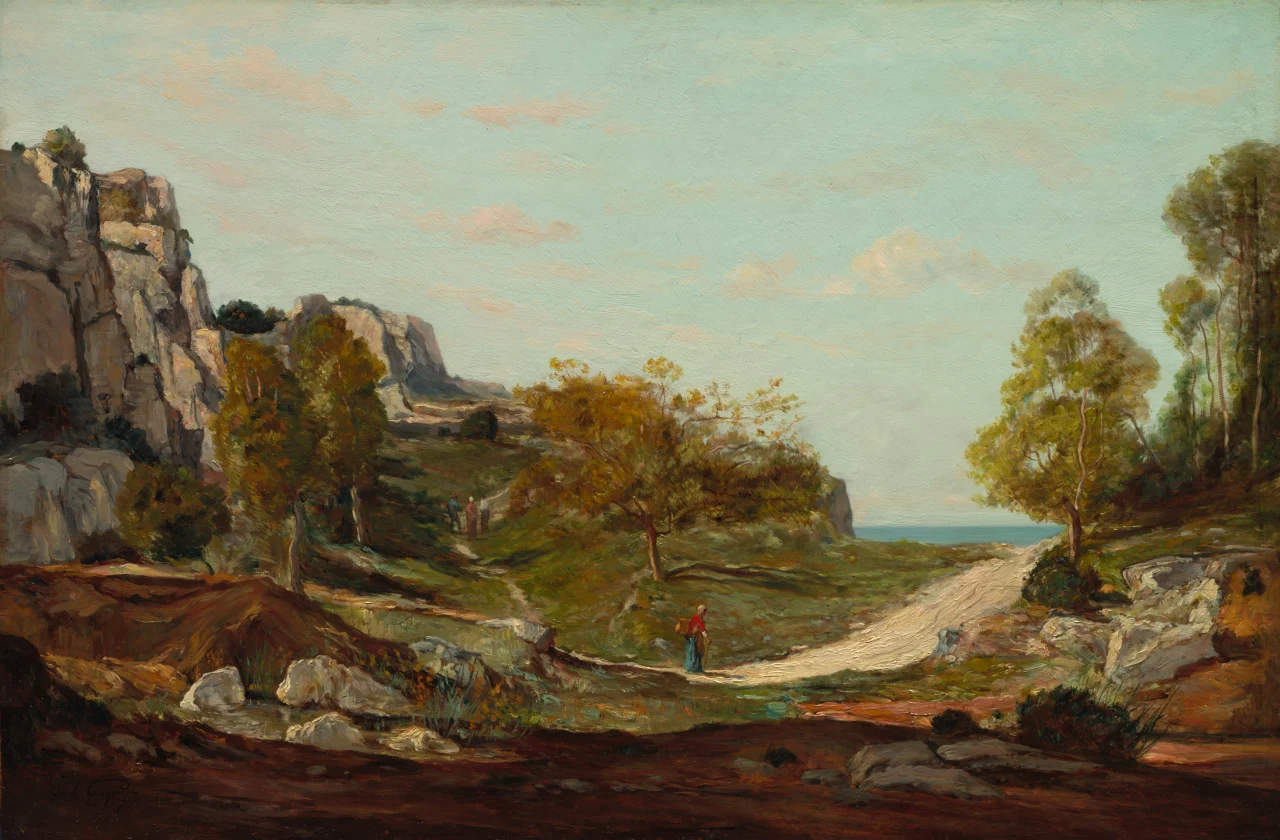
A road begins near the lower right corner of Landscape at Saint-André, Near Marseilles. It is not a clean line. White and beige paint has been dragged over uneven ground, then broken by stones, ruts, and shadow. The road rises through a shallow fold in the land and bends left behind a tree. Beyond it, a narrow blue strip marks the Mediterranean. A person in red and blue stands where the path opens. Farther back, other small figures gather near the darker earth. The view seems to promise a passage to the water. Yet the painting keeps returning the eye to the rough surface underfoot.
Paul Guigou gives the road more light than any other part of the ground. It catches the pale illumination from the large sky and carries it down toward the foreground. That brightness might make it a simple route through the landscape, but the road does not run straight or quickly. It widens, thins, and turns. Its brightest passage is also its most obstructed, crossed by small marks of ochre and gray. The paint makes the route feel climbed rather than surveyed. The sea stays visible, but it never becomes the picture’s reward.
The left side is held by a wall of rock. Its upper edge breaks into pale slabs, dark crevices, and a few shrubs. Guigou does not smooth the cliff into a distant geological mass. He gives it short, angular planes of gray, brown, cream, and mauve. Each plane catches or refuses the light differently. A dark band at the base makes the rock appear to stand forward from the middle ground. On the right, trees rise from another darker bank. Their trunks are thin and vertical, but their leaves spread in loose olive and yellow-green touches. The road lies between these two weights, a bright channel under pressure from either side.
The cliff also governs the painting’s scale. Its cracks and ledges are described in marks large enough to remain distinct from the lower edge of the panel. The trees across from it are less solid, their foliage opening into the sky. Rock and foliage therefore do different work: one fixes a boundary, the other makes a partial screen. The road passes between a surface that feels cut and a surface that feels dispersed.
The sky takes up almost half the panel. It is a pale, cloudy blue-green, spread in thin horizontal strokes. Peach-coloured clouds pass through it without gathering into a storm. Their smallness matters. They keep the sky active but leave its broad field intact. The upper half of the painting therefore feels open, while the lower half keeps dividing itself into rock, scrub, tree, path, and shadow. Guigou does not make the two halves agree. The clear space above makes the ground’s interruptions more exact.
That contrast gives the work its particular temperature. The painting is full of light, but the light does not wash the scene into ease. It falls hard on the road and cliff faces, then withdraws into brown foreground earth and the underside of the trees. The sunlit paint on the path is thick enough to look almost granular. By comparison, the sky is more lightly spread. In the middle distance, the foliage is built from small touches that leave darker colour visible beneath. Brightness here is not a mood added to Provence. It is a pattern of surfaces taking and losing light.
The panel is modest in size, only 38.6 by 58.4 centimetres. Its scale keeps the landscape close. The road advances and stalls within a compact horizontal field. The sea, compressed into a narrow band, appears only through a gap between the trees and low land. Its blue acts as a cool measure for the warmer, denser colours in front of it.
Many landscape roads settle perspective, narrowing toward a church, village, river, or mountain. Guigou’s begins at the edge of the panel but soon loses its shape among pale, uneven strokes. Its bend exposes an empty slope beside it. The road divides the ground into distances, yet its surface remains a changing patch of earth rather than a ruled line across the composition.
The painting also distributes its weight unevenly. The cliff on the left is heavy and near, while the stand of trees on the right is thinner but taller. Between them, the middle ground lowers toward a space of scrub, small figures, and a darker horizontal bank. The road cuts through that space on a diagonal, but the two sides never balance each other. The left side presses inward with stone. The right side lifts and screens with foliage. This asymmetry keeps the centre alert. The open area has to work as a passage rather than as a calm clearing.
Colour carries that tension without becoming decorative. Peach appears in the clouds, in the cliff, and in small passages of the earth, but it changes character each time. Against the blue-green sky it looks thin and cool. On the rock it becomes a dry, warm edge. Near the ground it is mixed into browns and reds. The same is true of green. The trees are green, but so are parts of the slope and the deeper marks beneath the pale road. Guigou uses these repetitions to bind the picture together, then lets texture and placement make each instance different.
There is no single point at which the landscape becomes complete. The sea is too slight, the figures too small, and the road too broken to provide one. The painting asks for a slower form of recognition: the route brightens, the foreground darkens, the trees cover and uncover distance, and the cliff fixes the left edge. These relations are ordinary, but they are not neutral. They make the coast feel lived through rather than presented from a detached overlook. Guigou’s attention stays with the difficulty of seeing past what is immediately there.
The middle of the panel is especially unsettled. A low, dark shape runs behind the shrubs, then breaks where the slope drops toward the water. Above it, a few short verticals establish tree trunks; below it, the road turns from cream to gray and back again. These small changes keep the picture from separating into a foreground, a middle distance, and a backdrop. The eye has to register each change of surface before it can make sense of the view as a whole.
The small figures give the road a human scale without taking command of the scene. The nearest is placed at a turn in the path, where the light begins to break apart. The body is just a few marks of red, blue, and dark paint. It is enough to establish a person, not enough to fix an action or story. The group farther back is even less distinct. Guigou uses them as intervals in the road’s movement. They make the path feel used, but the painting does not become a scene of travel or encounter. Rock, tree, and open sky remain more insistent.
Guigou was born in the Vaucluse in 1834 and spent much of his career painting Provence. He began exhibiting in Marseilles in 1854, moved to Paris in 1862, and continued to show at the Salon. This chronology can make him sound like a painter moving between two art worlds, the regional landscape and the capital’s exhibition system. In this panel, however, place is not offered as local colour or as a lesson in regional character. The attention is more practical. A white road has to cross an uneven slope. Trees have to interrupt a view. The cliff must hold its shadow while the sky remains bright.
The collection record describes the painting as part of a naturalist effort to catch exact details and atmospheric effects observed from life. The panel’s precision comes less from inventory than from relation. The cliff on the left is not a catalogue of rocks, and the foliage on the right is not a botanical record. Their forms become specific because they change the path’s movement. The cliff narrows the opening. The trees partly conceal the sea. The shadowed foreground prevents the road from becoming a clean white ribbon. Each element alters how far the eye can travel before it has to turn back.
Across the oil surface, long strokes in the sky meet shorter, more broken marks over the earth. Along the road, thick pale strokes lie over brown and green passages instead of blending into them. A stretch of colour may read as dust at one distance and as separate touches at another. The scene changes character as the eye moves across it, from a coastal view to a close arrangement of paint.
One can trace the composition through a set of small hinges rather than through one grand line. A reddish shrub near the centre turns the road toward the left. A dark bank behind it runs almost horizontally, then breaks at the gap that reveals the sea. The tree at the right leans its foliage back over the road, while the pale rock at the left rises in a series of steps. These movements connect foreground and distance without erasing the differences between them. They also explain why the view feels active even where there is little action. The painting continually adjusts its direction through changes in edge, colour, and texture.
The path sends the eye inward, but a line of middle-ground trees and shrubs slows it. The sea rests beyond them, almost level with the lower edge of the distant sky. There is no mountain chain or harbor to pull the scene farther open. Distance is present in the painting, but it is repeatedly interrupted by stone, scrub, and the dark edge of soil.
That dark foreground is easy to overlook because the road is so bright. Brown paint spreads along the lower edge in broad, restless strokes, interrupted by small stones and reddish passages. It has no neat border. At the left, it merges with the cliff’s shadow; at the right, it rises toward the road. These shifts keep the lower edge materially active against the broad sky.
Guigou’s career was brief. He died in Paris in 1871, at thirty-seven. It is tempting to turn that early death into an explanation for the work’s position outside the better-known histories of French landscape painting. The panel does not need that story. Its claim is contained in the way it organizes a small stretch of coast. The painter does not convert the road into an emblem of escape, nor the sea into a distant ideal. He allows both to remain ordinary parts of a demanding terrain.
At the road’s far bend, the sea remains a cool line under the trees. The foreground stays dark, the cliff presses inward, and pale paint catches against stone. Guigou holds these parts in view without turning any one of them into the painting’s conclusion.