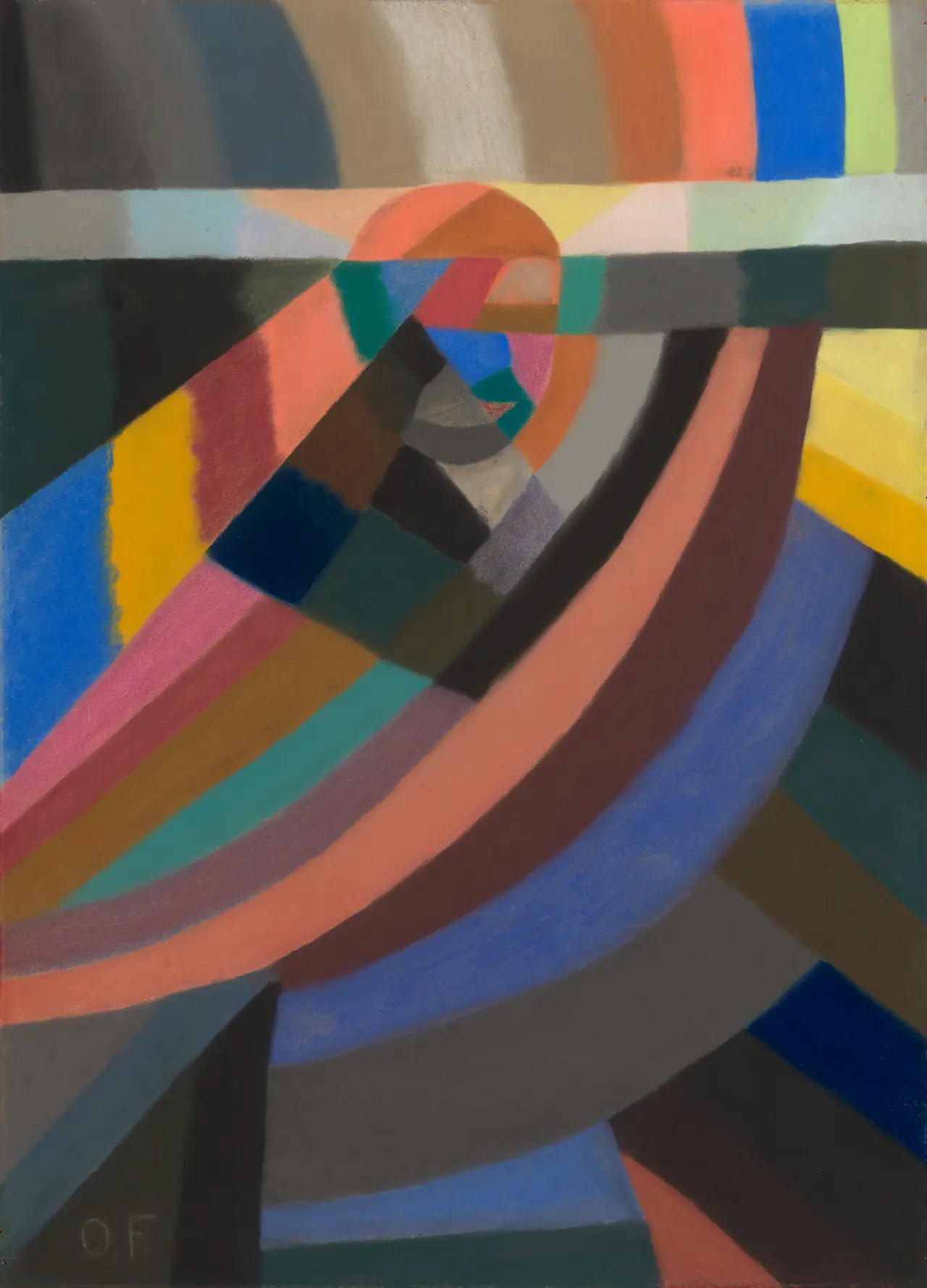
An orange circle the size of a plum sits slightly above the middle of a vertical sheet. It does not anchor the composition so much as interrupt it. Below and around it, small polygons in yellow, rose, pale blue, sea green, gray, and brick red lock together like a tiled floor seen from above. Above it, three upright bars in gray, peach, and blue stand side by side, capped by a thin horizontal band that could be a lintel. From the upper left, two broad arcs in muted peach and dusty rose sweep down and to the right, crossing behind and sometimes in front of the angular grid. In the lower left corner, the initials O.F. sit inside a black wedge, small enough to miss if the eye follows the stronger curves. The sheet is 74.6 by 53.8 centimeters, pastel on paper, signed on the front and again on the back with the place and year: Otto Freundlich / Paris 1924.
That description stays flat on purpose. There is no horizon, no ground, no source of light, no figure to name. The Cleveland Museum of Art, which holds the work as accession 1992.277 through the bequest of Lockwood Thompson, identifies its technique plainly as pastel and its date as 1924, the year Freundlich returned to Paris and showed with the Salon des Independants. The museum notes that he had painted his first purely abstract works in 1911 and had worked alongside figures such as Guillaume Apollinaire, Georges Braque, and Pablo Picasso in Montmartre after arriving in the city in 1908. Provenance is short and telling: Galerie Jeanne Bucher in Paris sold the sheet to its donor in 1938, the year the sheet left France. For a work that now lives in Cleveland in a German drawings collection, that early emigration matters. It traveled before it could be seized.
Pastel sets the tone before any composition can be argued. Dry sticks of pigment and chalk drag across textured paper and leave a matte, slightly dusty field. Color sits on the surface rather than sinking into it. Between strokes, paper shows. The hand can press harder for a saturated patch, such as the orange disk and the small brick field near the center right, or it can skim lightly for a pale peach band that remains translucent. Unlike oil, which can be scraped and reworked into a continuous film, pastel keeps each mark distinct and friable. It smudges if touched. A conservator frames it behind glass not only for light but for breath. That fragility is part of the thought. A large idea is carried by a material that can be brushed away.
Scale reinforces the same modesty. At roughly thirty by twenty-one inches, the sheet is too large to be called intimate and too small to be architectural. A viewer stands close enough to see the granulation of peach over gray and far enough to take in the whole interlock at once. The vertical orientation encourages a reading from top to bottom, as a body might scan a wall, yet nothing in the arrangement confirms that direction as primary. The upright bars at the top suggest architecture, perhaps a parapet or a row of windows, while the arcs imply movement across depth. The grid in the middle suggests a plan view. The pastel keeps all three readings in play without letting one claim the whole.
Freundlich arrived at this kind of ambiguity through conviction rather than indecision. Born in Stolp in Pomerania on 10 July 1878 and trained first in dentistry before turning to art, he moved to Paris in 1908 and lived at the Bateau-Lavoir, where cubism was being assembled from daily encounters. He returned to Germany in 1914, joined the socialist November Group after the war, and helped organize the first Dada exhibition in Cologne in 1919 with Johannes Theodor Baargeld and Max Ernst. When he came back to France around 1924, he joined the group Abstraction-Creation, a network of artists intent on an art without reference that still addressed common life. The Cleveland description singles out this moment for the most lyrically intense of his pastels, made after that return, and the 2017 exhibition catalogue Otto Freundlich: Cosmic Communism, published by Museum Ludwig in Cologne and Kunstmuseum Basel with Prestel and cited by Cleveland on page 141, gives the larger frame for what those lyrics were meant to serve.
Cosmic communism was Freundlich's phrase for a society and a cosmos without hierarchy. He imagined streets lined with sculpture, walls that belonged to everyone, color that did not illustrate power, and form that refused to place one direction above another. No top, no bottom, no privileged center. A line or a plane should not obey a social order. For painting, that meant an abstraction that did not quietly reinstate the very structures it claimed to leave. Many early abstract compositions still rely on a clear vertical against a horizontal, a stable center, or a figure against a ground. Freundlich tried to compose so that those relations remain provisional. Curves were his tool for loosening what straight edges and right angles would fix.
Composition tests that ethic visibly. The most hierarchical elements are the small polygons in the center. They assemble into a tight mosaic where each shape holds its neighbor in place, a kind of ideal city of parts. Their colors are distinct but close in value, so no single tile leaps forward. The orange circle could become a center, a sun or an eye, yet it is too small and too high to dominate. It sits on top of the grid rather than inside it, like a coin on a table, and its saturated warmth is answered by a smaller, cooler blue-green polygon two tiles away and by a repeated peach elsewhere. Balance is achieved by distribution, not by dominance.
The arcs work against the grid's stability. They are wide, smooth, and continuous, cutting across the patchwork without respecting its seams. One begins near the left edge about a third down, curves gently, and exits near the lower right; another follows beneath it with a slightly tighter turn. Their color, a pinkish peach that appears also in fragments of the mosaic, ties them to the whole while their shape declares a different order. Where the polygons suggest construction by addition, the arcs suggest movement by sweep. If the mosaic proposes a society built tile by tile, the arcs propose a flow that will not be tiled.
At the top, the upright bars test the idea of up and down. They are the most architectural passage, recalling columns or the edge of a wall. In a more conventional painting they would establish vertical as the direction of standing. Here they are shallow and brief, capped by a thin horizontal bar that stops them from rising. Their limited height and their placement against the sheet's top edge make them feel like a quotation of verticality rather than a declaration of it. Below them, the polygons do not align to their rhythm. The bars do not project into the field. They remain a band, one voice among several.
Even the signature resists hierarchy. The small O.F. in the lower left tucks into a dark shape and does not claim the corner in the way a bold signature might claim authorship. On the back, the full name with place and date records the work as an event in a life lived between Germany and France. Between the two signatures, the sheet is both a composition and a record of a decision made in Paris in 1924.
Looking closely confirms how pastel is used to keep equality precise rather than vague. Edges between polygons are sharp where a fresh stroke meets paper, but elsewhere they soften as color layers thin and the paper's tooth shows. The border between a pale gray tile and a rose one may be a clean line of pigment, while the passage where peach arc meets blue polygon blurs by a fraction as the dry sticks overlap. This is not a failure to finish. It is how the medium allows forms to touch without sealing. The eye can follow a contour and then lose it, which keeps the grid from becoming a diagram. Color does similar work. Most of the palette is muted, dusty, almost confectionery in its softness, which makes the few saturated notes feel exact rather than loud. A small rectangle of brick red near the center right holds attention because surrounding values are so restrained. The painting earns emphasis by withholding it elsewhere.
There are moments where hierarchy threatens to return. The orange circle, placed on a pale peach field, could easily become a focal point around which everything else is arranged. The horizontal band across the upper third could become a horizon line that organizes above and below. The darkest wedge at lower left could become a base that grounds the whole. Freundlich counters each risk with a nearby decision. The orange field under the circle is cut by gray; the horizontal band is interrupted by a blue rectangle that denies its continuity; the dark wedge is too narrow to read as ground and is balanced by a lighter shape on the opposite side. None of these corrections calls attention to itself. They simply prevent any one element from consolidating into a rule.
The political history that surrounds this sheet sharpens its stakes without needing to be projected onto it. By the early 1930s, Freundlich, who was Jewish, was among the artists the National Socialist government denounced as degenerate. His work was seized for the exhibition Entartete Kunst, and his monumental sculpture Der Neue Mensch was reproduced on the cover of the exhibition's catalogue as an example of what should be mocked and removed. The sculpture is now missing and likely destroyed, although another large Freundlich sculpture was unearthed in 2010 during construction work in Berlin and is now held at the Neues Museum there. Freundlich joined the Union des Artistes Allemands Libres in exile, fled to the Pyrenees after the occupation, was interned in Vichy France, was briefly released after intervention associated with Picasso, and was rearrested in 1943 and deported to the Majdanek concentration camp where he was murdered on arrival on 9 March 1943. The Cleveland pastel, sold through Jeanne Bucher in 1938 and later given through Lockwood Thompson in 1992, left Europe at the precise moment when many works that remained were being condemned, confiscated, or lost.
It would be easy to let that later knowledge reorganize the pastel into a symbol, to read the arcs as premonitions or the fragility of pastel as a metaphor for persecution. The sheet itself resists that use. Its abstraction was not illustration then, and its survival is not proof now. What the history does instead is clarify why a non-hierarchical composition might have mattered as more than a formal choice in 1924. For an artist who wanted sculpture for streets and color that did not enforce rank, making a sheet where no shape dominates was a practical rehearsal of a shared space. The Nazis' decision to put his more public form on a catalogue cover showed how seriously a state could take the threat of that rehearsal, even while misunderstanding it.
Provenance helps keep that distinction visible. A private sheet in pastel could travel. A concrete public sculpture could be seized for display. The fact that this composition was in a Paris gallery in 1938 and left for an American collection while its maker stayed and continued to work in hiding explains part of its preservation without turning the work into a rescue story. The sheet is valuable because it shows how Freundlich thought with his hands, not because it escaped what he did not. Cleveland's later acquisition history, including its inclusion in a small pastel-focused exhibition Pure Color in 2016 and 2017 and in The Jazz Age presentation in 2017 and 2018, treats it as a drawing that rewards close looking, which is the right emphasis.
That close looking returns us to the question of sweetness. Early abstract pastel can sometimes court prettiness, and this palette with its peaches, roses, and soft blues might do so here. Freundlich prevents that slide by keeping structure legible. The polygons remain firm, their edges matter, their adjacencies are not blurred into atmosphere. The arcs are not gestures of feeling but measured curves with consistent breadth. Even the most delicate passages, where pale peach arc meets gray ground, show a controlled hand adjusting pressure to keep the form readable. The result is not austere, but it is exact. The pastel allows pleasure without abandoning decision.
When the eye moves again across the whole, the initial sense of a center fades. The orange disk is still there, still warm, still placed where a center might be, yet the eye does not rest on it. It moves along the arcs, checks the upright bars, returns to the mosaic, and then follows an arc out toward the lower right edge where the sheet ends without framing. That movement is the work's real continuity. It does not lead to a point of resolution. It keeps relations in play. Hierarchy is not destroyed once and for all. It is prevented from forming as long as attention stays mobile.
This is where beautiful unease belongs for a sheet like this. The beauty is not in an image that resolves but in a structure that refuses to rank its parts while still holding together. The unease is not in a depicted event but in how easily that balance could tip, how a slightly larger orange, a heavier dark wedge, a more insistent vertical would turn equality into order. The pastel knows that fragility, and it does not hide it behind monumentality. Its dust sits on paper, covered by glass, in a museum far from the streets Freundlich imagined.
To stand before it is to practice the equality it proposes rather than to admire a picture of it. Follow the longest peach arc from left to right and see where it is overlapped by a polygon and where it overlaps. Notice how the gray between arcs is not background but a shape with its own width. Check the small blue-green tile near the center that answers the orange, and the brick red that answers both. See how the top bars hold the shape of up without becoming up itself. Each of these observations is small. Together they form the work's argument, which is made entirely of placement, pressure, and color.
Pastel elsewhere in the 1920s was often used for portrait softness or landscape atmosphere. Freundlich uses it to make an idea tactile. A communal form, if it could be made, would need to be light enough to change, precise enough to hold, and shared enough that no single part claims the whole. In 1924 he made that need visible at a scale a person can carry, in a medium that can be dispersed by a breath. The sheet survives behind glass in Cleveland, catalogued as 1992.277, described as CC0, reproduced in a book called Cosmic Communism on page 141, and signed twice by a hand that would be murdered at Majdanek in 1943. The pastel does not require that knowledge to be seen, but it allows the knowledge to sharpen the act of seeing. Its arcs continue across the paper, across the room, and toward a street that was never built.