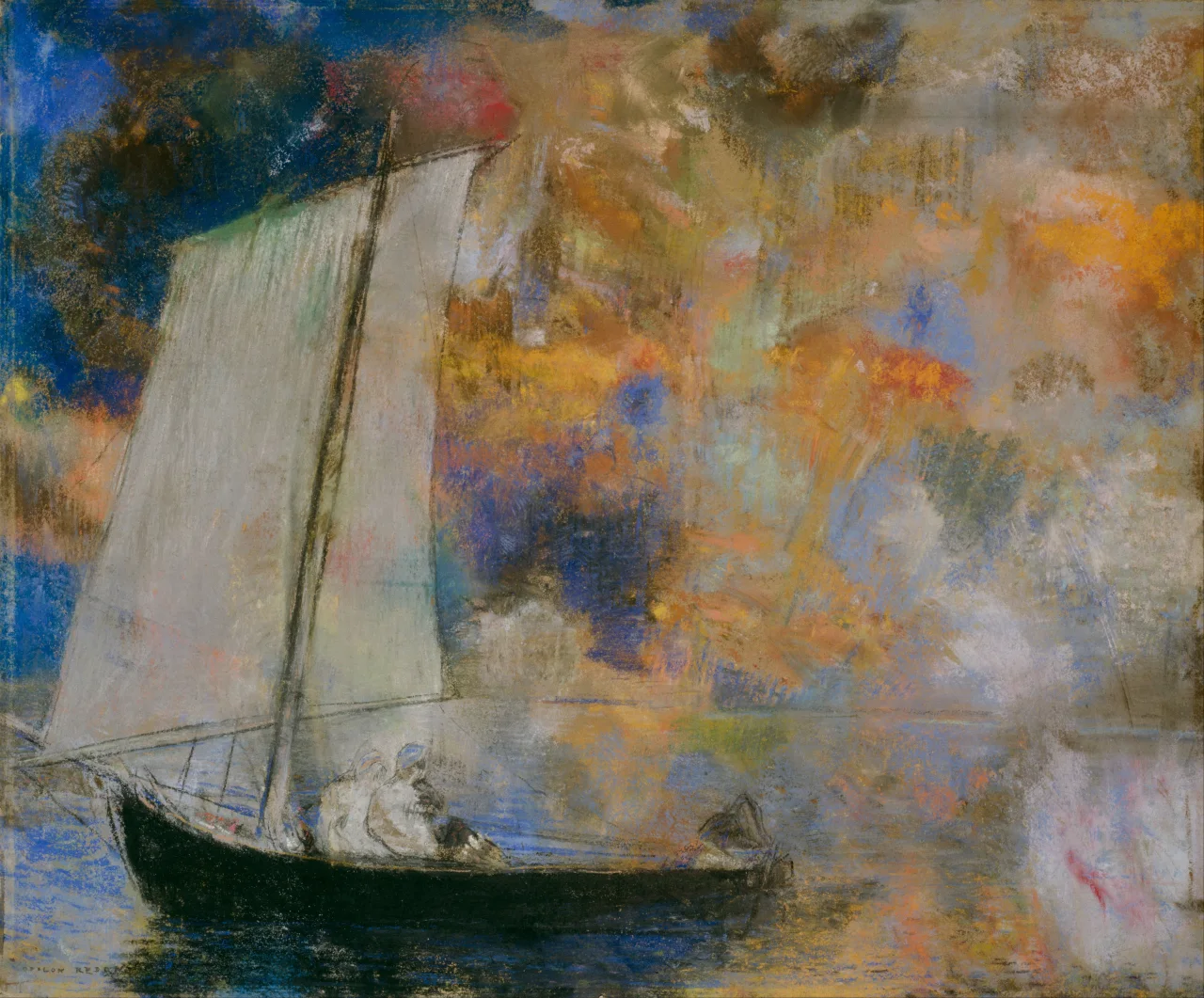
Before it became Flower Clouds, Odilon Redon’s pastel went to exhibitions under three other names. The 1905 Salon d’automne showed it as Marine; it became Barque in 1906 and Barque au soleil couchant in 1920. Sea, boat, sunset, flowers, clouds: each title fixes on a different part of the same sheet.
Through these changes, two passengers remain low in the black hull. Redon gives them no usable identity. Their pale forms sit together below a tall sail, enclosed by the dark side of the boat and a few lines of rigging. Their smallness provides a human measure that none of the titles changes.
Around them, scale and substance are less secure. The mast divides the picture vertically, and the enormous pale sail rises toward the left. Open blue presses behind it. To the right, orange, violet, yellow, blue, gray, and pale green billow, flash, and break into short marks. The passengers stay compact while the colored field can become weather, light, or flowers.
The contrast depends on how little the figures do. They do not identify a destination or explain the forms around them. Their size establishes a relation instead: the boat can hold two bodies, while a violet or orange cluster can occupy much of their surrounding world.
That colored field was physical before it became meteorological or botanical. Flower Clouds is pastel on wove paper that began blue-gray and has since altered to tan. Technical examination found the complete background built from striations and brush strokes of pastel. Redon fixed some passages, then incised them and worked them further with a brush, selectively uncovering colors underneath. The glow comes partly from application and partly from retrieval.
Long pale vertical strokes descend through blue and orange on the right. Small horizontal touches catch inside gray-brown areas. Violet and blue recur in loose clusters, while tan paper and abraded-looking passages interrupt any smooth illusion of air. Distance is available, but so is the record of a hand pressing, brushing, securing, and opening the surface again. The changing scale of the colored field begins in this worked surface.
Pastel can keep this double life unusually vivid. Its particles remain visibly particulate, especially where blue gathers in the upper left and along the water. A dense mark can act as color, mass, or atmosphere according to its neighbors. Incision adds another behavior. Instead of laying a line on top, it enters a fixed passage and exposes what the passage covered. The sheet makes revelation a manual act.
Each historical title brings a different relation out of that labor. Call the picture Marine, and the narrow blue bands near the lower edge begin to organize the scene. The dark hull floats; the colored field becomes sea and sky. The name supplies a setting broad enough to absorb most of the sheet’s strangeness.
Barque moves attention downward. The boat has the picture’s most legible construction: stern, hull, mast, rigging, sail. Its straight lines and dark weight make it seem almost diagrammatic beside the worked color. Yet a boat is an object defined by passage. Once it becomes the named subject, the absence of a clear course starts to matter. The vessel has equipment, occupants, and no visible shore.
Barque au soleil couchant supplies time. Orange and yellow can now collect into evening light, and the heavy blue at the left reads as the darkness arriving behind it. The journey gains an hour without gaining a destination. The passengers remain the same size as the colored field shifts from place to passing light.
Flower Clouds names the colored mass most peculiarly. Rounded orange, violet, and yellow touches can gather as blossoms. Their suspension lets them remain vapor. Flowers and clouds obey different scales, one held close and one seen far away, but the title presses them into a single compound. The passengers sit where that impossible change of scale feels most extravagant. Beside their heads, a violet cluster could be a distant cloud or a bloom large enough to swamp the boat.
The Art Institute of Chicago has proposed another account: a spiritual passage made by two women who may be saints. The sail’s upward reach, the radiant field, and the unlocated setting can carry that account. The figures themselves remain spare. No attribute identifies a saint, and no gesture establishes a rite. They can bear a story without illustrating its details, much as the surrounding strokes can bear sunset, weather, or flowers without settling into any one of them.
This balance appears elsewhere in Redon’s later color work. John Rewald and Harold Joachim observed that represented subjects could remain small incidents inside larger arrangements of color, form, space, and texture. Here the boat is such an incident, but it also places two human bodies inside the arrangement. Their size tells how vast the color has become. It also keeps each title answerable to the same occupied boat.
Marine names a setting. Barque names the object within it. Barque au soleil couchant gives the passage an hour. Flower Clouds changes scale, allowing petals to occupy the sky and clouds to bloom at the scale of weather. The boat remains the size of two seated bodies while sea, sunset, flowers, and clouds trade dimensions around it.