Polyphemus has a grooming problem. In Ovid’s Metamorphoses, he combs his stiff hair with rakes and trims his shaggy beard with sickles. Love has made the Cyclops study his face in a pool, and the result encourages him. The single eye in the middle of his forehead, he argues, resembles the sun. Heaven gets by with one.
Galatea tells this story, and her account keeps the makeover comic. Polyphemus praises his cave, his sheep, his grapes, his strength, and his father, who rules the sea. He describes his body hair as an ornament. Then self-advertisement slides into abuse. Galatea prefers the young Acis, so Polyphemus promises to tear him apart. He later kills Acis with a rock ripped from the mountain.
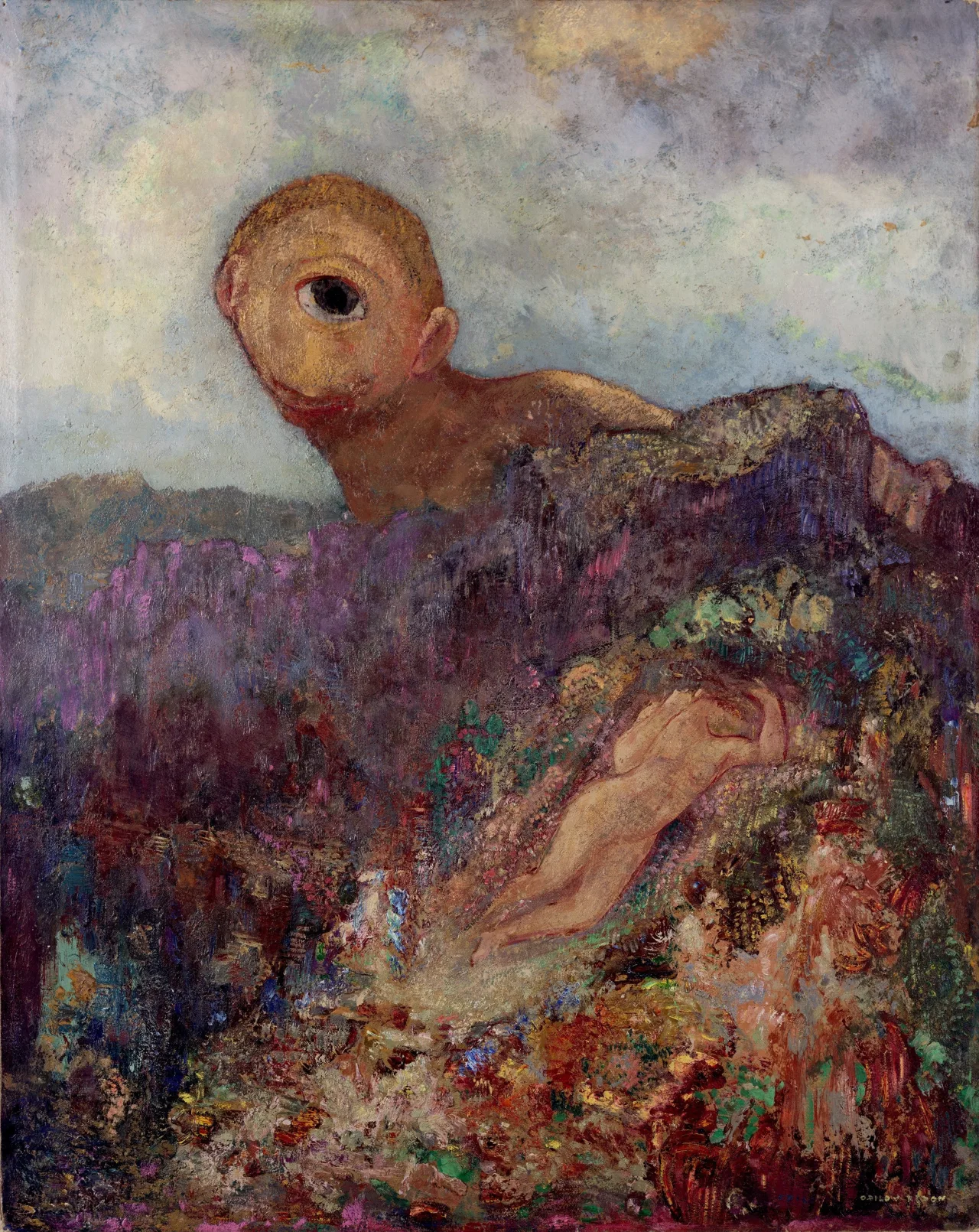
Odilon Redon’s The Cyclops is not documented as an illustration of Ovid’s text. It belongs to the same story, however, and Ovid supplies a wickedly useful way to look at the painting. Redon gives Polyphemus what every anxious suitor wants: flattering light, a controlled angle, and the chance to present only his best feature.
The head rises into a pearly sky at the upper left. Warm ochre, rose, and rust model the scalp and cheek. A small ear curls neatly at the side. The mouth has been reduced to a fine red line, almost prim against the broad face. One shoulder follows the ridge while the rest of the giant remains somewhere behind it. Polyphemus has borrowed a mountain as a portrait crop.
The crop is strange because it conceals mass and advertises size at once. A human sitter cut off at the chest would seem close to us. This head also appears far beyond a landscape barrier. Redon joins those two distances without resolving them. Polyphemus occupies the intimacy of a portrait and the scale of geography. He has arranged himself as a face large enough to be scenery.
His eye spoils any hope of tasteful restraint. It fills the upper half of the face, with a black pupil surrounded by a pale almond and a heavy red-brown lid. The feature is anatomically placed and magnificently excessive. Redon gives the improbable creature just enough bodily logic to make its impossibility persuasive. Ear, cheek, brow, and shoulder say that this is a living head. The eye says that ordinary proportion has lost the argument.
By about 1914, when Redon painted this small oil on cardboard, the eye had served him for decades. In the 1878 charcoal drawing Eye-Balloon, an eyeball rises over a marsh while carrying a severed head. Redon described his method as making improbable beings live through the logic of visible things. The Cyclops performs that method with unusual economy. A familiar organ receives so much attention that the rest of the body becomes almost optional.
An earlier Cyclops shows how long Redon had enjoyed this instability. In 1883 he made a lithograph titled The deformed polyp floated on the shores, a sort of smiling and hideous Cyclops, the third plate in Les Origines. The title strains between kinds of creature. A polyp suggests elementary life; a Cyclops carries the bulk of mythology. “Smiling” and “hideous” make another awkward pair. Redon could give a monster an expression without granting it a settled identity.
Color performs the courtship
The later painting keeps the awkward smile and changes the conditions of display. Redon had left his black charcoals and lithographs behind around the turn of the century and committed himself to color. He also tried to make oil behave more like pastel, reducing its grease to leave a chalkier pigment. In The Cyclops, thin clouded color drifts through the sky, while the ground gathers violet, green, turquoise, orange, black, and red into a dense, rubbed surface.
Color acts as Polyphemus’s finery. His skin glows against cool air, and the dark ridge opens below him like a lavish collar. Purples descend in broad vertical strokes. Small green and blue marks spark along the slope. Near the bottom, rust and coral collect beside deeper black. The giant’s naked face appears above an entire wardrobe of mineral and floral color.
Galatea lies inside that wardrobe. Her pale body runs diagonally through the lower right, clear at the torso and increasingly absorbed by the marks around her. One arm bends over her head. Her face turns into the ground. The Kröller-Müller Museum identifies her as sleeping, which leaves Polyphemus with the worst possible audience for a carefully managed appearance: someone present in every physical sense and unavailable as a witness.
The arrangement gives the painting the rhythm of a failed unveiling. Polyphemus has emerged. Galatea has not looked. His face receives open sky and a clean contour; her body enters a zone where pigment keeps interrupting anatomy. The difference does not make her visually weak. Her long, pale diagonal cuts through the most active part of the picture. It makes her absence from the giant’s performance unmistakable.
Ovid’s Polyphemus has the opposite problem. Galatea hears every part of his performance. His song begins with compliments, moves through an inventory of wealth and lineage, and ends by imagining Acis’s torn body. The speech reveals what the grooming cannot improve. Redon removes that voice. No inscription tells us what this painted Cyclops thinks, wants, or plans, and the quiet mouth offers no reliable substitute.
Silence makes the face available to sympathy, comedy, suspicion, and embarrassment in quick succession. The rounded scalp can look childlike. The low mouth can suggest hesitation. The enormous eye can turn those impressions into surveillance. Each reading uses a real feature; none becomes an x-ray of intention. Polyphemus has prepared an image of himself, while Redon lets the image exceed its owner’s control.
This is the pleasure of the painting’s bad courtship. The myth gives the giant physical power and disastrous speech. Redon gives him surface: warm skin, one colossal eye, a narrow mouth, a mountain arranged across his chest, and color in nearly every flattering register. The presentation is elaborate and its reception is nil. Down the slope, Galatea sleeps through the unveiling.