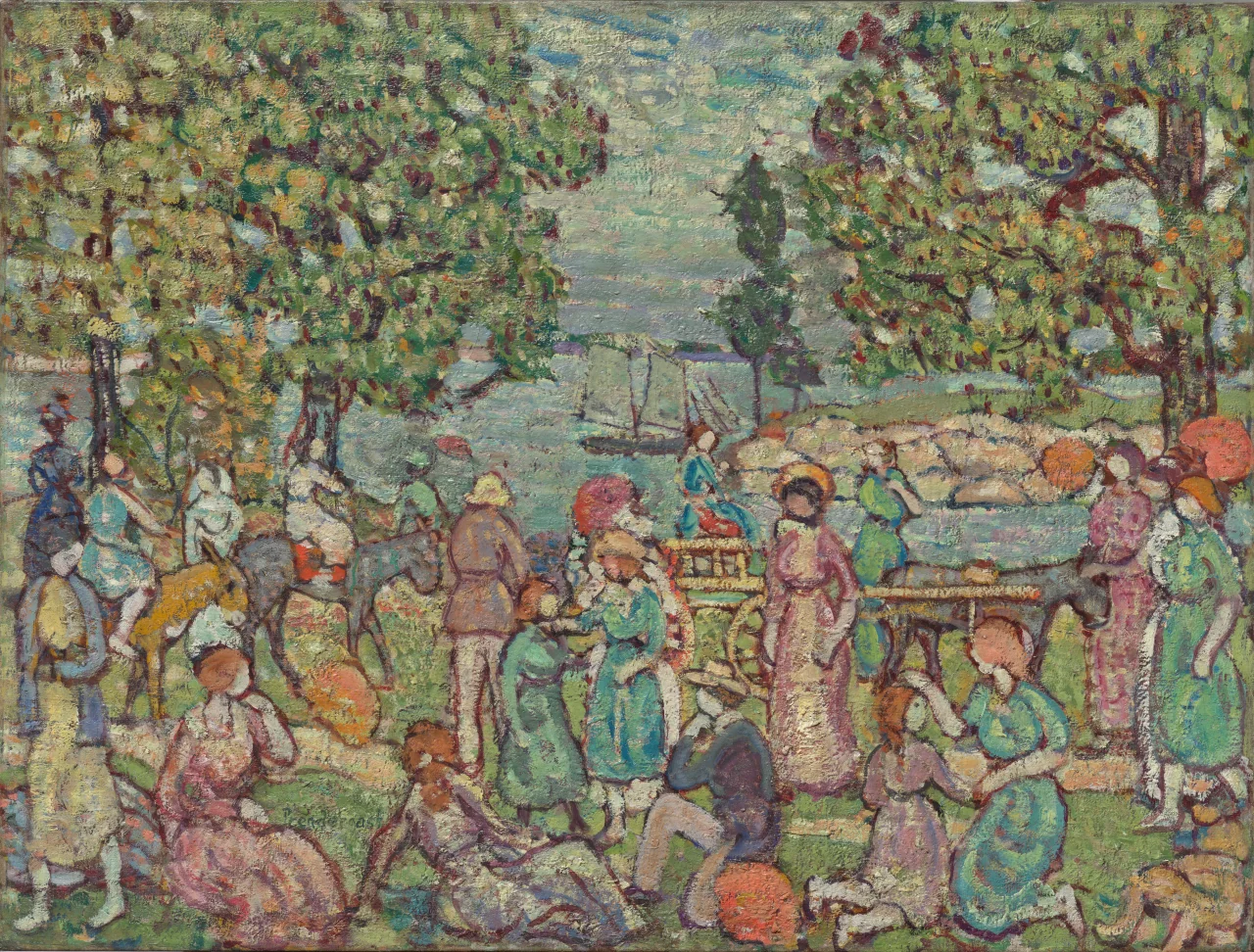
Near the center of Maurice Prendergast’s On the Beach, No. 3, a person in a green coat bends toward a seated companion. A turquoise sleeve meets a cream hat; the hat touches the brown contour of a nearby body; that contour runs into a russet patch beside a cart. At first these pieces can seem to belong to one compressed knot of color. Then the dark lines begin to sort them. A bent back appears. An arm reaches forward. One face turns toward another. Recognition arrives through contact, one adjacent shape at a time.
This compact exchange offers a way into the rest of the painting. Prendergast does not set a principal figure above the gathering or clear a stage around one event. The people occupy most of the canvas’s lower two-thirds, and their bodies overlap in loose rows. Some sit on the ground with legs folded or extended. Others recline. Standing figures face several directions, while a rider and animals cut through the groups nearer the trees. A cart extends horizontally behind the central cluster. Every few inches another posture changes the movement: upright to bent, bent to seated, seated to stretched out. The crowd is dense, yet density never settles into a single mass.
At the far left, a mounted figure rises above seated beachgoers. The rider’s blue clothing, the animal’s cream neck, and the dark harness make a narrow vertical passage beside the nearest tree trunks. A second animal carries a broad yellow-orange patch that almost merges with the clothing and ground beside it. Prendergast keeps these forms separate with reddish brown contours, though the contours rarely close them into clean silhouettes. Lines thicken, fade, and resume. A leg becomes clear where it crosses a light patch. A head becomes clear where a darker curve meets the sky-colored space behind it. Each body depends on its neighbors for definition.
The same process continues toward the middle. Two standing adults, one in muted brown and one in green, lean toward a smaller figure between them. Nearby, a broad turquoise dress descends in a column before widening at the hem. Behind it, cream, red, and green strokes gather around the cart. Prendergast gives faces little detail. Instead, a tipped hat establishes the angle of a head, a shoulder line indicates a turn, and the interval between two hands makes an exchange possible to see. These signs remain modest. They identify an action without completing a story about who the people are or what they feel.
Past the central cluster, upright figures gather near the cart and the shoreline, while seated and kneeling bodies fill the foreground. A person in blue-green kneels with one knee projecting toward the bottom of the canvas. Another sits in violet with an arm raised to the face. Their contours meet at several points, but their opposing bends keep them distinct. Behind them, pink, turquoise, cream, and green garments form a standing sequence. Bright parasols hover above this row as rounded orange and rose disks. They mark separate bearers while repeating the circular dabs scattered through the trees.
Color performs two jobs at once. Blue belongs to water, jackets, dresses, hats, and the shadows within foliage. Green moves from leaves to coats and the strips of ground around seated bodies. Pink and orange pass through clothing, parasols, sunlit shore, and the broken canopy. These repetitions draw the eye sideways, away from any fixed center. A turquoise patch may begin as a sleeve and answer another patch several figures away. Yet the response does not dissolve the sleeve. Its darker boundary and its place beside a hand, shoulder, or hat keep it attached to a particular pose.
The Cleveland Museum of Art describes Prendergast’s color here as rounded, thick patches that create a densely woven effect. The paint visible in the reproduction supports that account. Strokes sit against one another with a coarse, broken texture. Some retain a blunt direction; others bunch into short curves. Cream and other light patches break up many passages, so even the busiest areas contain small openings. The weave is therefore uneven. It tightens where bodies overlap and loosens where water appears, changing the amount of effort needed to separate one form from the next.
Three broad zones give this activity its measure. The crowd and shore fill the base. A band of water passes behind the figures and through the cart’s rails. Trees spread over much of the top, parting near the center to reveal sky. These divisions are easy to name, though Prendergast repeatedly crosses them. Tree trunks descend into groups of people. Boats lift narrow masts into the opening between the canopies. The water’s blue and green strokes return in clothing below and leaves above. The zones hold, while their colors and lines continue to trade places.
The strip of open water is especially active in this exchange. It can be seen through gaps among hats, shoulders, the cart, boats, and animals, then gathers into a wider area beyond the central figures. Small vessels and their rigging interrupt it. Farther back, a dark ship rests near the horizon. The water supplies distance, but its broken strokes share the same touch as the nearby garments and foliage. It expands the scene without becoming a calm backdrop. The crowd receives a wider setting, and the setting remains bound to the crowd’s painted rhythm.
Above, the two large canopies work in a similar way. Their branches form dark, irregular supports for hundreds of green, cream, blue, yellow, and wine-colored touches. The foliage is thickest toward the outer corners. Near the middle it opens around two tall, narrow trees and a pale stretch of sky. This opening does not command the composition as a perfect window. It is crossed by trunks, masts, and the distant horizon. Its light area gives the eye room to judge how tightly the figures have been pressed below, then sends attention back toward the denser growth on either side.
On the Beach, No. 3 dates from about 1915 to 1918, a mature period in Prendergast’s long attention to beaches and parks. He had worked seriously in oil since the early years of the century, and his later shore scenes often joined strong outlines, thick strokes, and crowded leisure subjects. Related paintings such as Salem Cove and Seashore also arrange people beside water through flattened, rhythmic forms. The comparison clarifies that the Cleveland canvas does not arrive at its density by accident. Prendergast had developed a method that could carry many bodies without relying on conventional depth or a dominant anecdote.
That context explains the assurance of the arrangement, while the particular work still requires its own looking. The number in the title does not establish a known narrative sequence, and the museum does not identify the beach. The canvas itself supplies no firm order in which its events should be read. A viewer can follow the horse and rider into the gathering, move along the cart, pause at a parasol, or descend toward a seated pair. Each route meets a different set of local relations. None gathers all the figures into one episode.
This openness keeps the pattern from becoming a social claim. Shared colors connect figures on the canvas, but color cannot tell us whether they know one another or what kind of community they form. Simplified faces do not disclose mood. Even the visible gestures remain partial: a hand approaches another person, a head turns, a body rests, an animal advances. Prendergast gives enough shape to recognize these acts and leaves their motives outside the painting. The restraint matters because it allows difference to remain visible without turning every difference into a character or plot.
Look again at the foreground, where the densest bodies meet the bottom of the canvas. A rose dress spreads beside a green garment. A dark reclining figure stretches through the middle, crossed by lighter legs and bordered by orange. The kneeling blue-green body at the right leans toward the seated violet one. The contours sometimes touch so closely that one person’s boundary becomes the beginning of another’s. Posture restores the distinction. A tilted torso, a planted knee, or the direction of an extended leg gives each figure a temporary enclosure within the continuing color.
The painting’s legibility is therefore mobile. It does not offer a diagram in which every person can be counted at once. Forms clarify as attention moves among them, then sink back into the larger painted structure when attention moves on. Repeated hues make that movement easy, carrying the eye from person to tree, from tree to water, and from water into clothing. Outline slows it at the scale of a body. Interval changes its pace, opening a space around one gesture and compressing the next among several neighbors.
Prendergast keeps these forces in close balance. The shared touch of the brush holds the beach together, while every bend, turn, gap, and crossing gives the crowd another local direction. No person governs the scene, and no common rhythm finishes the people into one story. They remain available in clusters: the rider beside the trees, the adults leaning toward a smaller body, the group near the cart, the kneeling pair, the seated figures at the front. The crowd becomes clear through these brief relations, each held long enough to be seen inside the color that connects it to all the others.