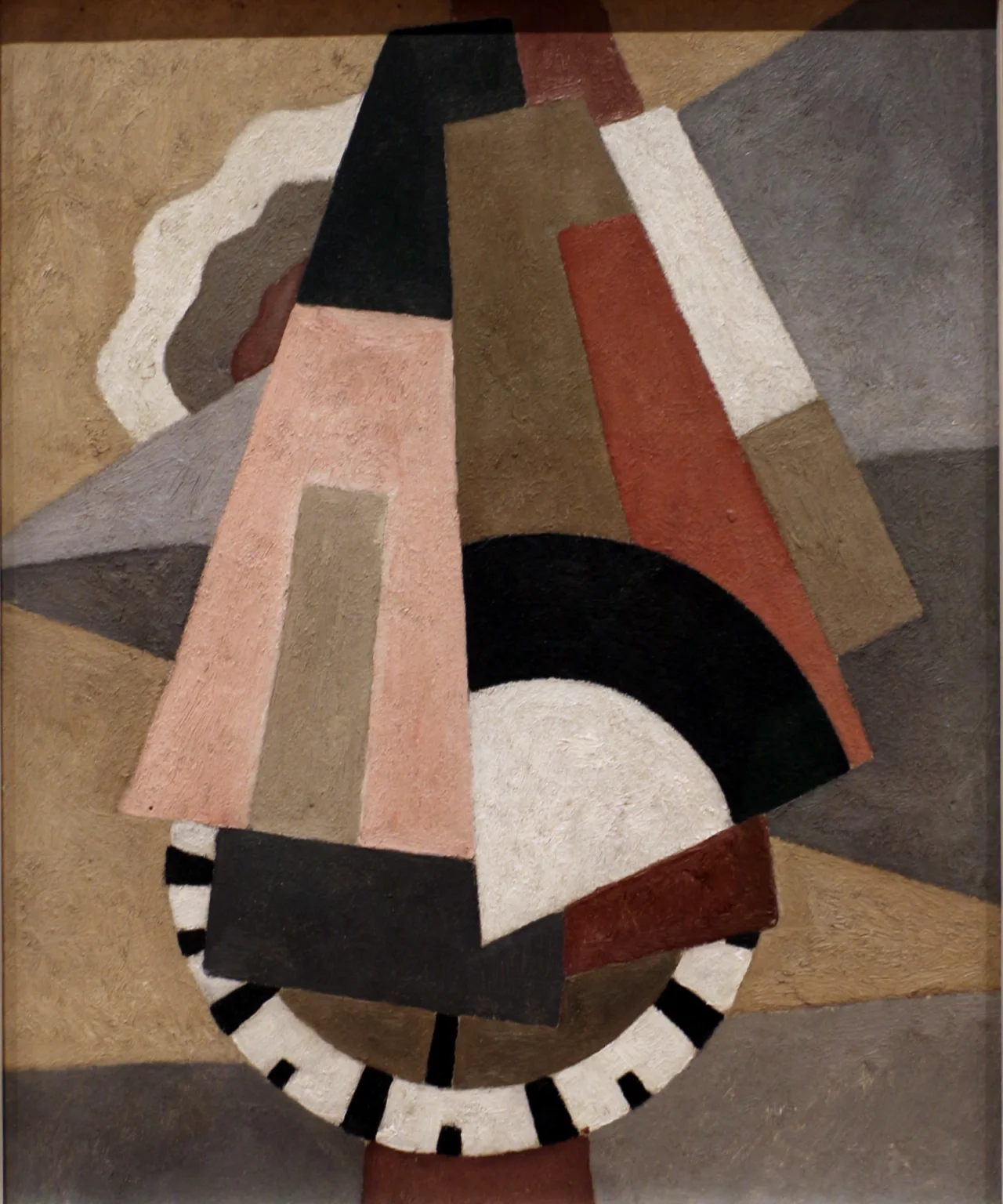
There is nowhere in Marsden Hartley’s Provincetown for distance to begin. Gray and tan planes cross the field from edge to edge. Smaller wedges fill the spaces between them, and no horizon divides water from sky. The painting presents a named coastal place, then denies the eye the usual structure of a view.
A broken ring occupies much of the lower half. Alternating black and white blocks mark its outer edge; inside it, a black semicircle presses against a white one. The repeated arc sets up a turn, yet long strips of pink, brown, rust, white, and black rise through the crowded center and check that motion. Every direction meets resistance. The curve cannot complete its course, and the uprights cannot open a clear path toward the top.
Some of those uprights narrow like masts among rigging. Their suggestion comes from placement and proportion, not from descriptive detail. Each is caught inside the same shallow weave of planes. An angled gray shape passes behind one strip and seems to cut in front of another. Without a stable foreground or background, depth becomes a series of brief crossings. The eye advances only a short way before an edge turns it aside.
Color reinforces that compression. Muted pinks and browns sit among gray, black, and white, with no broad field opening into air or water. Paint texture remains visible across many of the color areas, keeping attention on the worked surface. The strongest contrast belongs to the striped ring, but even that form cannot stand apart. Outer planes lean toward it, and the rising bars split its claim on the center.
Hartley spent the summer of 1916 in Provincetown with the painter Charles Demuth and the playwright Eugene O’Neill. Ships moving into and out of the harbor supplied sources for related abstractions. In Movement No. 1 (Provincetown), a bow-like sail and coiled hull can be traced through the geometry. Movement No. 5, Provincetown Houses compresses houses, sailboats, and the Pilgrim Monument into flat forms. Those paintings make the mast-like rises and crowded passage of Provincetown legible as harbor pressures, without assigning a fixed object to each part.
The alternate title Abstraction - Provincetown states the tension with unusual economy. The town remains named while its familiar distances disappear. Hartley gathers the possible signs of a harbor into one vertical field, where a turn, an ascent, and a crossing occur in almost the same space. Place survives here through congestion.
The ring concentrates this effect. Its black and white intervals imply an incomplete circuit, while the inner semicircles fold the curve back toward its center. Uprights cut across that lateral pull. One action has barely become visible before another blocks it. This makes the composition feel active without depending on a sequence of identifiable boats or harbor fixtures. Movement is carried by the limited room each form allows the next.
Most harbor views let the horizon sort their elements into layers. Near and far can be read at once; open water grants passage between them. Hartley removes that organizing distance. A mast-like line rises, disappears into an angled plane, and returns beside another strip. The striped arc sends attention around the lower cluster, where its route closes early. Looking becomes local and physical, directed by edges rather than by a prospect across water.
The title supplies the location, but the missing horizon determines how that location is felt. At the top of the painting, the uprights taper as if they might release the eye into distance. Gray and tan planes close around them instead. Provincetown ends not at a far shore, but inside the next obstruction.