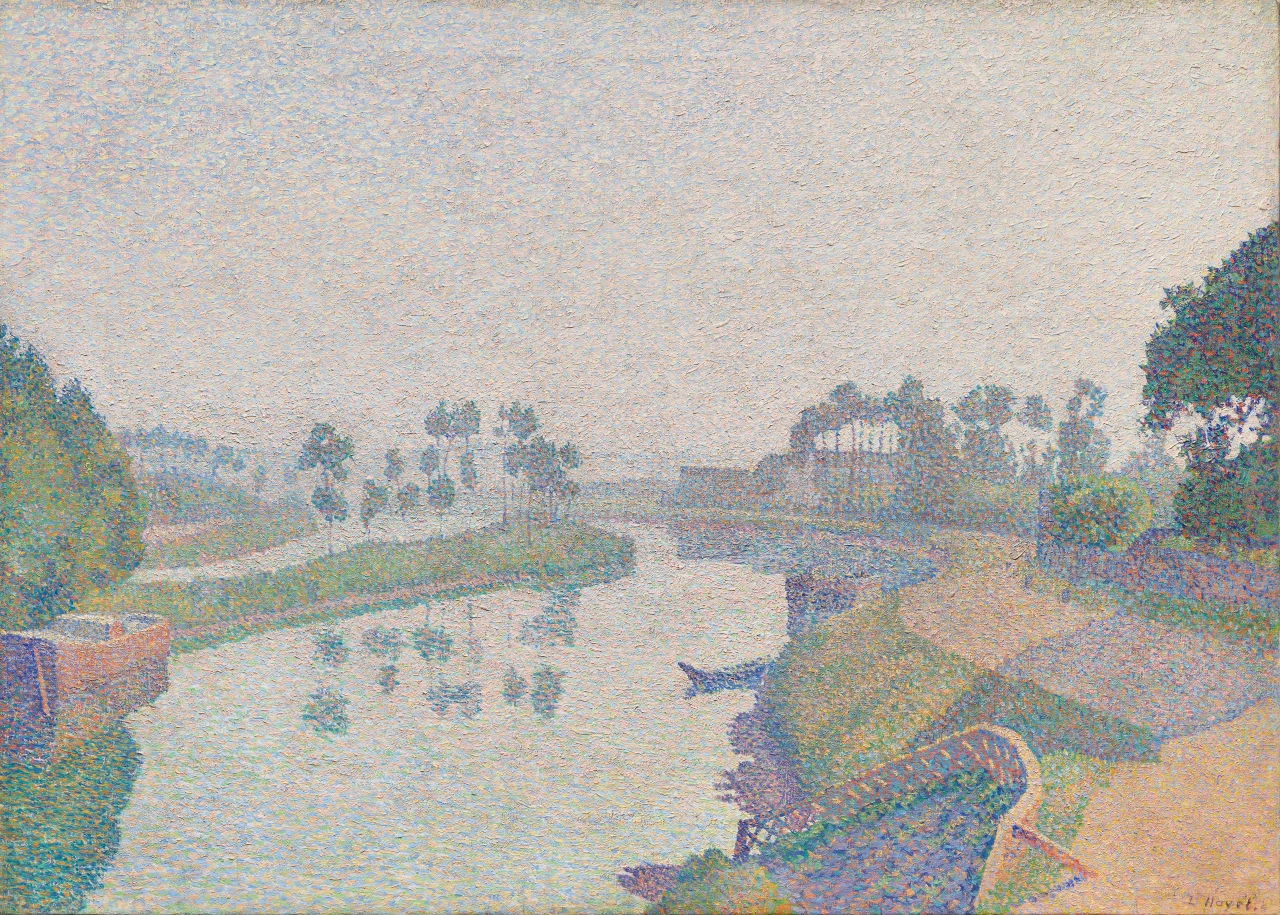
Louis Hayet developed a Neo-Impressionist color chart that included gray tones, an idea that earned critical praise. In Banks of the Oise at Dawn, that workshop achievement becomes sensuous. The morning seems gray at first. Close attention separates that reserve into pink, orange, blue, yellow, and green. Gray becomes a meeting among colors.
Hayet painted the canvas in 1888, when the new method was still young. Neo-Impressionists placed distinct strokes of pigment beside one another in the belief that separate, often contrasting hues would combine in the viewer’s eye. The separation of color into individual marks became known as Divisionism. Its theory promised order: the painter apportioned the colors, vision brought them together. The Oise, the river of Hayet’s native Pontoise, gives that theory a fitting test. Water makes one thing appear in two places, then changes the second version with every shift of light.
The painting gives most of its area to the sky. Across this large pale field, small touches overlap in direction without merging into a smooth wash. Blue cools beside faint orange. Pink catches against green. Cream-colored passages remain active between them. At an ordinary distance these incidents settle into early light, yet the settlement is incomplete. The eye receives the weather and the separate decisions that make it at the same time.
That double experience is the particular pleasure of Hayet’s gray. Mixed on a palette, the complementary colors could have arrived on the canvas already neutralized. Kept apart, they retain a slight argumentative life. Orange continues to warm; blue continues to recede. Their aggregate can be mild while its parts stay vivid. They can belong to the morning without surrendering their identities.
Below the sky, the method changes pace. Spindly trees rise along the left bank and reappear as short, downward trails in the water. Their reflections are sparse enough for the pale river to pass between them. On the right, houses, trees, shore, and moored boats gather into a denser weave. The same family of hues serves air, foliage, earth, timber, and reflection, but Hayet adjusts the intervals. A few strokes can indicate a distant trunk; the foreground needs a crowd.
This uneven density keeps the system responsive to place. The horizon is thin and cool, while the lower corners press blue against orange with greater force. A boat at the left edge becomes a blunt block of warm color over a dark vertical reflection. At the lower right, two narrow boats lie on the bank, their curved outlines carried by blue, violet, green, and orange marks. They remain recognizable objects, but they also reveal what the distant view conceals: this pale world has been assembled from strong disagreements.
Aquatic reflections appealed to Neo-Impressionist painters because water offered a visible trial for separated color. Hayet extends that trial across the canvas. Dispersed strokes in the vast sky repeat the river’s palette, while the river answers with broken verticals. The banks between them hold the darkest concentrations. Color links sky, land, and water as changing levels of pressure across one continuous field.
Dawn matters here because it delays the usual authority of local color. A tree has not yet become simply green, a boat brown, a shadow blue. Hayet fills this interval with hues held below full declaration. Even the gray tones belong to that abundance. They temper the complementary contrasts and let a clear orange or blue sound inside a generally muted atmosphere.
The result is a modest kind of astonishment. A color chart, associated with classification and control, helps Hayet paint an hour when categories have not quite taken command of sight. His river landscape remains legible, down to its houses and beached boats, while every object participates in the same unsettled light. The gray morning holds because each color remains slightly itself while taking part in the tone that contains them all.