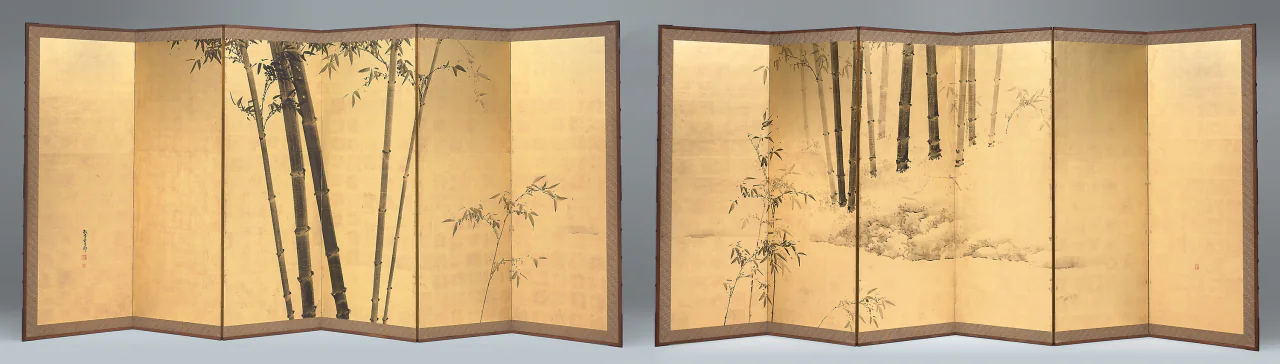
Ink usually enters paper. A brush presses liquid into its fibers, and the paper receives a trace of the brush’s speed, pressure, and moisture. Kishi Ganku chose a less compliant ground for Bamboo. Gold leaf covers the paper of these two six-panel screens. The metal closes the absorbent sheet beneath it, so the ink must adhere to a skin that resists it. Every stalk begins in that material disagreement.
The Art Institute of Chicago’s account of the screens describes Ganku moving a loaded brush with even pressure to build the segmented trunks. On the non-absorbent gold, some ink skipped instead of settling into a continuous band. The museum also says that he mixed animal glue with ink in some passages. In the museum’s account, those passages suggest the irregular texture of bamboo or changes in light. This is a curatorial account of his method, rather than a published conservation finding, but it makes sense of what the reproduced object shows. Dense black sections sit beside gray washes and dry, broken trails. The brushstroke records both Ganku’s control and the refusal of the gilded ground.
Gold therefore does more than supply radiance behind a finished image. It participates in the making. It interrupts one stroke and sharpens another. Where the ink thins, the metal remains visible inside the painted stalk. Where a heavy deposit holds, blackness blocks the reflected light. A bamboo trunk can shift from solid bar to ragged deposit within a short distance, although the plant continues through the change. The material variation becomes a way to describe a surface that is jointed, fibrous, and exposed to light.
Ganku had several painting traditions available to him. Born in Kanazawa in the eighteenth century, he moved to Kyoto and studied Kano painting, the work of the Chinese artist Shen Nan-p’in, and the natural observation associated with Maruyama-Shijo practice. He later received an imperial appointment and founded the Kishi school. These affiliations do not provide a code for reading the screens. They establish the range behind his brushwork: disciplined pattern, close study, and an ability to move between thin lines and thick, loaded strokes. In this pair, that range serves a plant whose structure depends on repeated divisions but whose growth refuses a tidy boundary.
The Art Institute’s current record dates Bamboo broadly to the early nineteenth century. A label prepared for the museum’s 2009 exhibition Beyond Golden Clouds assigned the work the more specific year 1829. The broader live date is the safer one, yet the exhibition date places the screens late in Ganku’s career if that attribution is correct. By then, the changes between heavy and fine brushwork had become an established part of his practice. The pair presents that command through remarkably spare means: ink, gold leaf, paper, twelve panels, and enough unpainted metal for the bamboo to seem both present and incomplete.
Twelve planes of gold
Each screen measures 178 by 376 centimeters, approximately six feet high and more than twelve feet wide. Together they could extend for over seven meters if laid flat. They were made to stand in shallow folds, however, and the photograph preserves that zigzag. Each panel meets the next at a slight change of angle. The gold brightens or dims at those joints, dividing a continuous painted scene into physical planes.
One screen gathers several thick stalks near its middle. They enter from the lower border, pass through knuckled joints, and rise beyond the top frame, where only parts of their leaves remain. A few thinner stems lean away into the open gold. The other screen reverses the weight. Dark trunks descend from the upper region and stop above low, pale rocks and a narrow course of water. A finer plant climbs near them, while light leaves and branches dissolve into the metal. Neither cluster supplies the complete outline of a grove. The strongest forms arrive from outside the frame or leave it before their growth can be followed.
The folds change these incomplete plants in practical ways. A stalk that crosses more than one panel occupies several angles at once. Open the screen wider and its sections approach a continuous line. Close it further and the same trunk turns more sharply with each joint. Light changes at the same time. Gold leaf on a plane angled toward a window will return more light than gold on the next plane, even though both belong to one ground. The painted bamboo gains a variable rhythm from an object that can be adjusted to the room.
This movement is easy to lose in a flat digital image. The reproduction shows the whole pair clearly, including the frames, seams, signatures, and seals, but it also compresses an object designed to occupy floor space. A folding screen has thickness, balance, and reach. It can divide an interior, shield part of it, direct movement, or establish a temporary boundary. Ganku’s painting works through those functions. The broad gold passages are not simply empty zones within a composition. They are substantial areas of reflective material, spread over panels large enough to alter the light near them.
The Art Institute interprets Ganku’s severe cropping as a way to place a nearby viewer within the grove. That reading remains a proposal about the screens’ effect, not a documented statement of the artist’s intention. The physical evidence gives it force. At this scale, the trunks approach the dimensions of the body. Their unseen roots seem to continue below the frame, toward the floor on which the screen stands. Their tops continue above eye level. A person facing the pair encounters partial plants at roughly architectural size, rather than a distant landscape contained within a small rectangle.
The open gold also changes according to where that person stands. From one position, a sequence of panels may read as a long illuminated band. A few steps away, alternating planes separate into warmer and duller sections. Leaves painted with thin ink can almost disappear into the brighter metal, then return when the viewing angle changes. This effect does not require the painted forms themselves to move. The support distributes them through changing light.
A grove around a gathering
The museum has proposed a larger original setting for the pair. Its 2009 interpretation suggests that these screens may once have belonged to five pairs arranged around the perimeter of a room for a salonlike gathering of literati. The proposal connects that possible installation with the Seven Sages of the Bamboo Grove, the Chinese scholars, writers, and musicians whose withdrawal to a bamboo grove became a model for later literati culture. They were remembered for wine, writing, music, and a form of searching conversation called qingtan.
No evidence in the current object record establishes that one known gathering used these screens, and the surviving pair alone cannot prove a set of five. The Institute’s proposal is valuable because it treats the objects as equipment for a room as well as paintings. If several pairs stood around a gathering, their folds would have formed a broken perimeter of gold and ink. The bamboo would recur at intervals, with doorways, corners, people, and furnishings occupying the spaces between. The grove would depend partly on the screens and partly on the interior they organized.
Even without accepting that reconstruction as certain, the pair supports the underlying spatial idea. The two screens do not meet. A visible interval separates them, yet their shared materials and scale let them belong to one environment. Bamboo appears in concentrated groups rather than as a wall of foliage. Gold carries the eye through the broad gaps and toward the room beyond the frames. The incomplete plants make continuation possible without depicting it. Another screen could follow, or a doorway, or an expanse of plaster touched by the light reflected from the leaf.
This is where Ganku’s handling of ink returns to the physical use of the object. The same gold that made the brush skip also receives the room’s illumination. Some passages mix animal glue with ink, while the folds place each deposit at a distinct angle. Cropping extends the stalks past the paper, and the standing panels place those absences beside actual floor and air. Material, image, and interior remain joined in one operation.
A grove made this way has no fixed depth. It expands when the screens open and contracts when they fold. Its dark trunks hold their scale, while the gold varies with daylight, lamps, and the position of a person passing nearby. The twelve panels stand as twelve responsive planes, carrying bamboo into the same changing light as the room and the people within it.