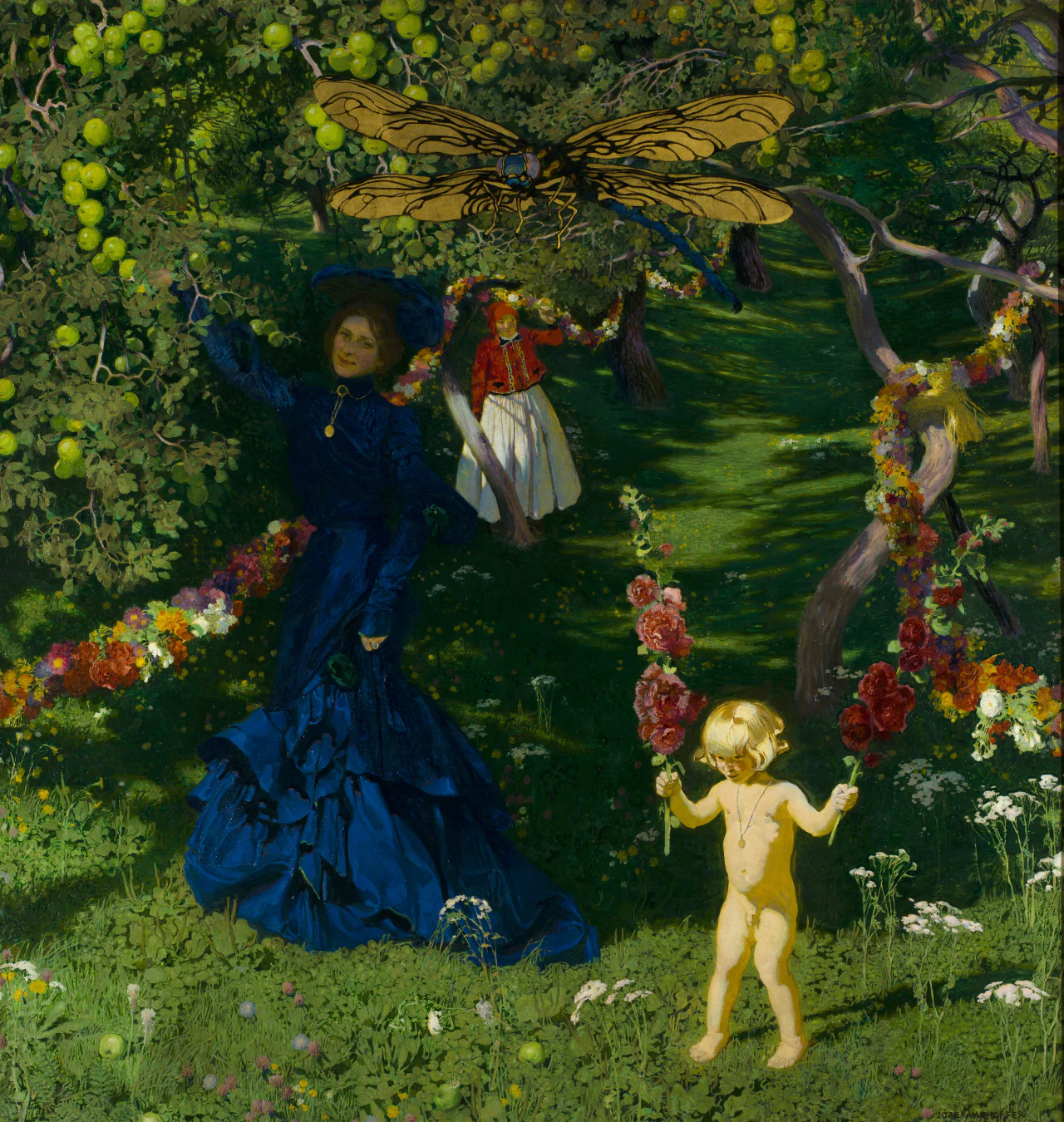
In 1903, Marysia got a white apron. She had already been standing in Józef Mehoffer’s Strange Garden for a year, small and red at the center of the orchard. The painting had even appeared in a Vienna exhibition. Mehoffer reopened the scene the following summer, brightened the nurse with that apron, scattered meadow flowers near his wife’s feet, and only then signed the canvas with its final date. The family holiday resumed because its painted version still needed work.
The revision is minor enough to be funny. Marysia does not acquire a new face, action, or importance. She gets a patch of white that keeps her body from vanishing into green shade. The lawn, already dense, receives more bloom. Mehoffer adjusts visibility and abundance, the two practical needs of a spectacle. His garden can be approached as a stage whose production values have become so lavish that a dragonfly hangs over the cast like a piece of golden machinery.
Nothing about the original setting required theater. During the summer of 1902, Mehoffer stayed with his family at Sielec, now Siedlec, near Krzeszowice. The orchard belonged to their rented house. The woman in sapphire is his wife, Jadwiga. Their two-year-old son, Zbigniew, known at home as Żbik, carries hollyhocks in the foreground. Marysia, his nurse, follows farther back. These are the people who were there, in a place they occupied together. Yet the finished painting, more than two metres high and two metres wide, gives their walk the scale of a public appearance.
The cast enters on a diagonal. Marysia stands furthest up the path. Jadwiga advances below and to the left, leaning into the apple tree. Żbik has reached the bright front edge on the right. Their positions suggest three moments of one entrance, as if childhood, adulthood, and hired care had been released from the wings at measured intervals. None of them looks at another. Marysia faces out, Jadwiga turns her face toward us, and Żbik attends to the ground under his bare feet. They share the route without sharing a glance.
Costume separates them more sharply than distance does. Marysia wears a red bodice over white. Jadwiga’s sapphire visiting dress swells into a train of layered folds, grand clothing for passing beneath low branches. The blue is so deep in the shade that her torso nearly disappears, leaving her face, raised arm, pendant, and lower sleeve to emerge as isolated cues. Żbik wears only a small chain. Sunlight models every soft crease of his body. The painting assigns one figure folk dress, one fashionable ceremony, and one radiant nakedness. A country walk has become a procession of roles.
Jadwiga’s raised hand looks designed for this production, though it began in fatigue. Earlier drawings show other positions for her arms. Jadwiga later recalled growing tired during the pose and lifting her hand toward an apple bough to steady herself. Mehoffer retained the movement. The accident was useful because it connected everything: the dark sleeve rises into the fruit, the elbow opens a curve around her face, and the hand seems to draw the loaded branch down toward the family. An attempt to stop posing became the pose that organizes the scene.
That conversion of ordinary action into display continues around her. Żbik holds a tall flower stem in each hand with his arms spread, an entrance made more precarious by the uneven grass. Behind him, long chains of blossoms cross the orchard, loop around trunks, and return at intervals through the green. They behave less like plants discovered where they grew than like decorations brought forward to make growth legible. Even the apples crowd the upper edge in lit clusters, enlarged by their proximity until the canopy resembles a heavy border hung above the action.
The orchard supplies its own scenery while refusing natural depth. A path opens from the figures toward the upper right, but stripes of light keep interrupting it. Pale trunks lean across the route. Dark foliage closes the distance that the diagonal tries to establish. Meanwhile, the flower chains run laterally and insist on the picture’s surface. In Mehoffer’s murals and stained glass, line and color carry monumental designs. Here, depth remains available for the family’s entrance, then ornament pulls the whole production forward again.
The lighting has equal authority. Żbik occupies a hard pool of yellow sun, so bright that his hair seems almost white. Jadwiga stands under the canopy in blue-black shade. Marysia receives a smaller, cooler light, helped by the apron added in 1903. Across the empty path, alternating bands of green shadow and acid brightness resemble a lighting plot laid on the ground. One summer hour separates into three assigned intensities.
Then the lighting equipment enters the picture.
The dragonfly spans the upper center with four gold wings outlined in dark veins. It has a blue body, jointed legs, and enough insect detail to be recognized at once. Its scale, however, refuses the orchard. It is wider than Jadwiga’s shoulders and nearly as wide as the child is tall. The wings do not shorten as they recede, and the thick contour has little in common with the broken brushwork of leaves behind it. It looks attached to the face of the painting, hovering in front of the garden rather than flying through it.
Mehoffer gave this contraption a job. When he exhibited the work in Munich in 1905, he used the title Sun, and the dragonfly was meant to stand for that light. The explanation clarifies very little in visual terms, which is why it remains useful. A normal sun would sit somewhere beyond the orchard and illuminate it from a distance. Mehoffer’s sun has wings, moves to the front, and shows the apparatus. The source of the family’s brilliant day becomes the least natural object in it.
No one below reacts. Żbik does not point; Jadwiga does not look up; Marysia continues her approach. Their disregard keeps the dragonfly from joining the anecdote. The dragonfly belongs to the production that contains them. It hangs where a proscenium would cross the view, framed by apples and branches, directing gold across the width of the canvas. If it feels watchful, that effect comes from its frontal position rather than an eye we can read. It faces the same way as the painting.
This staging changes the usual meaning of a family keepsake. The painting preserves a day through conspicuous arrangement. Mehoffer enlarged his wife, son, and nurse, dressed them into separate visual registers, converted a tired reach into choreography, handed the child floral props, and returned after an exhibition to improve the supporting player’s costume. Affection passes through these arrangements. It gains ceremony from them.
The painting’s title acknowledges the result more honestly than Sun does. The garden is strange because everything in it is both local and overproduced. The apples came from an orchard beside a rented house; on canvas they form a canopy fit for an entrance. A family member paused against a branch; the gesture became the hinge of a monumental design. A nurse walked behind a child; one year later, Mehoffer made sure her white apron could still be seen from across a gallery.
Near the lower right, the signature records 1903, the year of those final adjustments. Above it, Żbik steps forward carrying two hollyhock stems, while the great false sun holds its position over the route. The second summer remains present in the extra flowers, the sharpened costume, and the date Mehoffer chose only when the garden was ready to open again.