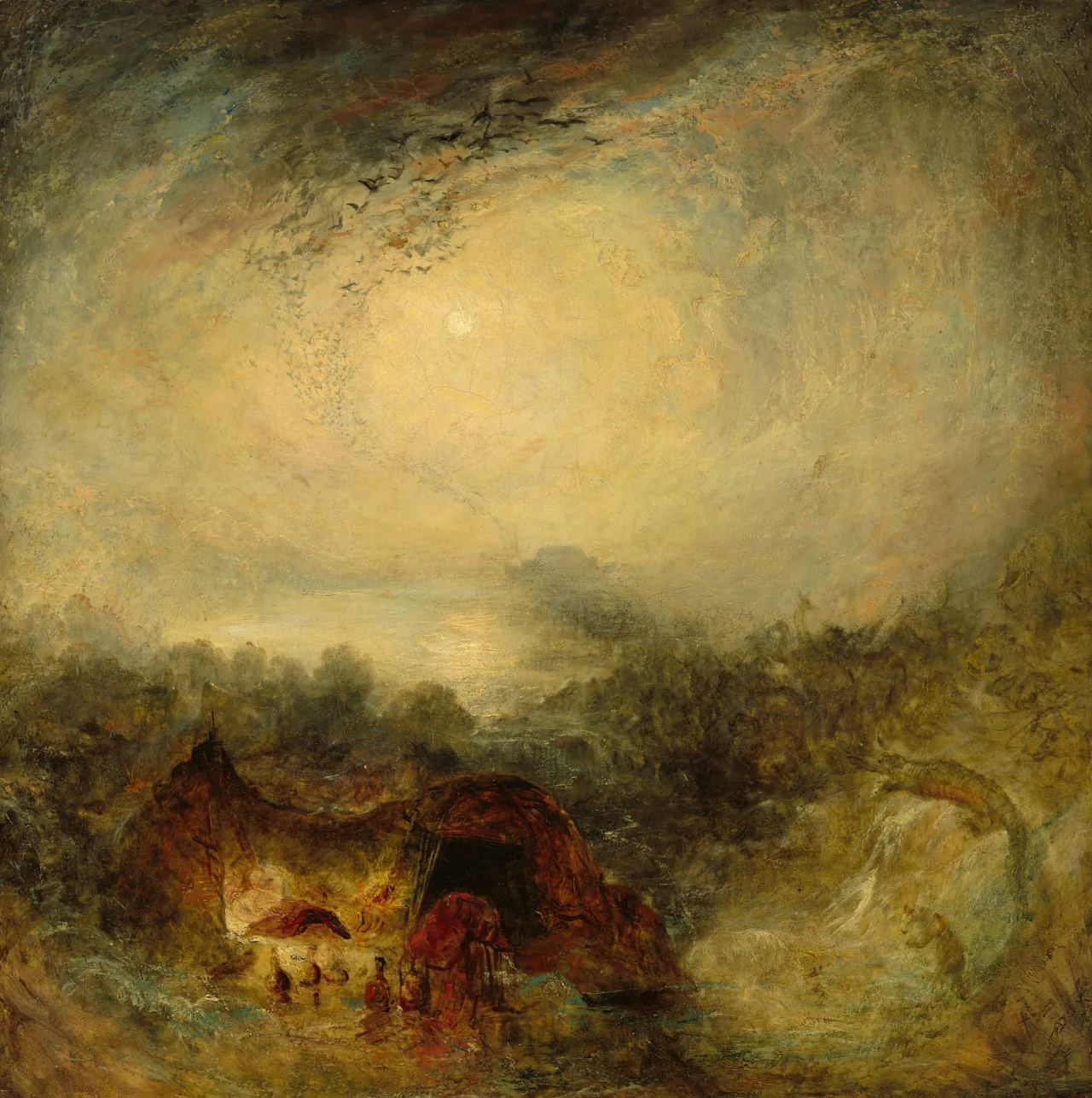
The alarm has reached nearly everyone in J. M. W. Turner’s The Evening of the Deluge. Birds lift from the upper left and wheel around a pale disk. Animals push through the lower country toward a dark ark. Water shines between them. At the front, where red and yellow paint gives the scene its only concentrated warmth, a couple sleeps inside a tent.
A tent is the painting’s absurd object. It is a respectable answer to night, wind, and ordinary rain. Against the Flood, it is cloth arranged around a misunderstanding. Turner places it close enough to inspect: a low curved roof, an opening blackened by shade, and bodies tucked beside or within it. The ark sits much farther away, a blunt little block near the horizon. One shelter offers comfort now. The other has been built for what comes next.
The couple’s sleep gives this grand biblical weather a domestic fault. No gesture of terror redeems them. They have settled beneath the structure that resembles a bed most closely, while the creatures around them have begun to leave. It is possible to read their stillness with pity. Exhaustion can survive an emergency. Yet the distance between tent and ark keeps a harsher reading available: they have mistaken feeling sheltered for being safe.
Turner makes the mistake attractive. Thick reds, browns, and ochres gather around the tent and sleepers. The paint catches in folds and ridges, holding light where a fire might hold it, although no flame needs to be imagined. The ark receives none of this material hospitality. It is grey, compact, and remote. Looking therefore repeats the couple’s bad preference. The eye goes first to the warm lodging and only later discovers the useful one.
The animals complicate the joke because they are difficult to name but easy to understand as a crowd in motion. Pale backs, dark snouts, lifted necks, and long reptile-like bodies surface along the lower edge, then sink into earth and water. The National Gallery’s visual description cautiously finds suggestions of a bear, crocodile, and giraffe among them. Exact species matter less than direction. John Hayes, writing in the Gallery’s catalogue, identifies the animals as wading out toward the ark. Their smeared bodies perform the practical intelligence that the sleepers lack.
Above, the birds turn evacuation into pattern. The first are broad black marks with wings. Farther along the curve they shrink, multiply, and approach a loose script. The flock bends around the light, so flight and weather appear to share one circular current. Turner had used a spiral of birds in an earlier painting to accompany his line, “The roused birds forsook their nightly shelters screaming.” Here the visible action is enough. The birds have left their shelter; the couple has improved theirs with a roof.
An auction catalogue of 1872 called this picture The Animals going into the ark-circle. The phrase was recorded two decades after Turner’s death, so it cannot safely be treated as his instruction. It remains a remarkably useful piece of accidental criticism. The animals go somewhere. The circle goes everywhere. Ark, flock, cloud, water, and land are pulled into a rotation that gives the scene enormous activity without bringing the sleepers any nearer to safety.
The square canvas nearly submitted to that rotation. Shallow diagonal grooves cross all four corners beneath the upper paint. X-radiographs confirm that the original support always remained square, but Turner considered an octagonal design like the shape used for the related Deluge paintings now at Tate. An octagon would have clipped the corners and tightened the storm around its center. He left this version square, with the attempted boundary still buried in its skin. Even the edge of the picture records an argument about how completely the circle should close.
Inside that edge, Turner built unlike kinds of attention from unlike kinds of paint. The support consists of two pieces of plain-woven canvas under a thick white ground. He worked with brush and palette knife, laid opaque masses beside thin glazes, blended passages while wet, and probably used some watercolor. The method lets the foreground congeal while the sky remains permeable. Tent, sleepers, and animals accumulate as deposits. Light crosses the upper field without settling into a firm object. The couple has chosen the part of the world that feels most solid, although solidity has become a local effect of pigment.
This canvas appears to precede the evening subject shown at the Royal Academy in 1843. The exhibited Shade and Darkness was paired with the radiant morning scene Light and Colour (Goethe’s Theory). Its colder, darker tonality produced a stronger opposition to the companion work. The Washington canvas is lighter. Its attribution was questioned in the twentieth century, then accepted by leading Turner scholars as almost certainly a first version. Hayes went further: it is nearly the same size as the Tate canvases and equally finished, perhaps superseded because its luminosity weakened the intended contrast between evening and morning.
That practical exhibition problem preserved a different kind of Deluge. In the darker picture, the evening’s force belongs more completely to shade, cold color, and vortex. In Washington, the tent, ark, animals, and sleeping bodies remain clearer. More light does not make the story hopeful. It allows the embarrassing parts to survive: the ark has been noticed by the animals, the birds have abandoned their roosts, and two people have made themselves comfortable in the wrong architecture.
Turner gives no account of whether they wake. The picture holds them before that decision, under a roof whose rich paint makes it more persuasive than the vessel waiting across the water. By the time the eye reaches the ark, it has already spent its closest attention on the shelter that cannot float. Safety occupies the poorer address, while warmth, color, and human attachment remain gathered around the tent.