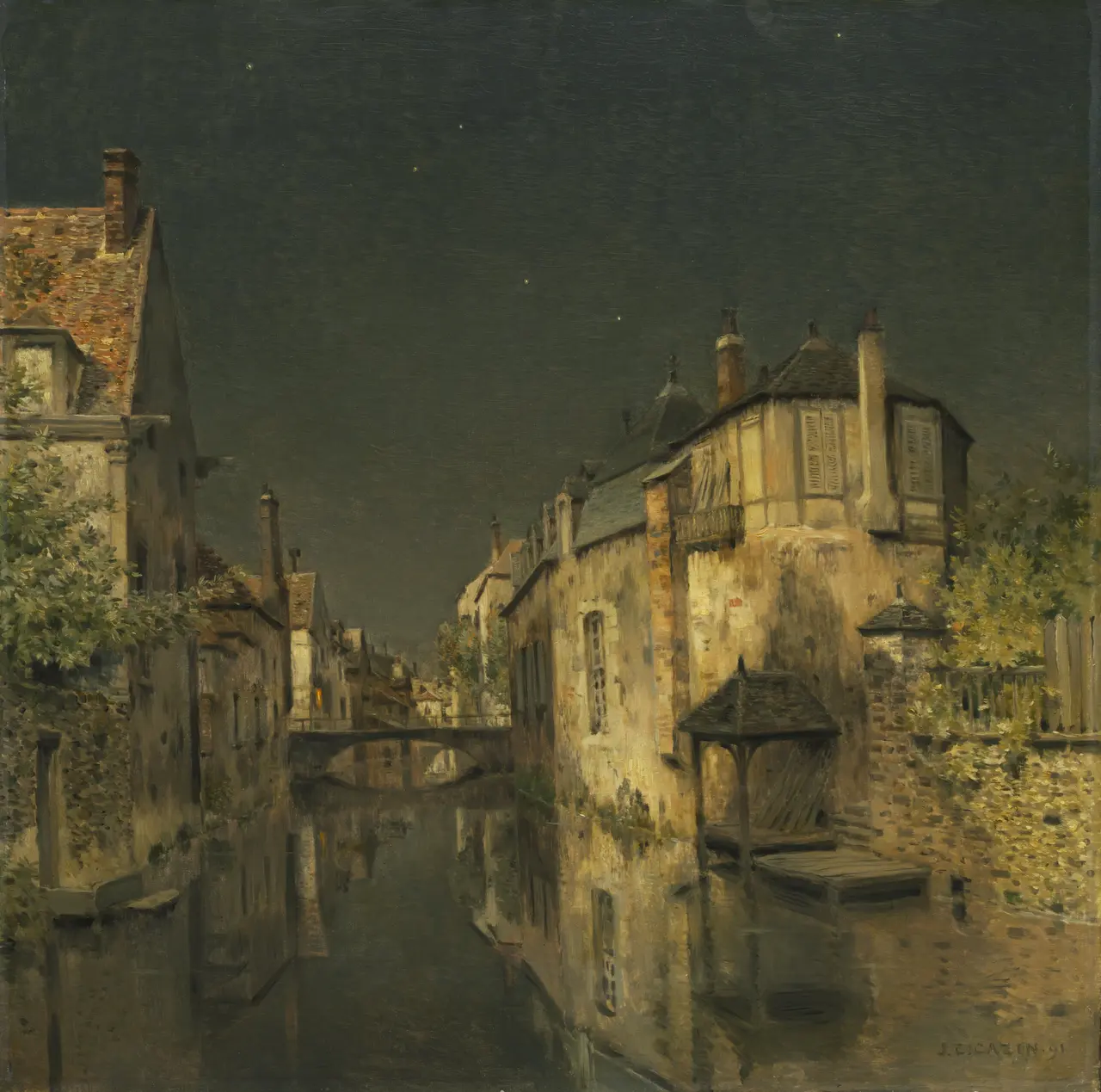
The water is the first thing to hold the eye, even though it is almost black. In Jean-Charles Cazin’s Midnight the canal fills the lower half of a near square canvas, 88 by 89 centimeters, and it does not move. Its surface is a flat plane of brown black that carries the reflection of the buildings on the right with a steadiness that real night water rarely has. The tan stone walls, two chimneys and a run of uneven roofs repeat upside down in the canal with only a slight tremor, as if the water were a second, darker sky laid on the ground. On the dock at the right, a small wooden shelter, dark and boxed, sits at the edge where wall meets water, with no lamp burning in the shelter, no figure waiting and no boat passing. The left bank is a mass of shadowed foliage and a wall that is more suggestion than description. In the distance a low stone arch frames the canal’s continuation, and above it a few lit windows punctuate the darkness without illuminating it. The sky is a matte grey that is lighter than the water but hardly luminous. Five pale points, placed with restraint, mark stars.
The night is subdued and even, without moonlit cloud, storm or theatrical chiaroscuro. Cazin, who signed the canvas at lower right j. c. cazin. 91, keeps the palette tight and the handling thin. Oil on fabric, as the Cleveland Museum of Art records it, is laid in even, fused passages rather than broken impasto. Greys, warm ochres, muted blues and the soft black of the water are modulated so closely that the painting can look at first like a monochrome. The effect is quiet in a way that takes a moment to register as constructed. The canal at Abbeville, a northern French town near Boulogne-sur-Mer known for its waterways and brick architecture, was a working place. Boats, towpaths, workshops and the traffic of a port city would have filled it by day. At midnight Cazin shows it emptied, and the museum’s description notes that the title and the image suggest silence and stillness, Cazin’s hallmarks, and that only rarely did he attain this almost surrealistic atmosphere. The word surrealistic records the feeling the picture gives before analysis, describing its quiet exactness. Something about the exactness of the reflection, the perfect squareness of the format and the absence of incident makes the scene look remembered rather than witnessed.
A night remembered in the studio
Cazin preferred to paint in his studio using memory, a habit learned in his training and later passed to his own students. The museum’s did you know panel states it plainly, and the collection text links it to his education at the Ecole Gratuite de Dessins in Paris, where Horace Lecoq de Boisbaudran taught drawing from memory. Lecoq’s method, developed in the 1840s and published as L’Education de la mémoire pittoresque, asked students to look hard, then draw without the model, then check and correct. It trained retention of proportion, tonal relation and spatial intervals rather than transcription of surface detail. Cazin entered that school after early study in Boulogne-sur-Mer, England and Lille, and by 1863 he was living in Paris and sending a landscape to the Salon des Refusés. In Lecoq’s studio he worked alongside Henri Fantin-Latour, Alphonse Legros and Auguste Rodin, a cohort the Cleveland biography notes as sharing an interest in Symbolism, the movement that sees symbols in reality and perceives reality through symbols.
Memory training is a disciplined way of holding observation until it can be rebuilt in the studio, a relationship between looking and making that depends on retained intervals rather than immediate transcription. Cazin could walk the canals of Abbeville, note the way the wall meets the water, the spacing of chimneys, the small shelter that punctuates the dock, and then reconstruct those intervals in the studio without the pressure to record shifting light or passing figures. The result is a studio synthesis that clarifies the underlying structure and lets incidental detail fall away. In Midnight the structure is the repetition of vertical walls and their horizontal reflection, the narrow recession to the arch, and the band of sky that holds the stars. Each interval is even and deliberate. The water is not rendered with ripples that would indicate a breeze, because a remembered image of stillness wants the reflection to stay intact. The foliage on the left is massed into a single dark shape because its particular leaves matter less than its function as a shadow that balances the illuminated walls on the right.
This explains why the painting feels both specific and generic. The buildings are recognizably the modest brick and stone of a northern French canal town, with no Haussmann grandeur and no picturesque ruin. Yet they are not portraits of individual houses. Their windows are suggested as darker rectangles, their chimneys as simple blocks. Cazin leaves enough architecture to anchor place but not enough to invite anecdote. The shelter on the dock is emblematic of that choice. It is ordinary carpentry, dark wood, a single door, a low roof. In a plein air sketch it might have been rendered with weathered texture and a cast shadow. Here it is a solid, almost abstract rectangular volume that rhymes with the chimneys and the distant arch. Its darkness functions as a tonal weight that steadies the right side against the light of the walls.
The Lecoq lineage also clarifies Cazin’s place between schools. Art histories often place him awkwardly between late Naturalism and early Symbolism, sometimes with a nod to his English period. After the Franco Prussian War devastated the country in 1870 to 1871, Cazin and his wife Marie Guillet, herself a painter who had studied with Rosa Bonheur, left for England. There he made ceramics influenced by Japonisme to support the family, eventually hiring staff to produce the blanks he decorated. That practical turn matters because it shows a painter accustomed to controlling an entire surface and sequence. When he returned to France in 1875 and settled near Boulogne-sur-Mer, he painted the dunes, beaches and nearby towns with a method that valued overall tonal unity over captured instant. Honors followed, the Légion d’Honneur in 1882, a gold medal at the Universal Exposition of 1889 and a Grand Prix in 1900, but they did not make him a central figure in the Paris avant garde. He was respected for what the 1911 Britannica would later call his combination of luminous landscape with figure subjects and his poetical treatment of landscape and seascape in a tonal key. Midnight, with no figure at all, strips that luminous figure subject away and leaves only the tonal field.
What Abbeville gives and what Cazin removes
Abbeville lies inland from the Channel, about twenty kilometers from Boulogne-sur-Mer, where Cazin spent the last decades of his life. Its canals are engineered rather than romantic, straightened for transport, lined with working walls rather than ornamental quays. The painting honors that engineering. The canal is straight, the walls are sheer, the arch in the distance is plain. There is no curve introduced for pictorial grace. The viewpoint is frontal and level, as if the painter stood on a bridge and looked down the axis of the water. The view is a working view organized by interval, with straight walls and a plain arch that record engineering rather than picturesque irregularity.
The museum’s text notes that he specialized in landscapes often influenced by his knowledge of English and Dutch painters, a phrase that points to seventeenth century Dutch canal scenes as much as to contemporary English tonalism. Dutch painters like Van der Neer filled nocturnes with modest activity, a lit interior, a boatman, cattle. English painters of the 1870s, including Whistler in his Thames nocturnes, reduced activity to suggestion but kept the river as a social space with distant lights and drifting forms. Cazin goes further toward withdrawal. The five stars are the only lights in the sky. The few illuminated windows in the walls are dim points, not sources of radiance that spread into the water. No smoke rises from the chimneys. No reflection is broken by a wake. The painting asks the viewer to accept that at midnight a town can appear uninhabited.
That acceptance is easier because the format contains it. The near square, 34 and five eighths by 35 and one sixteenth inches, gives equal weight to water, walls and sky. A more horizontal format would have emphasized recession and implied a journey along the canal. A vertical format would have stressed the sky and its stars. The square holds the three bands in suspension. Water occupies roughly the lower half, walls the middle, sky the upper quarter, but no band dominates. The eye moves from the dark foreground water up the reflection to the walls, across to the shadowed left bank, back to the arch and then to the stars, and then repeats the circuit. Without a figure to direct attention, looking becomes a slow patrol between these zones, and the slowness itself is the content.
Color carries the same restraint. Cazin does not use the saturated blues of a later expressionist night or the broken complementary flecks of Neo Impressionism. The sky is a grey that leans toward warm beige at the horizon and toward a cooler slate directly above the walls. The water picks up that temperature but deepens it with brown and a touch of muted blue green. The tan walls hold a dusty, weathered tone that reflects the sky without becoming a highlight. Even the stars are not white but a pale, slightly warm grey that sits inside the sky rather than on it. This is tonal painting in the literal sense, where value relations matter more than hue. It is what allowed contemporary critics to speak of Cazin’s luminous landscape without referring to brightness. Luminosity here is a product of close value control and of the studio’s ability to hold tones together without the competition of real dusk.
A quiet that has a history
When Midnight was new it was not a private exercise. It was exhibited at the Salon at the Champ de Mars in Paris in 1891 as Minuit, with a reproduction. Two years later it crossed the Atlantic for the World’s Columbian Exposition in Chicago in 1893, shown as Midnight Moonlight Abbeville and lent by Charles T. Yerkes of Chicago. Early records trace it from the Paris dealer Knoedler to Philadelphia and then to Yerkes in Chicago by 1893. After Yerkes’s estate sale in New York in 1912 it passed to Edward S. Harkness, and in 1923 it entered the Cleveland Museum of Art as part of The Charles W. Harkness Gift.
The shifting titles register how hard it was to name this kind of night. Night with Stars, Night, Midnight Moonlight, Moonlight at Midnight, Midnight. Each seller tried to attach a more marketable cue, stars or moonlight, even though the painting shows no moon. The final title, the one Cazin gave it, is the most accurate and the least descriptive. It does not promise a celestial event but a time when events have ceased.
The early exhibition history also shows that the painting was visible in the two most important arenas for a French artist of the moment, the Paris Salon and a major world’s fair, yet it did not secure a lasting reputation. Cazin’s larger decorative landscapes with figures, such as his illustrated Judith cycle or his dunes with women, were better known and more frequently reproduced. A quiet, nearly empty canal at night offered little narrative for critics who wanted either a modern subject or a clear symbol. It is not surprising that the work settled into a museum collection and then into storage, where it remains not on view.
That museum quiet is part of why the painting can be looked at anew. Unlike more famous nocturnes that have accumulated layers of interpretation, Midnight arrives with little critical baggage. The Cleveland catalogue entry by Argencourt and Diederen in 1974 gives it a concise place within European painting of the nineteenth century, reproducing it and noting its dimensions and media, but it does not propose a grand thesis. The museum’s own description lets the Symbolist interest sit lightly, suggesting that Cazin and his classmates shared a sense that symbols can be found in reality rather than applied to it. An empty canal at midnight can be a symbol without being coded. Its stillness can stand for inward attention, for the interval of night that belongs to no labor, without requiring a dictionary of meanings.
How to look now
The painting rewards attention that is patient rather than searching. Stand close enough to see the surface, which is surprisingly smooth for an oil of this period. There is no heavy impasto where light strikes, no scraped highlight that would assert the hand. The brush moves in thin, blended passages that keep edges soft. The line where wall meets sky is not a hard contour but a gradual change of value. The line where wall meets water is more precise, because the reflection demands it, but even there Cazin does not use a drawn edge. He lets the darker water and the lighter wall define one another through tone alone. The five stars are the only passages where a distinct touch is visible, small round dabs that sit on the sky without a halo.
It is the result of holding an image in memory until unnecessary incident falls away, a handling that reflects sustained retention rather than hesitation. The French writer Théodore Child, discussing Cazin in Harper’s Magazine in 1890, noted the painter’s combination of landscape with figures and his growing reputation for idealist subject painting. In Midnight Cazin tests whether landscape alone, without figures, can carry that idealist charge. The ideal is an interval of attention that is usually lost between day and night, between work and sleep. The canal is not beautified. Its walls remain plain, its water dark, its shelter utilitarian. What is idealized is the condition of looking, the length of time one is willing to keep the eye on a dark surface to see how many greys it contains.
For a contemporary viewer who knows the light pollution of cities and the glow of screens, the painting’s darkness has an additional force. Most nocturnal images now are captured with long exposure or enhanced sensors that pull detail from shadow and create a brightness the eye never saw. Cazin does the opposite. He holds the night at the threshold where the eye must adjust. The tan walls remain visible because remembered light is stronger than physical night would permit, yet they do not become daylight. The water stays dark enough to be water at midnight. The stars are few because in a canal town with walls so close, only a narrow strip of sky is visible. The painting keeps tones close enough that the viewer supplies the darkness as an act of perception, remaining nocturnal without artificially darkening the image.
That act can be tried again after leaving the museum image. Walk along any narrow urban waterway at night, where walls rise directly from the water and a single streetlight or window is the only source. The reflection will be more broken than Cazin’s, disturbed by current, wind or the passage of a distant train. The sky will show fewer stars or none. The shelter, if it exists, will likely be metal and lit. Yet the interval that Cazin isolates will be there, the repetition of wall in water, the arch that limits recession, the band of sky that feels shallow because darkness compresses distance. His memory method universalizes a local canal. Abbeville provides the interval, but the studio provides the stillness.
Cazin’s later career near Boulogne confirms the locale as more than backdrop. The dunes and skies of the Boulonnais, which he painted repeatedly in the 1880s and 1890s, are a landscape of open horizontals and diffuse light, the inverse of the enclosed verticals of Midnight. That he could move between the open dune and the closed canal suggests a painter who understood that atmosphere is not only weather but enclosure and interval. Midnight compresses atmosphere into a slot between walls. The dunes expand it across an open field. Both depend on the same tonal control.
There is a final, small fact that steadies the reading. The inscription low on the right, j. c. cazin. 91, is written without flourish, in the same muted dark as the water. It does not assert authorship over the scene. It marks the time and maker as quietly as the shelter marks the dock. In a painting that could be mistaken for a stage set, that small, even signature reminds the viewer that the image was made in a room, from a sustained act of recollection, and then released to stand as if it had simply been found at midnight.
To keep looking at Midnight is to keep a night that would otherwise pass without notice, with the canal empty, the water holding the walls without ripple and the five points of light staying where Cazin placed them. The painting rewards the kind of attention its maker trained himself to give, a look held long enough that memory, rather than the incident of the moment, determines what stays visible.