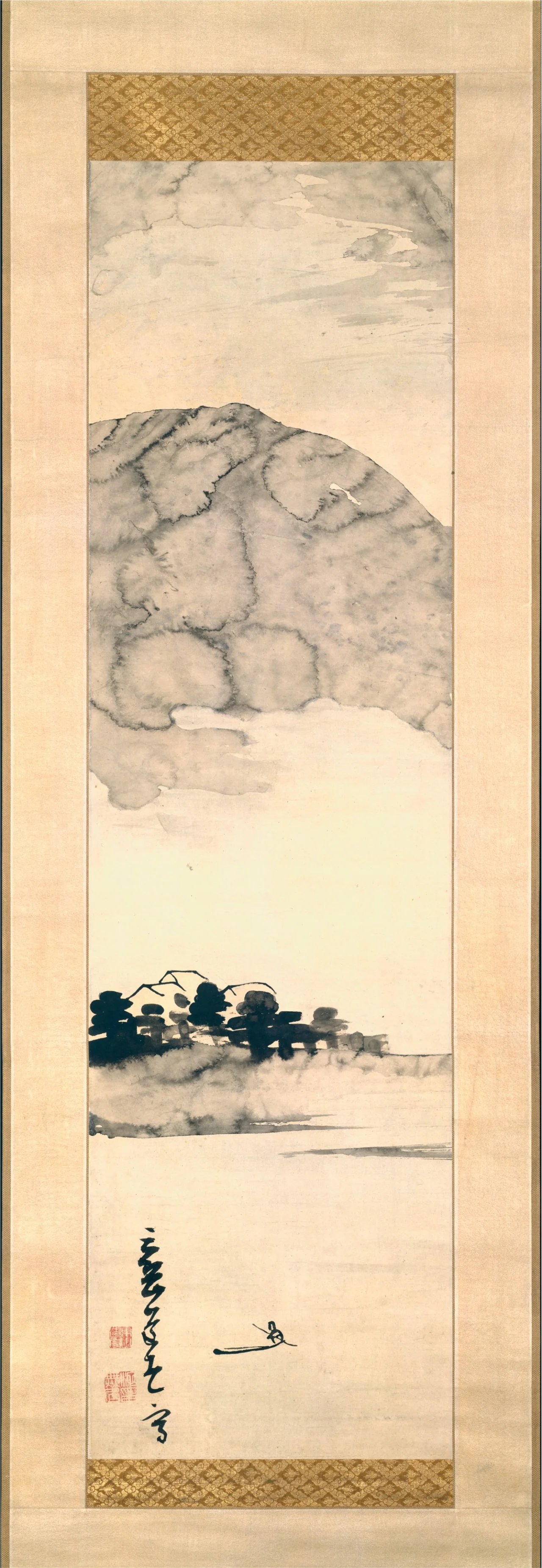
The mountain in Ike no Taiga’s Finger Painting of a Landscape changes its manner of appearing from one passage to the next. A broad gray body swells across the upper middle of the scroll. Dark, branching rims divide it into wet compartments. Ink gathers along their edges, diffuses into paler pools, and sometimes ends in a ragged tide line. Lower down, trees become blunt knots. Roofs cross them in a few thin angles. Near the bottom, a boat contracts to several light strokes. One landscape holds all these kinds of marks, yet no smooth sequence of brushwork joins them.
Taiga made the work with his fingers rather than relying on a brush. That fact can sound like the premise of a display, a feat meant to make the hand more interesting than the image. The scroll directs attention instead toward the uses of a restricted method. A fingertip meets and releases wet ink differently from the flexible point of a brush. Taiga lets those conditions govern how each part of the landscape comes into being. The changing pressure, breadth, and liquidity of contact become a means of separating mass from structure, and nearness from distance.
The largest form shows the method at its least linear. Its rounded shoulder enters from the left edge and expands until it nearly fills the painted field. Inside it, dark seams wander around pale cells. Their courses are irregular, but their accumulation gives the slope weight. The Metropolitan Museum of Art identifies the wet process here as tarashikomi, in which ink is added while an earlier layer remains wet. The deposits bloom, meet, and settle at speeds the hand can guide but cannot fully regularize. Broad contact and liquid movement give the mountain its physical density.
This density depends on variation within a narrow range. The gray wash is translucent enough for the paper to keep lighting it from beneath. Dark ink has collected at the boundaries, while softer traces float within the broad body. Several pale openings interrupt the surface. The mountain therefore seems both compact and permeable, an expanse of stone made from liquid behavior. Its divisions do not explain geology. They register successive contacts and flows, giving the form an internal movement that continuous modeling might have stilled.
Finger painting had a history before Taiga. It developed in China and was later adopted and refined in Japan by painters working from Chinese literati models. Taiga was a pioneer of Nanga, a Japanese literati painting practice shaped by those models, and his work ranged widely across techniques and compositions. The Kyoto National Museum notes that in his late twenties he often used fingers and fingernails, and that the reduced freedom of finger painting mattered to the formation of his later style. This scroll is dated only to the eighteenth century, so it cannot be assigned securely to that early period. The broader history still changes what its method means. Direct touch was not an escape from learned painting. It was one way of testing what a learned landscape could become when a familiar instrument was withheld.
Beneath the mountain, the method shifts toward a compact settlement gathered around a strip of dark ground. The trees are pressed into dense, rounded marks, some almost opaque. Their close spacing produces a band of resistance after the diluted mountain. Angular roof lines thread across and between them. These narrow strokes bear just enough detail for a few changes of direction to establish built structures amid the foliage. Touch supplies the heavy clusters; line supplies the roofs. Their difference keeps the settlement legible without loosening its compression.
Between mountain and settlement lies a long interval of nearly untouched paper. The mountain stops. The settlement begins far below. That separation makes the scroll’s empty field active as distance. Because the upper form is so large and the lower cluster so concentrated, the paper between them holds open air with little description of sky, mist, or water. Scale and placement extend the space across the unmarked sheet.
The pale horizontal washes around the settlement shift the same open field toward water. Some spread in soft bands beneath the trees; others extend to the right as narrowing traces. They do not close into a firm shoreline. The dark cluster seems to rest within a wider, lightly moving plane. Below it, the boat sits alone. Its hull is a shallow line, its passenger or fitting a small upright turn. The boat’s marks are spare enough to remain vulnerable to the blank paper around them. Its size fixes the reach of the landscape more decisively than added description would.
Here the restricted tool creates a useful division of labor. Wet contact enlarges the mountain and presses foliage into compact masses. A narrow linear touch reduces the boat to the minimum needed for recognition. Empty paper carries the intervals between them. Each abrupt change of contact resets the landscape’s scale, from the breadth of the slope to the slight hull in open water.
The upper part of the painted field widens that range again. Above the mountain, pale wash drifts across the paper, with darker liquid edges collecting near the top. Thin, unpainted openings remain inside the wash. They resemble breaks in cloud or light without requiring a fixed reading. Their irregular edges echo the wet boundaries within the mountain, but their lower density produces another kind of space. The same behavior of diluted ink that gives the mountain a heavy, divided body can become dispersed weather when it is allowed to thin across open paper.
Touch functions here first as a practical condition. Fingers, nails, and palms could make different kinds of contact across Taiga’s finger-painted work, while the precise source of each mark in this scroll remains uncertain. The title identifies the painting method, but it cannot establish the tool used for every part of the mounted object. The visible landscape shows a disciplined use of uneven capacities: pooling, spreading, pressing, and drawing remain distinct. Their placement gives the work its coherence.
The mounting makes that placement especially clear. Patterned textile bands close the narrow painted field at top and bottom, and the surrounding fabric keeps the landscape visibly vertical. The eye must travel through it. Broad wash, rounded mountain, empty interval, dark settlement, pale water, inscription, seals, and boat occupy successive levels, but they do not read as separate scenes. Each level adjusts the measure set by the last. The mountain makes the trees small; the trees make the boat slight; the boat makes the lower emptiness expansive.
Finger painting offers Taiga a way to let the resistance of a method organize an image. Reduced control concentrates judgment in the amount of ink, the pressure and span of contact, the choice to interrupt a surface, and the decision to leave a long reach of paper alone. The mountain’s wet cells, the trees’ blunt density, and the boat’s attenuated line remain visibly unlike one another. Their separation deepens the scroll.
This is the consequence the technique could carry into Taiga’s later visual language. A limit on representation became a reason to invent with breadth, deposit, and interval. Direct touch gave him marks whose behavior resisted full uniformity, and those differences became materials for composition. Across the scroll, each change in contact changes the span of the visible world. The mountain gains mass from pooled ink, the settlement gathers under compressed touches, and the boat’s slight line leaves the surrounding paper open for its long passage.