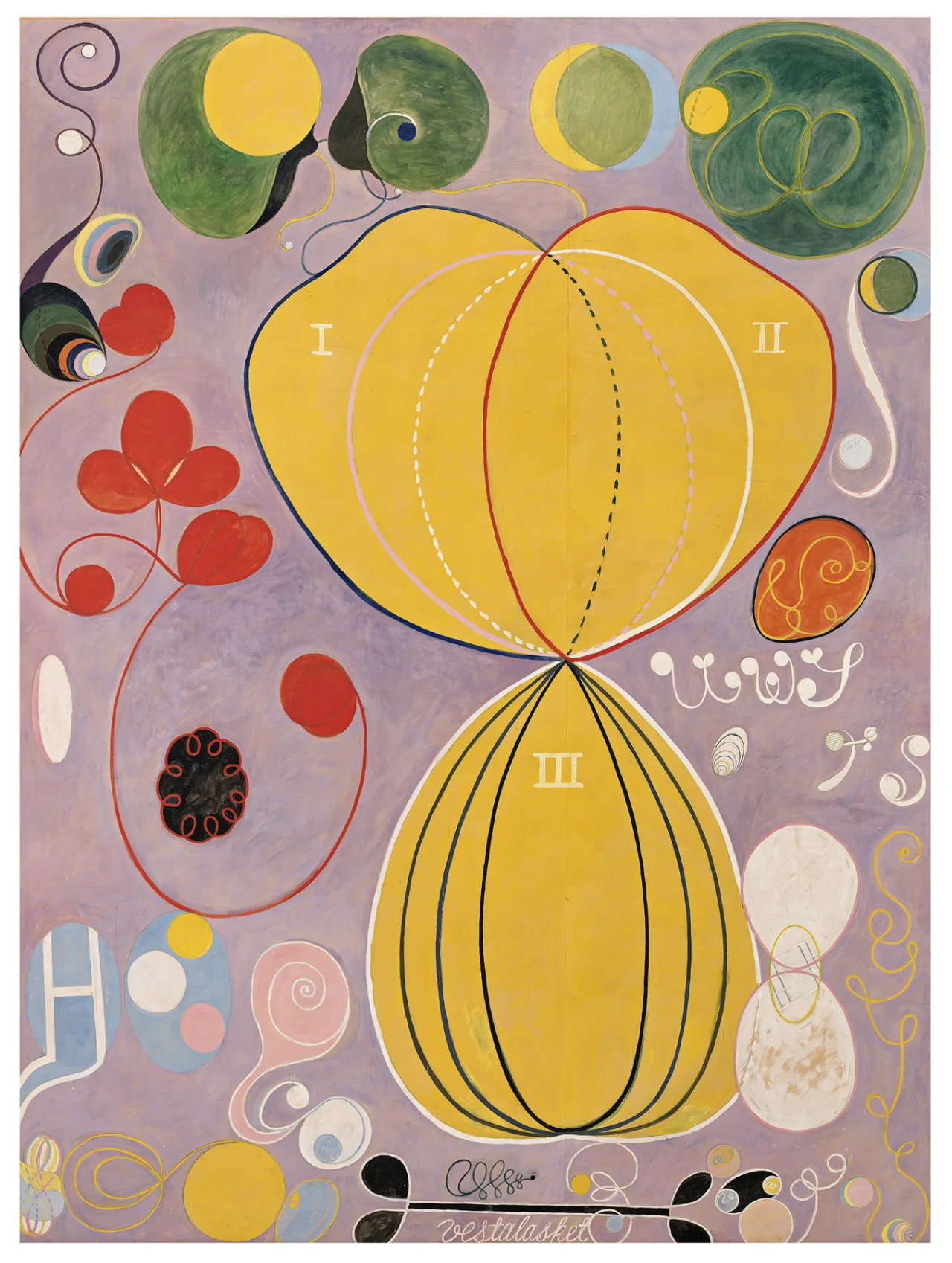
This looks like the largest form anyone has ever forgotten to fill in. Two swollen yellow compartments carry the Roman numerals I and II. A third yellow compartment, marked III, hangs beneath them. Red, white, pink, and dark lines describe routes through the upper pair, meeting at the narrow point where all three sections touch. The apparatus has labels, boundaries, and an evident sequence. What it asks for is anybody’s guess.
I and II: the confident form
Hilma af Klint gave the painting a category more decisive than any of its marks: Adulthood. It belongs to The Ten Largest, her 1907 suite that assigns ten vast paintings to successive phases of life. Four works on purple grounds concern adult life; No. 7 is the third. Seen in that sequence, the numerals acquire the air of an official procedure. Adult life has been sorted, divided, and given fields. The procedure still refuses to become useful.
The painting enjoys that refusal. The upper yellow body resembles a diagram, a fruit cut open, a pair of lungs, or an inflated cushion. Its dark blue edge holds the left side while a red edge holds the right. Within it, one white arc is solid and another breaks into dashes; pink and dark dashed lines lean across each other. None stops at the border between I and II. The compartments announce an order that the colored routes cheerfully ignore.
Around this large administrative shape, the page has been overtaken by its marginalia. Green discs enclose yellow circles, blue dots, and curling forms. A red clover spreads from the left edge. White stalks rise at the right. Spirals uncoil in several corners; an orange oval contains a yellow line that wanders like string dropped on a table.
Some forms suggest seeds, cells, eggs, flowers, eyes, or planets, then lose the resemblance as another contour crosses them. The lavender ground does not separate these events into a clear rank. It lets them crowd one another.
This is an undignified way to picture maturity, and that is part of its pleasure. The colors could furnish a nursery. The loops have the direct charm of doodles. Hearts, balloons, beans, letters, and botanical fragments gather around a monumental center with no concern for adult good taste. Af Klint’s subject is mature life, but the painting has not aged out of play. Its scale makes that choice emphatic. At more than three metres high, a curl that might look idle in a notebook expands beyond the easy reach of a wrist.
u, w, s: the changing key
The apparent doodling came from a disciplined and unusual practice. Beginning in 1896, af Klint worked with four other women in a spiritualist circle called The Five. They used meditation, séances, automatic writing, and automatic drawing while recording messages that they believed came from spiritual beings known as the High Masters. In 1906, af Klint understood one such being, Amaliel, to have offered her a commission. It expanded into the large project she called The Paintings for the Temple. She painted this suite the following year.
That history gives the marks serious stakes without turning them into an answer sheet. Af Klint developed a language of letters, colors, botanical forms, and paired principles across the temple project. The language remained changeable. The Moderna Museet guide notes that one letter or combination could carry different meanings in different settings, so a universal key does not work. In No. 7, the letters u, w, and s recur. Near the bottom she wrote vestalasket, translated by the museum as “Vestal ascetic.” The word can be read; its job in this particular field remains uncertain.
Opacity here is not a failure caused by our distance from af Klint’s notebooks. It is a working condition of the picture. A fixed code would turn each shape into a substitute for a word and bring looking to an end. No. 7 keeps its parts relational. The two upper numerals matter because their fields press together. The lower numeral matters because its compartment touches the others at one pinched point. The small green worlds above matter because their circles repeat and complicate the great yellow curves below. Meaning travels by proximity, rhyme, and interruption before it settles into doctrine.
III: the room on the floor
The painting’s physical production was more organized than its unruly surface suggests. Af Klint used fast-drying tempera on paper mounted on a textile support. Moderna Museet reports that the large sheets lay on the studio floor and that each painting took about four days. The ten works were completed in roughly forty days. Af Klint’s notes name Cornelia Cederberg, one of The Five, and her friend Gusten Andersson as assistants, although the surviving account does not divide their tasks.
The studio joined quick planning and physical coordination on an enormous symbolic surface. A loop at this scale required travel. Paper had to be handled; broad fields had to be covered; long contours had to meet. The lightness of the image was achieved through logistics. Its playfulness survives preparation, speed, and coordinated labor.
Af Klint was fully capable of making a solemn monument. Here she made solemnity share the floor with visual jokes. The yellow center has the authority of an emblem and the soft bulk of an overfilled bag. The numeral III sits on its lower half like a label pasted to produce. At left, a red stem makes an extravagant trip through several round leaves before arriving nowhere in particular. At right, a white flourish seems ready to become handwriting, plant growth, or ornament. Each confident beginning develops into another kind of mark.
The title now exerts a useful pressure. Adulthood often collects systems: timetables, accounts, ranks, diagnoses, family trees, forms with numbered boxes. No. 7 borrows their visual confidence while withholding their efficiency. Its systems overlap with growth, decoration, private language, and the pleasure of making a line wander. This is a reading of the picture rather than a program af Klint left for adult life. It fits what the surface does. Classification remains present, but it never gets the field to itself.
Near the lower edge, vestalasket runs in pale script beneath a long black-and-white bar. Small black shapes cap the bar, and loose loops gather above it. The placement resembles a caption designed to settle the meaning of everything overhead. Instead, the legible word joins the spirals, seeds, numerals, and routes as one more exact part of a system whose use keeps changing. Af Klint gives adulthood a form, then allows every mark around it to keep behaving badly.