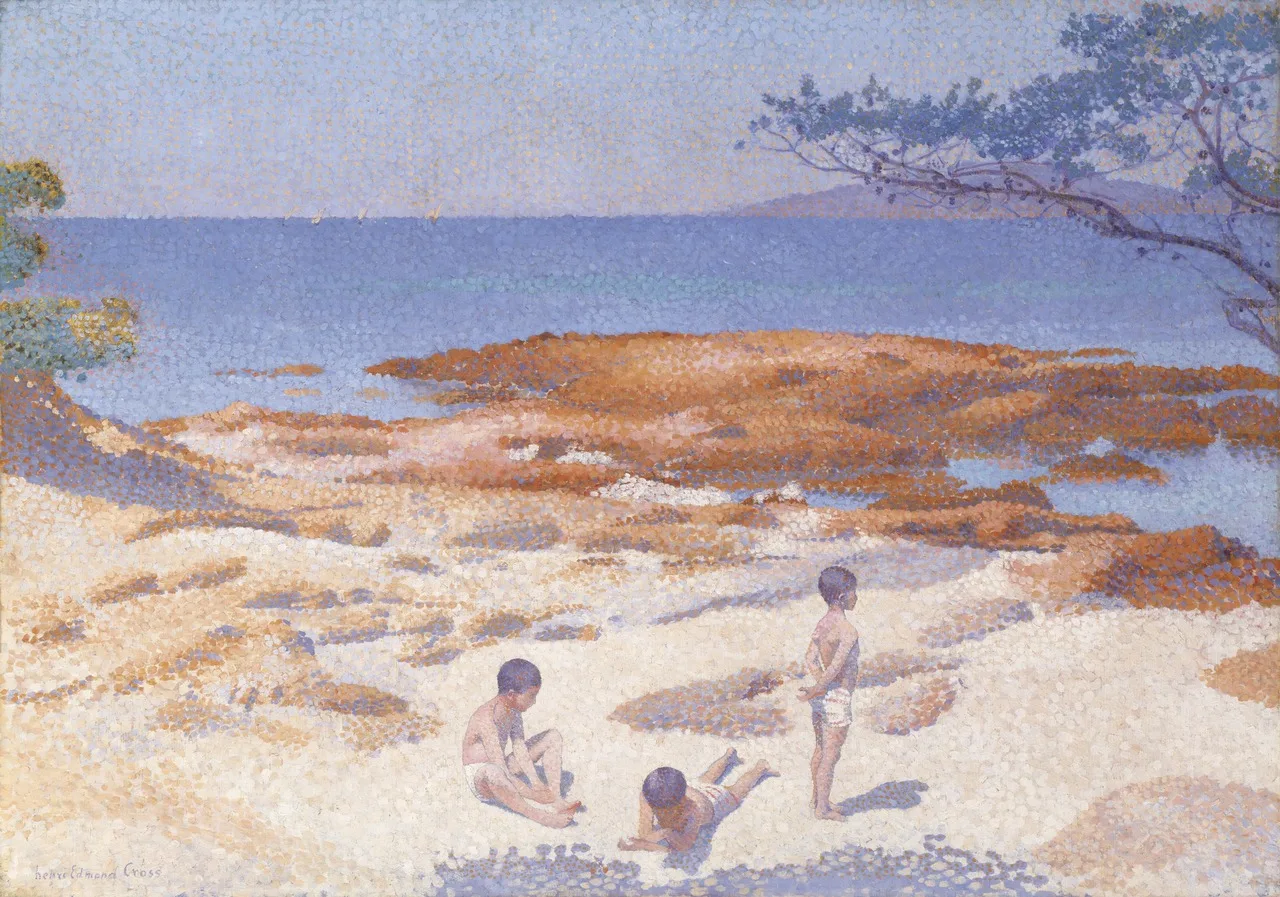
From across the room Beach at Cabasson holds as three quiet horizontals. A pale band of sky sits above a cooler band of sea, which sits above a broad field of sand. The palette stays light and dusty, with ochres and pinks answering blues and lavenders, and the whole reads at first as a calm, unemphatic beach under high sun. Walk closer and the calm opens. The surface separates into thousands of small, distinct touches of color placed side by side. Ochre touches pale rose, rose touches lemon, lemon touches gray on the sand; turquoise touches lavender, lavender touches white, white touches a grayed blue over the water. Close up the horizon thins into a change in density and hue, and the sand meets the water through a shift in which colors keep company and how tightly they are packed.
Cross painted this beach as his life changed place. After years of dark still lifes and portraits in the north, he moved to the Mediterranean in 1891. He chose Cabasson, a hamlet on the Côte d’Azur near Le Lavandou, for the warmth that eased a chronic joint condition. The light there was strong and the coast offered a daily horizon where land and sea reduced to bands. He had already helped found the Société des Artistes Indépendants in Paris in 1884 with Paul Signac and Georges Seurat and others who had stepped away from the official Salon. In the south he continued to show with the Indépendants, and he kept the double name Cabasson and Baigne Cul in his title for this local strand, holding hamlet and cove together.
Born Henri Edmond Joseph Delacroix in Douai in 1856 and trained in Lille under Alphonse Colas with a brief period in Paris, Cross had changed his name twice to distinguish himself from other artists, first to Henri Cross and then to Henri Edmond Cross. By the early 1890s he was showing regularly in Paris. After Cabasson he settled a short distance away at Saint Clair, where he stayed for the rest of his life except for Italian trips in 1903 and 1908 and annual returns to Paris for the Indépendants. Signac moved to nearby Saint Tropez in 1892. Their gardens became gathering places for artists who would later include Henri Matisse and André Derain. The beach at Baigne Cul was part of that immediate geography, a short walk from where Cross lived and worked.
Color that gathers into a shore
The method becomes legible a few feet away. Cross sets down small vertical and slightly oblique dashes, short strokes whose uneven length keeps them from reading as perfect dots. On the sand the dashes vary in direction without a single system. One ochre mark touches a pale rose one, the rose touches lemon, the lemon touches a gray that cools the sequence. No intermediate sand color is mixed on the palette. The sand appears because those distinct tones are placed together and the eye gathers them from a few steps back. The same distribution continues over the water with a cooler selection. Turquoise beside lavender, lavender beside white, white beside a blue that keeps a trace of warmth. The passage from sand to water happens through a change in the colors invited to sit together and the density with which they are set. The horizon reads clearly from a distance yet resists tracing up close, because it exists as a narrow interval where density loosens and hue shifts.
Light lives in the intervals. Between dashes Cross leaves small openings where pale ground shows, sometimes the primed canvas, sometimes a thin off white wash. The openings give the blues room to breathe in the upper sky, catch reflected brightness across the sand even though no sun is described, and keep the darker blues of the water from growing heavy. Because the ground is light, separated tones turn luminous without needing saturation. A dusty peach beside a gray holds brightness through the white that surrounds both. The heat of the picture grows from that adjacency. Warm and cool are distributed so that their nearness does the work blending would have done, and the result feels sunlit through spacing and interval.
At this scale the mark stays countable. The canvas is broad enough for the three horizontals to read as a place that could be entered, yet small enough that each dash remains a single decision. A slightly more saturated orange may travel for a few inches through paler ochre before a cool gray interrupts it. The thread continues because the surrounding paler field needs that warmth to keep its pallor from flattening. The beach appears as a relation among touches that cohere at distance and separate up close. The inscription lower left, henri Edmond Cross, sits inside the sand field at the same small scale as the surrounding marks, without insisting on the edge,
Close inspection shows how little mixing happens on the palette. Each dash keeps its hue, and relation does the work that blending once did. A warm passage holds cooler flecks, a cool passage holds warm ones, and the exchange keeps both alive. The eye gathers those distinct touches from a normal viewing distance into a beach that looks naturally lit, with breadth carried by distribution and interval.
Leisure held as density
Figures live in the same field. Near the left third and scattered toward the water, slightly darker flecks suggest presence without closing into silhouettes. A longer vertical a little darker than its neighbors reads as a standing figure, a cluster of two or three marks as a seated group, yet no enclosing line separates a body from the sand. The bodies are variations in density and temperature. A cooler, denser grouping where the sand is warmest coheres just enough to suggest a person and then releases. Leisure stays present as atmosphere, with scale and spread carried by how marks gather, through concentration and spacing of touches.
That handling aligns with a wider interest among the Neo-Impressionists in how shared life might look beside the sea or among trees. Cross, Signac and others followed anarchist ideas in these years, a politics often expressed through subjects of ease and garden life. Cross made only one directly political lithograph for Jean Grave’s journal Les Temps Nouveaux in 1896. His beach and garden pictures carry the idea differently, through the equality of the marks. Each dash sits in the same light field, and no figure is lifted above ground by outline. The sense of a common field is rehearsed in placement and interval, an arrangement where no single part claims the whole.
Within that equality the surface keeps variation. The warmer half of the sand holds a slightly higher density than the cooler half nearer the water, so the beach lifts faintly as it recedes before flattening toward the sea. The lower water carries a few more white openings than the upper water, so near water shimmers while farther water settles. The sky, the palest band, carries a fine gradation where white thins or thickens among touches of cerulean and warm gray. The gradation happens through sparser or denser placement, and even without clouds the sky shifts as intervals change.
Viewing distance completes the picture. At ten or twelve feet the separate colors fuse into continuous, still vibrant fields, and the small darker flecks read as figures at ease. The light feels high and even, with everything equally visible in the way midday makes values close. At two feet the fusion opens into decisions, with places where Cross returned, where he let ground show, where a rose mark sits a little askew among blues because warmth was needed at that interval. The far view gives the beach its calm, the close view gives the calm its structure, and the two belong together.
The same logic carries to the handling of edges elsewhere. The sand thins toward the water through a looser scatter, the water deepens through a tighter concentration, and the sky lightens through a wider interval of ground. Each transition stays legible as color before it is legible as place, and the continuity across those transitions holds the width of the shore together.
Between dot and block
This beach belongs to an early moment in Cross’s southern work. In 1891 and 1892 he was still using the small, closely set marks associated with early Neo-Impressionism, keeping color separate to make luminosity through contrast. After about 1895 he moved to broader, more block-like strokes with small reserves of bare canvas between them, surfaces that later viewers described as mosaic and that opened a path toward Fauvism. The early Cabasson picture shows the system at its most disciplined and most responsive to a particular place. The touches remain scaled to an observed shift from warm sand to cool water under a southern sky, before the unit grew and intervals widened in later years. Artists who visited the south, among them Matisse and Derain, later acknowledged how much that subsequent broadening mattered for the way a single plane of color could stand for light. The earlier beach carries the prior lesson, that a recognizable shore and a local light could be sustained by distribution alone.
Shown with the Indépendants in Paris in the early 1890s, the painting entered a conversation that was still arguing for Neo-Impressionism as a living practice. Its later presence in museum presentations that returned it to that discussion placed the small beach among larger, more declarative works, where its quiet horizontal could be read against more emphatic structures. Signac often organized color into firmer architecture. Cross let architecture dissolve into atmosphere while keeping the width of a beach, and the difference was visible even then. He kept a specific local title at a moment when the language of divided color was being presented as universal. The particular title steadies the idea, and the idea keeps the particular from becoming anecdote.
Where distance is made
Look again and the beach shows an open stretch of sand under high diffused light that flattens modeling and asks color to carry form, with the archival name Baigne Cul the only marker of a particular bay. Cross keeps variety alive by letting no single mixture govern a passage. Sand stays open because it gathers many sand colors. Water stays open because it gathers many blues. Small corrections, a gray among warm marks or a peach among cool ones, keep each field from settling into a tint.
The method also fits the body that made it. A hand that needed regularity could place a dash, lift, place again, with a pause between that quick, loaded Impressionist handling did not allow. Building a luminous field through many small, similar actions, with tonal change achieved by how colors are distributed, spaced across the surface, allows a long, even illumination to grow without torsional strain. That practical rhythm helps explain why the beach feels patient even while its color remains active. Biography clarifies the steadiness of the making, while the picture holds its own value in how the marks gather.
A simple test makes the steadiness clear. Try to follow a horizontal line across the sand. The eye moves from one dash to a neighbor of a different color, to an interval of ground, to another dash with a slightly shifted orientation. Movement goes by steps. Return to the whole width and the beach reforms as a continuum. The effort of stepping makes the continuum feel built, a calm made through accumulation.
The painting rewards that kind of staying because its exactness lies in how a common stretch of coast is allowed to be recognizable and still open. The openness carries how light lies on sand when no line separates them. The shore holds through the relation of its parts, the way a bright coast holds when heat makes distance look solid and close color looks scattered. In that relation the beach is specific and still permeable, a local strand that keeps its name while letting its edges breathe.
Return to the horizon. Above it the dashes grow sparser, whites more dominant, blues more diluted. Below it the sea tightens and cools. The change occupies a band perhaps a quarter of an inch high, where the two densities intercut and a few longer dashes stretch horizontally, acknowledging the direction they otherwise leave unmarked. That narrow zone holds the painting together. It separates sky from sea while leaving both open. It is where distance is made, a place where one distribution becomes another, much as sand thins into water and water thins into air on the coast a short walk from Cabasson under strong sun.