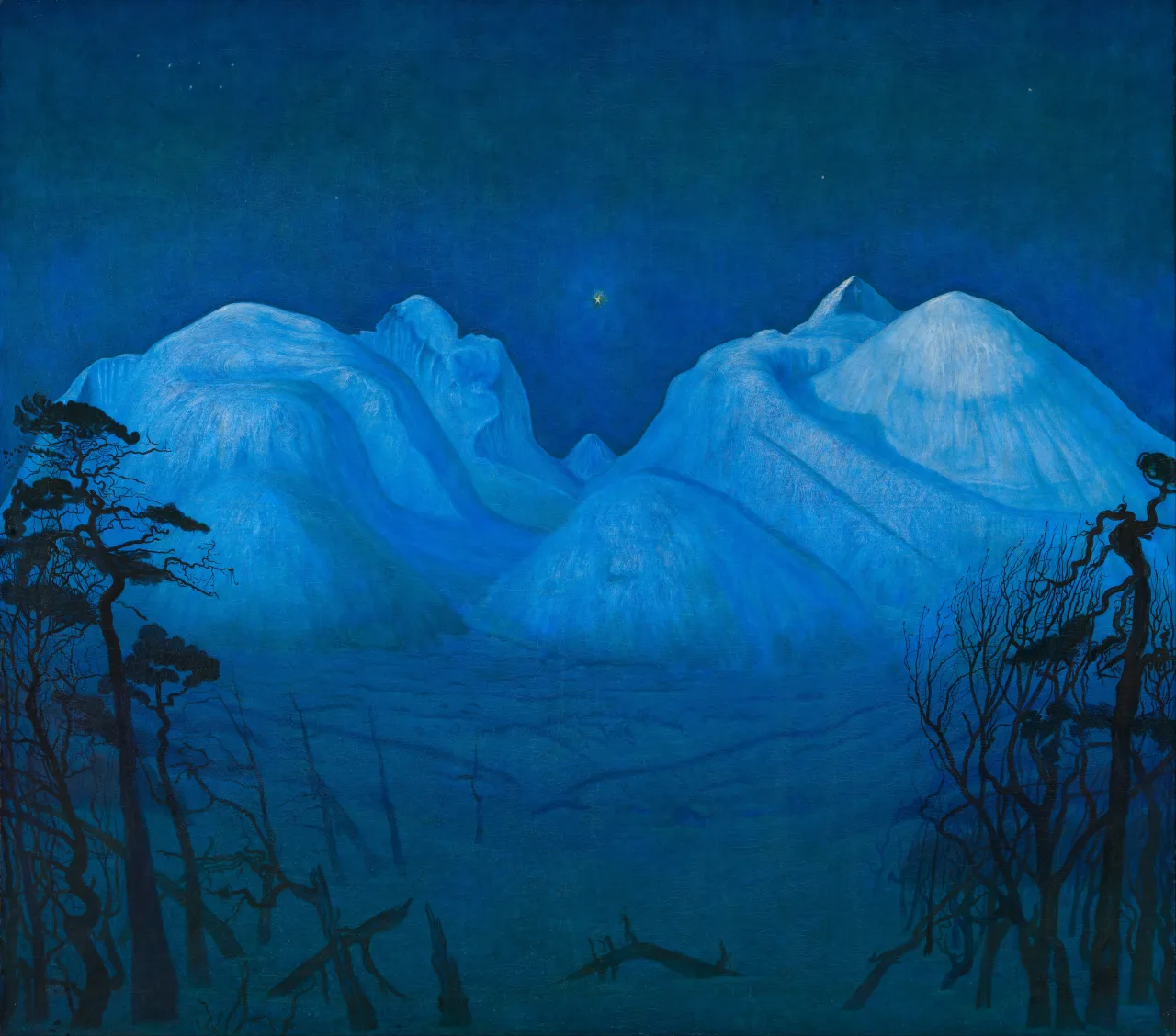
The first thing the painting gives us is distance. A low wilderness of snow and black branches presses close to the picture’s edge, while beyond it two immense mountains rise beneath a blue-black sky. They are near enough to dominate the view and far enough to be unreachable. Between their summits, almost exactly on the painting’s central axis, one star burns with an improbable steadiness.
Nothing moves in Harald Sohlberg’s Winter Night in the Mountains. There is no falling snow, no animal breaking the surface, no smoke to locate a house. The air seems to have stopped circulating. Yet the stillness is not empty. It has pressure. The thorny silhouettes in the foreground reach inward like nerves exposed to cold, and the clean mountain forms seem less asleep than watchful. This is the painting’s peculiar achievement: solitude is everywhere, but aloneness belongs to whoever stands before it.
The eye enters through a narrow opening in the dark vegetation. Bare trunks and hooked branches gather at the left and right like a curtain pulled back, though what they reveal offers no easy passage. The snowy ground between foreground and mountain is compressed into bands of blue and white. It could be a mile deep or a few frozen steps. Sohlberg gives enough detail to make the cold tangible, then withholds the ordinary markers that would let the body measure its place.
Across the middle of the canvas, snow describes the range in long, pale folds. The mountains are solid, identifiable landforms, but their symmetry and calm make them appear built rather than formed, as if a palace had risen without doors or inhabitants. The left mass swells toward the center; the right answers it. A fine dark contour holds both against the sky. On the high slope to the right, a small cross is barely visible. It does not announce a doctrine. It registers first as a fragile human sign, nearly absorbed by the scale around it.
Then there is the blue. It does not settle into a single atmospheric wash. It moves from the deep mineral darkness of the sky to cold turquoise, violet-blue, smoky grey, and the thin luminous color of snow at night. Stars are scattered across the upper field, but the central light governs the composition. This precision could have made the scene decorative or inert. Instead, the balance feels held under tension. The painting is composed as strictly as a threshold, and what lies beyond it remains open.
A night carried home
Sohlberg first encountered this view in the Rondane mountains during an Easter skiing trip with friends in 1899. He was twenty-nine, approaching thirty, and had already developed an exacting way of turning evening landscapes into states of feeling. On a cold night, the distant range appeared under strange blue moonlight. The experience struck him with such force that he later described the winter mountains as silencing him, like standing beneath the vault of a vast church, only far more overwhelming.
On the train back to Kristiania, now Oslo, he drew the range and its twin emphasis on an envelope. That modest act matters. The famous painting did not begin as a grand national statement or a polished studio idea. It began as an attempt to keep hold of a sensation already receding: a few lines made in transit after the landscape itself had disappeared.
He returned to Rondane repeatedly. Around the beginning of 1900, he settled near the mountains and began sustained work on the motif. He tried to set up a large canvas outside in the winter cold, an impractical undertaking he abandoned. The failure clarified the task. Direct observation could supply contours, intervals, trees, snowfields, and light, but the final image would have to be made elsewhere and over time. Sohlberg was not trying to record one arrangement of weather. He was trying to reconstruct what the night had done to his sense of scale.
He drew and painted, and he also photographed the range for study. The photographs are important because they complicate the idea of Sohlberg as a dreamer simply inventing a mystical Norway. His process was anchored in looking. Rondeslottet and Høgronden remain recognizable in the finished canvas. The dark pines belong to the terrain. But accuracy was a foundation, not a limit. Facts gathered outdoors would be selected, compressed, repeated, and made to serve the original encounter.
Fifteen years toward stillness
Between 1900 and 1902, Sohlberg developed a long sequence of studies in oil, watercolor, charcoal, and colored crayon. The surviving works do not show a single image becoming gradually neater. They show a painter testing what kind of image this memory required. The width of the range changes. Foreground trees crowd or release the view. Light gathers in different places. Some versions admit a cabin or skiers; another places a fox in front. The motif could have become a story about crossing the mountains, sheltering in them, or encountering an animal at dusk.
The final painting refuses those stories. Sohlberg stopped work on an early large canvas in 1901 and did not resume the definitive version until 1911. That decade-long interval turns the familiar claim that he “worked on it for fifteen years” into something more interesting than continuous labor. The work included waiting, leaving, and returning. Other places and paintings intervened, especially his severe nocturnal views of the mining town of Røros. When he came back to the mountains, he carried a more concentrated understanding of how absence could organize a scene.
From 1911 until the spring of 1914, he brought the final oil painting to completion on a canvas about 160 centimeters high and 180 wide. Its authority came through revision and subtraction. Cabin, skier, fox, and path are gone. No incident explains why this night deserves attention. Even the foreground had to be calibrated: Sohlberg wanted the darkness and anxiety of the image to reside there without making the scene merely wild or desolate. The branches therefore obstruct the landscape and frame it at once. They are not a wall. They make entry feel possible, then difficult.
Subtraction did not mean simplification everywhere. Sohlberg worked slowly, building color through thin, layered glazes. The method gives the painted surface an enamel-like luminosity: light seems suspended within the blue rather than laid on top of it. Precise drawing keeps the tangled foreground sharp, while the distant forms are resolved into larger, quieter planes. Nearness is brittle and complicated. Distance is smooth, whole, almost absolute.
This division gives the image its psychological structure. The foreground corresponds to bodily knowledge: the snag of a branch, the bite of cold, the anxious awareness of being exposed. The mountains belong to another order. They neither threaten nor welcome. Their remoteness allows them to hold feelings that cannot be attached to an event. Sohlberg transformed a remembered view by making its emotional distances visible.
The real, rearranged
Sohlberg emerged at the meeting point of realism, Neo-Romanticism, and Symbolism in Norwegian painting. Those labels can make the work sound divided between truthful landscape and private fantasy. Winter Night in the Mountains shows how completely the two depend on each other. Its symbolic force comes from observed particulars: the profile of the Rondane range, leafless growth under snow, the peculiar color of nocturnal winter light. Its realism is equally shaped by feeling. Every particular has been disciplined by the need to recover one internal shock.
The composition makes this transformation plain. Natural terrain rarely presents itself as a balanced façade with a star at its hinge. Here the mountain masses lean toward a center that appears ordained, while the trees form a dark proscenium around them. The cross on Høgronden intensifies the association with sacred architecture, but the painting does not require a religious reading. Sohlberg’s own church comparison describes magnitude more clearly than belief: the sensation of entering a space whose scale changes the person inside it.
That person never appears. In many landscapes, a small figure establishes immensity by contrast. Sohlberg removes the figure and lets the missing body become the measure. The canvas itself is nearly human in span. Standing before it, the absent witness is supplied outside the painted world, close to the black branches and far from the lucid peaks. This is one reason the scene feels inhabited despite its emptiness. It has been constructed around a position that no painted figure occupies.
Color deepens the contradiction. Blue ordinarily makes distant things recede, and Sohlberg uses its coldness to extend the space. But he also saturates the entire scene with it, joining near snow, far mountain, and upper sky in one emotional climate. Distance expands while the atmosphere closes around the image. The snow does not simply reflect a natural source of light; it seems to retain light, especially along the ridges where pale surfaces emerge from darker slopes. The effect is credible as winter and heightened beyond reportage.
The star is the smallest element and the strongest interruption. It can be read as hope, orientation, revelation, or simply a point of celestial light. The painting settles none of these possibilities. Its power comes from placement rather than explanation. The star holds the central gap without filling it. Likewise, the cross is too faint to turn the mountain into an altar, and the branches are too particular to dissolve into pure emblems of fear. Sohlberg repeatedly brings an interpretation close, then keeps it from becoming a code.
This restraint separates psychological charge from melodrama. The painting does not illustrate loneliness as misery. It creates the conditions in which solitude becomes physically large: no company, no task, no visible route, and no event to bring time forward. Stillness feels inhabited because attention has nowhere else to go. What remains is not a supernatural presence but a heightened relation between mind and landscape, a sense that the outer world has become exact enough to expose an inner one.
A national image without a slogan
Sohlberg completed the painting for the 1914 Jubilee Exhibition at Frogner in Kristiania, a vast national display marking one hundred years since Norway’s constitution. The exhibition gathered art alongside industry, agriculture, design, and other accounts of the country’s culture and achievement. In that setting, a monumental view of a recognizable Norwegian range could readily be understood as an image of the nation. It arrived with the scale, finish, and gravity of a culminating work.
Its reception was strongly positive, including among critics and fellow painters who had previously shown little sympathy for Sohlberg’s art. He regarded the canvas as the essence of his artistic outlook and handled its presentation with unusual care. Yet the institutional path was not immediate. Efforts to secure it for the National Gallery did not at first succeed. The collector Jørgen Breder Stang bought it in 1915, then gave it to the museum in 1918.
Its later reputation became inseparable from Norwegian identity. In 1995, a public vote organized by the national broadcaster chose it as “Norway’s national painting.” The title is understandable. The work binds a specific terrain to a century of looking, reproduction, and shared recognition. It presents winter not as a picturesque accessory but as a condition that alters distance, color, sound, and thought. It has helped generations imagine Rondane before seeing the mountains themselves.
But calling it national can also make it smaller. There are no citizens in this imagined nation, no labor, settlement, border, flag, or claim of possession. The mountains do not offer themselves as property. Even the triumphant scale expected of a national image is unsettled by the anxious thicket at its edge. The painting can carry patriotic feeling, but it does not behave like an emblem designed to reassure. Its silence exceeds the use later made of it.
That excess is why the image survives its fame. The first star still appears too steady. The mountains still seem at once geological and composed, their blue surfaces remote from touch. The dark branches still hold open a place where a body might stand, though none is permitted to enter. Fifteen years of study did not solve the night Sohlberg encountered. They removed everything that would have made it easier to solve.
What waits when the world goes still is not an answer. It is the unsettling discovery that emptiness can have structure, color, distance, and weight. Sohlberg’s mountain night contains no visible life, yet it remains intensely occupied by memory, by attention, and by the unpainted witness at its edge. The quiet does not end. It looks back.