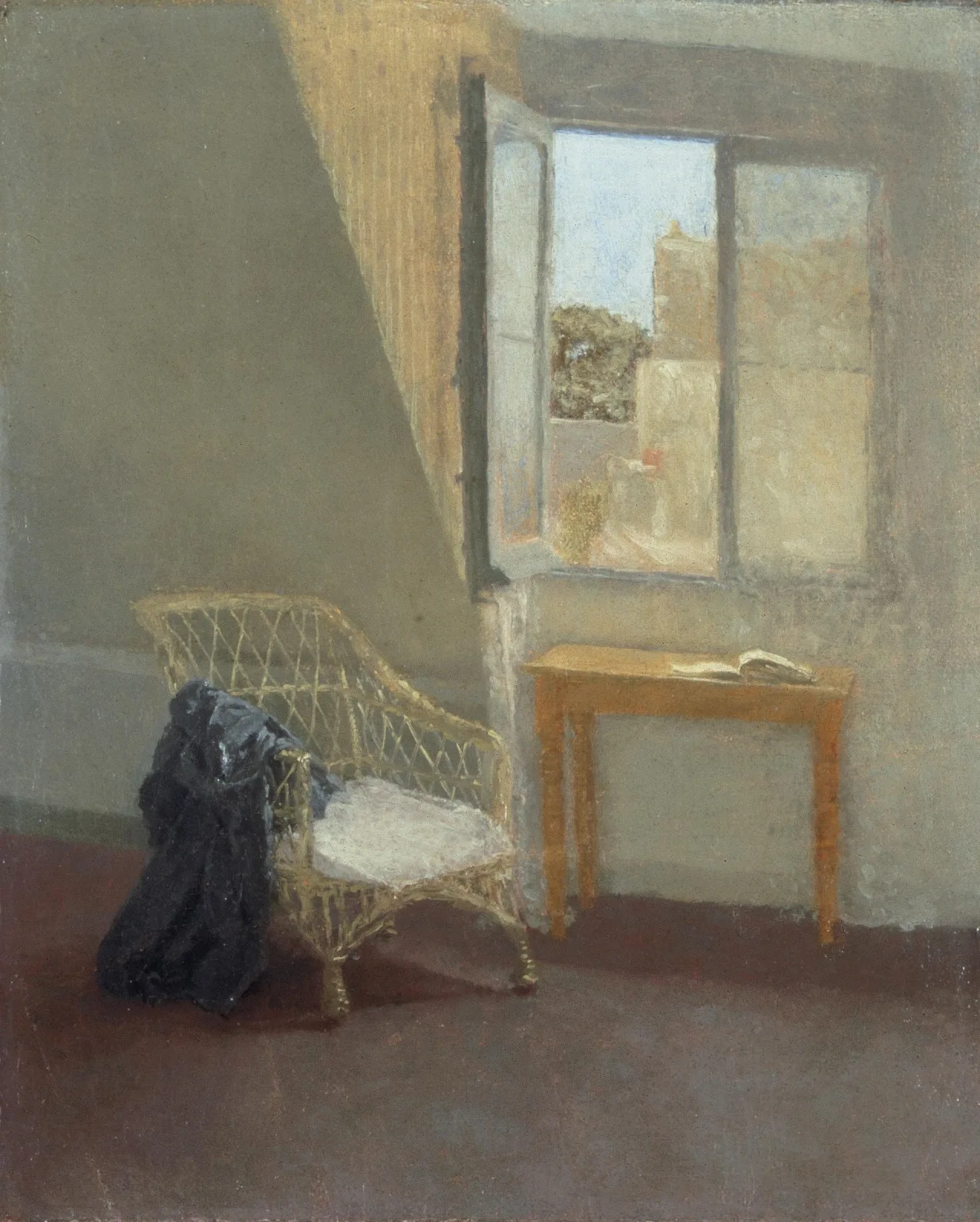
A room can provide two kinds of travel before anybody stands up: a window and a book. Gwen John placed both in A Corner of the Artist’s Room in Paris, one directly above the other. The window opens toward trees, pale buildings, and a piece of blue sky. The book opens toward whatever its pages contain. At 31.2 centimeters high, the painting is smaller than many windows and only a little larger than many books, yet it holds both forms of elsewhere.
They are generous openings with strict limits. John reduces the Paris view to blocks of cream, rose, green, and blue. A tree becomes a soft knot; masonry loses its edges in the light. The book is even less forthcoming. Its pages make a low white shape on the table, divided by a dark crease and a few strokes that could be print. There is enough information to recognize reading and none that permits it.
This restraint makes the two objects rhyme. Each has leaves joined at a hinge. Each presents a pale plane bordered by a darker frame. The left casement turns inward, showing its thickness; the pages rise slightly at the center. John gives the room an upright opening and a horizontal one, then withholds the particulars beyond both. The promise of another place remains more distinct than the place itself.
The rest of the room is built to redirect that promise. The table legs carry the book’s vertical position down to the floor. The chair, turned across the picture, pushes back toward the window. Its wicker strands form a loose lattice beside the rigid bars of the glazing. A curtain descends between wall and casement, and a dark garment drops from the chair to the floor. Lines that begin as architecture end as cloth.
John could have made a convincing interior from perspective and furniture. Instead, the objects behave like instruments for moving attention. The garment supplies the deepest dark and the greatest weight. The window supplies the highest light. Between them, pale wicker, warm wood, white pages, and the slanting casement make a gradual ascent. The eye does not enter the room and settle. It climbs.
That movement complicates the usual word applied to John’s interiors: stillness. Nothing here performs an action, but almost everything indicates one. The window has been opened. The garment has been put down. The book has been opened and left at a page. The chair has been turned away from the wall. These are small verbs in the past tense, preserved after the person who carried them out has moved beyond the frame.
The fashionable chair
From 1907 until 1909, John lived under the roof at 87 rue du Cherche-Midi. Her limited furnishings were practical, but they were not culturally blank. Wicker chairs were light, inexpensive, and common in Parisian studios and apartments. Museum Wales notes that they became fashionable signs of artistic identity. John’s chair could serve a body, a model, and a composition while quietly identifying the kind of room in which it stood.
Its weave is also the painting’s most elaborate drawing. Along the back and arms, pale lengths cross in diamonds and irregular loops. The garment covers a large part of this structure, making the chair both intricate and unavailable. Whoever returns will first have to move the cloth. That modest inconvenience gives the furniture a convincing life. It has not been staged as an emblem of work; it has been caught between uses.
The empty chair has carried a large amount of John’s biography. Because the painting dates from the period around the breakdown of her relationship with Auguste Rodin, the vacant seat and open book have been read as signs of romantic absence. The association is possible, though the picture offers no way to identify whom the chair awaits, whether the reader plans to return, or whether either object concerns Rodin at all. More secure evidence lies in John’s decision to paint this corner twice, making another version of the subject rather than treating the room as the scene of one unrepeatable confession.
Repetition was part of her working life. Across paintings and drawings, John returned to the same people, poses, rooms, and objects, varying detail, technique, color, and tone. The practice replaces the dramatic idea of inspiration with a more exact pleasure: seeing how much can change while the subject stays put. A familiar chair can alter the balance of a wall. A small shift in a window can change the pressure of all the light around it.
The interior also connected John with artistic life in Paris. Rooms were active subjects for many of her contemporaries, places where modern painting could test the relation between bodies, possessions, color, and compressed space. Her attic belonged to this shared investigation as well as to her private circumstances. The objects that make the picture look secluded also identify a working artist’s environment.
John’s paint gives that environment its unusual weather. Museum conservators found that she applied fluid oil in successive layers over a white ground. Pink preparation remains visible through the upper colors in places, warming the gray-green wall, pale curtain, and muted floor. Brush marks are mostly disguised, and varnish contributes to the smooth, soft gloss. The surface looks settled because one translucent decision has been laid over another.
Pink preparation may seem an unlikely foundation for such reserved color. It keeps the grays from becoming airless. Around the window, warmth passes through the thin upper paint like light held inside plaster. Along the chair, touches of yellow and brown answer the table. Even the dark garment contains blue. John does not use color to separate the room into named things. She lets nearby tones borrow from one another until wall, furniture, fabric, and outdoor light share an atmosphere.
This is why the indistinct view and illegible book feel deliberate rather than incomplete. Description would pull attention outward, toward a particular building or a particular text. Tone keeps it circulating through the picture. Paris matters as brightness, distance, and a few softened colors. Reading matters as an open interval on the table. John gives each object the amount of information needed for its part in the room.
The painting consequently holds privacy without sealing itself. Its open things lead the eye away, while its tonal relations keep bringing that eye back into the work. A viewer can imagine the street beyond the glass or the words beneath the page, but the picture reserves its sharpest account for the nearer facts: the thickness of a casement, the bend of wicker, the warmth under gray paint, the point where a garment becomes too heavy for a chair.
John painted this corner twice, one instance of her wider practice of returning to a subject with changes in detail, technique, and tone. Repetition turned temporary arrangements into a durable working set. The chair, table, book, curtain, and window could stay in place while attention changed its route through them, allowing the same small room to become another picture.