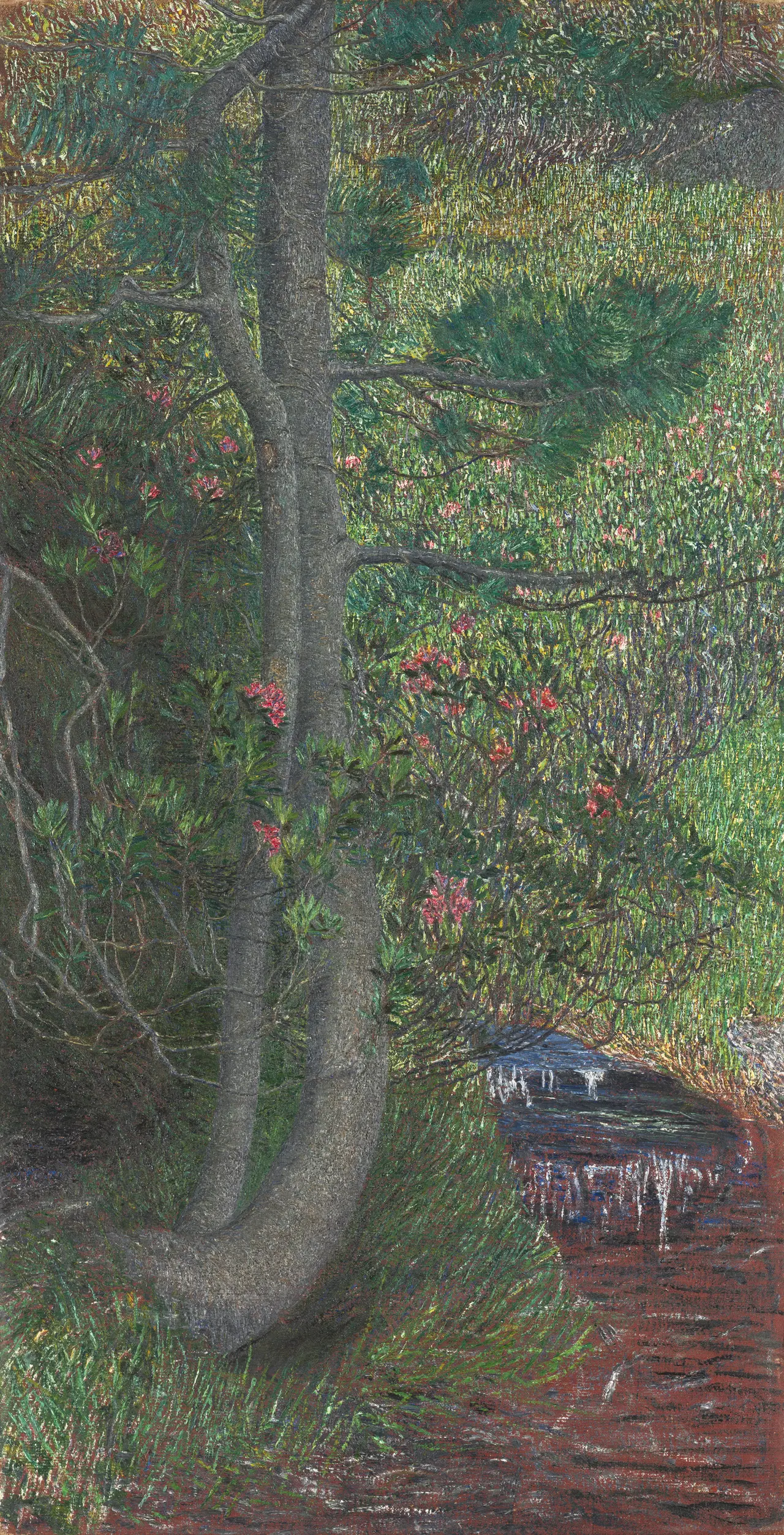
At the lower right corner of Giovanni Segantini’s Pine Tree, the painting stops. The surface that has been built so carefully for more than a meter above suddenly gives way to a flat wash of earth red. Short white filaments still try to mark water moving over stone, but they skim over a ground that has been left uncovered. The Cleveland Museum of Art, which keeps the picture, notes the fact plainly: the bottom right portion was left unfinished, the earth red ground layer is still visible. It is the kind of detail that a reproduction can smooth away. The weave of the fabric remains visible around the exposed ground, and the interruption reads as a decision not to hide how the picture was made.
That patch of exposed ground is a good place to begin because it shows the picture for what it is: a piece of fabric covered stroke by stroke with filaments of paint until the painter chose to stop. The picture measures 135.2 by 72 centimeters without its frame, almost twice as tall as it is wide, and the pine inside it is larger still. Segantini placed his easel so close to the tree that the trunk enters at the very bottom edge and leaves at the top without ever showing where it meets the earth or where its crown resolves against sky. There is no sky at all. There is no horizon. There is a thick trunk at left, grey and brown, its bark written in short horizontal ticks, and a thinner companion beside it that follows the same upward curve. Behind them the forest compresses into a dark green brown mass. In front, a narrow stream cuts diagonally to the corner that remains red.
The tree is made of color that does not mix on the palette. Yellow and acid green, olive and ochre, small flecks of pink red where a flowering shrub has caught light, are laid as separate filaments that sit side by side. Up close the surface shivers. From a step back those separate marks resolve into foliage that appears to breathe. Segantini called this working with brilliant colors applied in small, broken strokes. Italian painters after 1890 called it Divisionism. It shared an optical idea with French Neo-Impressionism, that separate dabs of pure color could mix in the eye, but Segantini used it for a different aim. The museum’s description makes the intention clear: rather than a direct transcription of nature, the extreme close up view and the flat, decorative space are designed to arouse an emotional response. The strokes record sustained attention, letting brilliant color accumulate filament by filament without blending on the palette.
It helps to know where he was standing. By the time he painted this pine, around 1897, Segantini lived year round at about 1,800 meters in the Engadin, the high valley in Graubünden where lake and meadow give way quickly to rock and pine. He had come there from the Brianza hills above Lake Como and then from Savognin, moving each time higher and more isolated. He was stateless, born in Arco on Austrian territory in 1858, trained at the Brera in Milan, and unable for years to obtain a passport. In 1894 he settled with his partner Bice Bugatti and their four children first in Maloja and then on the Schafberg above Pontresina, where the light is hard and the air thins work. Visitors described a house with little heating and a studio open to wind. He worked outdoors on large canvases under wooden shelters even in cold, returning to the same motifs of mountain, bread, mother, and tree until they carried the weight of repeated looking.
He also wrote about that looking in language that can sound grand until you see how literally he put it into paint. Finding spiritual consolation in the forests and clear light around his home, he wrote, I am now working passionately to wrest the secret of Nature’s spirit from her. Nature utters the eternal word to the artist: love, love, and the earth sings life in spring, and the soul of things reawakens. The Cleveland text quotes the line because it matches what the pictures do. The pine is a single organism treated with the same seriousness that earlier painters gave to a saint or a mother. That seriousness came from a set of convictions that historian Robert Rosenblum summarized as turning the earthbound into the spiritual, and that Segantini himself called naturalist Symbolism. He meant that observation could be devotional without inventing symbols to pin on it.
His technique grew out of that conviction. In 1886 the dealer and painter Vittore Grubicy, who had supported Segantini since 1880 and once taught him to look at Millet and Anton Mauve, visited him in Savognin and urged him to separate his colors further to increase their brilliance. The next year Segantini painted a second version of Ave Maria using the Divisionist method for the first time. It won medals in Munich and Turin. From then on his color was built from adjacent filaments rather than blended tones. The method was slow. It asked the hand to lay thousands of small strokes in parallel or fanlike directions, letting complementaries vibrate instead of muting each other. The white of snow, the yellow of alpine sun, the deep green of pine, each required a field of marks rather than a single passage. For a painter who wanted to stay with one place until its spirit showed, the slowness was not a cost. It was the point. The time spent stitching the surface became a form of attention that matched the long time spent looking.
A tree that is also a wall
Stand before the Cleveland picture at the size its file allows and the first thing you notice is how little depth it offers despite its subject. A tree usually implies recession: roots in foreground, trunk receding, branches overlapping, sky behind. Here Segantini removes those cues. The trunks run parallel to the picture plane, their curve echoing the left edge. The foliage masses are not modeled with light from one side but are lit from within by the color filaments themselves. The stream at lower right should carry the eye back, but it runs so steeply toward the corner and is so interrupted by the unfinished ground that it acts more like a dark seam than a passage. The background trees are not fainter with distance. They are darker and denser, pressing forward. The result is a surface that reads as a wall of green more than a vista into woods.
That flatness is deliberate. Earlier Segantini panoramas, like the huge triptych Life, Nature, and Death that occupied him through the late 1890s for a planned Paris panorama, open wide to accommodate mountain and sky. Pine Tree does the opposite. It refuses the Alpine breadth that made his reputation in Zurich, Munich, and Vienna and chooses a square meter of forest that could be anywhere along the track between Maloja and Pontresina. By cropping in tight, he exchanges geography for presence. You are not shown where the tree stands in Switzerland. You are placed under it.
Color does much of that placement. The palette is not the muted tonalism of his early Lombard peasant scenes, nor the pale high key of his snow subjects. It is saturated but not sweet. The greens are mixed with yellow filaments that keep them from sinking. The pinks, scattered as small clusters through the mid canopy and along the lower edge near the water, keep the green from becoming monochrome. They are not clearly blossoms of a single species. At this altitude and scale they read as alpine roses, the small rhododendrons that bloom in early summer around the tree line, but the painting does not label them. What matters is their function: they puncture the green with a complementary warmth that makes the whole field throb. Where a Barbizon painter might have glazed a single green and added a few flower touches, Segantini gives the flowers the same filament structure as the pine needles, so that blossom and needle belong to the same fabric.
The water is handled differently, and that difference holds the lower third together. While foliage is built with dense parallel strokes, the stream is made with long thin whites dragged diagonally over the dark reddish brown underlayer. The whites do not describe foam or reflection as solid shapes. They describe movement. You read them as water tumbling over small ledges because they are the only marks in that zone that run counter to the vertical trunks and the horizontal bark ticks. They also tie the finished upper area to the unfinished corner, because the same dark red that underlies the stream continues into the exposed ground. Where the painter stopped, the red remains as both earth and painting ground, reminding you that the dark stream and the dark forest share a common basis that is not observed light but material laid first.
There is a temptation to treat that exposed corner as a flaw or a sign of a study left incomplete. The catalogue history suggests otherwise. Quinsac’s catalogue raisonné of 1982 lists the work as number 530, a finished picture despite the small lacuna. The Cleveland collection keeps it among its modern European paintings rather than sketches, and it has been shown as a complete work in Zurich in 1990 and at the Fondation Beyeler in 2011. Segantini died suddenly of peritonitis on the Schafberg in September 1899 at forty one, leaving the large triptych still in progress, and Giovanni Giacometti had to complete some passages. Yet this pine is not an abandoned fragment. Its edges are considered, its color is fully developed across ninety percent of the fabric, and the red corner is bounded by the same white water strokes that elsewhere resolve. It is better understood as a painting that allows its support to remain visible, the way a woven textile might show its warp at a selvage.
Work in isolation
Isolation shaped how the pine was painted in practical ways. At Maloja, Segantini could not order prepared colors in the quantity Paris painters enjoyed. He mixed and laid them as he found them, often outdoors, often in cold that thickened oil. Photographs from those years show him in a heavy coat beside a large canvas propped on a sled, with wooden windbreaks. His half brother Napoleon had taught him photography in the 1870s while running a studio in Trentino, and Segantini continued to use photographs to record mountain forms, but this close pine does not look like a photograph enlarged. It looks like a memory checked repeatedly against a tree that did not move.
The choice to paint fabric rather than canvas for this work also matters. The Cleveland record says oil on fabric, not the more usual oil on canvas. In Segantini’s late years he often preferred a coarse, absorbent support that took the filament strokes without blending them at the edge. The fabric holds each mark slightly separated, so that the division remains legible. It also explains why the earth red ground, a thin imprimatura, still shows. On a primed canvas the ground would be white or light ochre and would read as blank. Here the ground is a saturated red that asserts itself as color. When it peeks through between green filaments across the whole surface, it warms them. When it is left exposed at the corner, it declares itself.
That red is not accidental to his Alpine vision. Earlier in his career Segantini painted peasant interiors and ploughing scenes where earth tones dominated. After Divisionism, his earth did not disappear but was broken into color that still remembered its origin. The red ground of Pine Tree carries that memory. It is the Lombard earth and the Engadin rock under the bright alpine color. To leave it visible is to refuse the illusion that green is simply there in nature. Green, in this picture, is made by putting yellow next to blue filaments over red.
There is also the question of why a pine, among all the Alpine subjects that could demonstrate spiritual presence. Segantini painted many trees, but this one is unusually frontal and singular. Most Alpine painters who take a pine make it a coulisse at the edge of a lake view, a diagonal that leads toward a mountain. Here the pine is not an accent. It is the subject, and its form is not heroic. The trunk is not straight. It leans slightly and the second trunk crowds it, so that the two forms read almost as a single divided column. The association with mother and child, a recurring theme for Segantini after the early death of his own mother and the birth of his children with Bice, is not illustrated but is felt in how the painter stays with paired verticals. He painted cows and sheep as mothers, women as mothers in stables, and later angels as mothers. To say the pine here stands for maternity would overstate what the work shows. To notice that his eye was practiced in staying with a double trunk and letting it hold, as he stayed with a mother and infant, is to honor how repetition trains attention.
What the closeness teaches
The close crop teaches a different kind of looking than the picturesque Alpine view. A view asks you to survey from a distance and feel awe. A close tree asks you to look up along bark, to notice how light catches needle clusters, to hear water at your feet. The painting enforces that bodily position. You cannot step back inside the image because there is no middle distance to step onto. The foreground is at your shoes, the trunk is at your shoulder. That compression is why the picture remains atmospheric even without mist or sunset effects. Its atmosphere is not weather. It is the closeness of air among branches, the sense that the green around you is dense and slightly damp, that the white streaks of the stream have a sound.
That sense of being inside weather rather than looking at it helps place the pine among Segantini’s late work without needing to classify it as Symbolist or naturalist. Britannica calls him a Symbolist who used Divisionist technique, and that is accurate for pictures like The Punishment of Lust or Love at the Fountain of Life, where angels and lovers populate the mountains. Pine Tree has no allegorical figures. Its symbolism, if the word is needed, is in the treatment. The act of covering a surface with separate strokes of pure color until it vibrates is itself a way of saying that nature’s life is not in a single tone but in the relation of tones. His quoted line about love as the eternal word nature utters can read as rhetoric until you see it enacted: yellow next to green next to pink, each distinct, together making a field that feels alive.
From a distance the pine reads as a strong vertical bar, its trunk curve, dark stream, and light foliage giving it weight at top and bottom. Closer, the filament structure becomes legible and the painting shifts from shape to making, from immediate presence to slower attention, a change that mirrors what Segantini wanted from a viewer who first felt the picture and then stayed to see how it was built.
The picture holds because the direction of strokes follows the growth of the tree: vertical for trunks, fanlike for branches, diagonal for water. You can count yellow beside violet or red beside green, but the coherence comes from those directional relations and the filament color adjacencies rather than a diagram of complementaries. Grubicy brought Seurat’s idea to Segantini through Mauve and Millet, and Segantini kept a warmer, more filamentous touch than Seurat’s dots, one suited to mountain light and coarse fabric. The spot remains an ordinary pine forest that holds snow late and flowers early, valued for that ordinariness.
That ordinariness is part of its value. Segantini is remembered for the large Alpine panoramas that museums in Hamburg, Vienna, and Berlin bought in the 1890s, and for the tragic finish on the mountain that turned him into a legend for Kandinsky and the Futurists. A single pine near a stream is not central to that story, and the Cleveland picture is not the work most often reproduced. It has lived mostly off view, shown in Zurich or Riehen when his full career is surveyed and otherwise in storage where the museum’s 2021 Stories from Storage allowed a look. Its quiet persistence is an argument for keeping optional works visible. Not every important picture is a summary. Some are a day’s sustained attention to a motif that would otherwise pass as background.
For a reader who has followed the close reading, the unfinished corner may now feel less like an interruption and more like a signature. Segantini left many things slightly open, not from lack of craft but from a conviction that a painting should not pretend to be more finished than nature. The mountain light changes while you lay filaments. The flowers open. The stream rises. To stop and leave a square of ground uncovered is to indicate that the work of making could continue. It also protects the picture from becoming decorative. A fully covered surface might read as tapestry. The red interruption keeps it as work.
There is a final detail that only sustained looking brings forward. In the upper half, among the yellow greens, there are small flecks of pure ultramarine and violet that have no naturalistic justification. They do not describe shadow or flower. They describe the coolness of shade among needles as a color separate from green, and they keep the green from flattening into a single hue. That is Divisionism at its least programmatic: not a system applied, but a habit of seeing one more color where habit would say green is enough.
To return to the corner where the painting stops is to understand that the pine is both a place and a thing made on fabric. The trunk will keep curving, the water will keep cutting, and the foliage will keep shivering between yellow and green as long as someone keeps laying filaments. Segantini stopped short of the edge, left the ground red, and let the stream carry itself out of the picture. The tree remains standing because its making remains visible. In a period when Alpine painting often pushed toward panorama or allegory, that decision to stay close and to show the hand keeps the forest present in a way a larger view cannot.