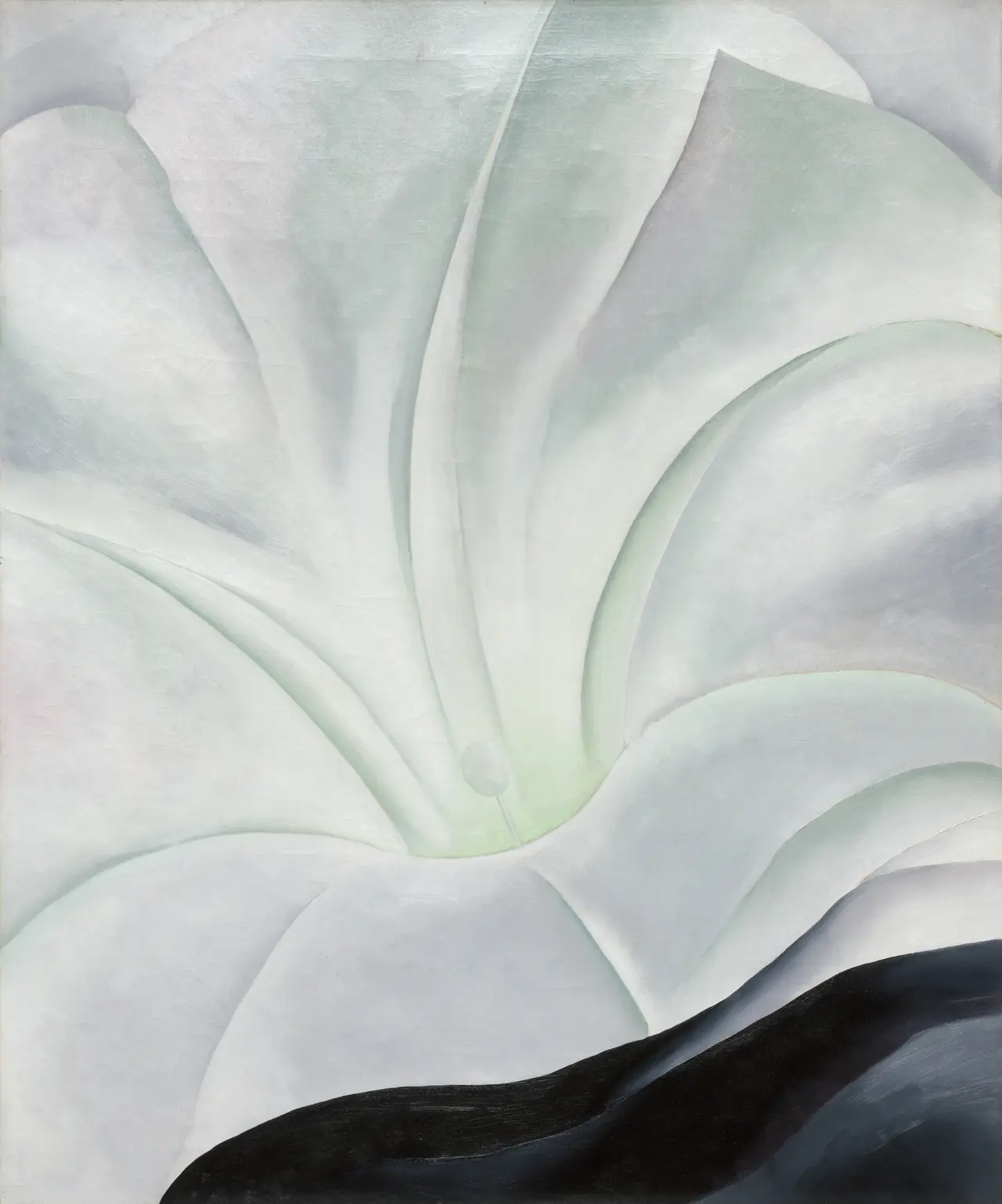
The edge tells you how to look. In Georgia O’Keeffe’s Morning Glory with Black, a pale trumpet meets a flat black wedge along a line that is almost too precise to belong to a flower. The petal is thin, ruffled at its rim, and very light, a white that carries a little lavender and a little warm grey where the canvas turns. The black below it is matte and even, without highlight or modeled form. Where the two meet, there is no shadow, no soft transitional tone that would say the flower casts darkness onto a ground. There is a meeting of two planes that have been cut to fit. That meeting holds the picture. The flower does not sit on the black. The black steadies the flower.
The picture is vertical and modest in size, 91 by 75.5 centimeters without its frame, about thirty five and thirteen sixteenths by twenty nine and three quarters inches, on the Cleveland Museum of Art record. Framed it measures 96.5 by 81.3 centimeters. The museum keeps it in its American Modern gallery and notes on its reverse the inscription G OKeeffe -- 1926 in white paint. The surface is oil on canvas, laid thin and blended, with little impasto. From a normal viewing distance the form appears clearly: a single morning glory seen close, cropped so that its outer petals are cut by the top and side edges of the canvas, its throat turned slightly away, its tube narrowing to a point that almost touches the black. Around the bloom the ground is a muted sage, a greyed green that keeps a little warmth, especially toward the upper left. It stays flat. It does not recede as sky or foliage. It functions as a field that is quiet enough for the contrast between pale and dark to remain the whole subject.
Look first at the flower itself, because O’Keeffe gives it with precise, unsentimental attention. The throat is the darkest part of the white, a closed center that holds a faint pinkish grey. From there the petals open outward in five shallow lobes that are not identical. Their edges undulate, one fold slightly overlapping another, and at the extreme rim the paint thins so that the canvas weave and the ground show through as a cooler line. There are no hard veins drawn across the petals, no botanical indicators of species. The structure is suggested by value alone, a gentle modeling where the white lifts a fraction toward the light and falls a fraction into the fold. On the right side the petal curves over itself, creating a crescent of slightly deeper tone that reads as the thickness of the tissue. On the left the petal stretches broader and flatter, its edge almost straight where the crop cuts it. The color never becomes sweet. The white stays cool, and the pale lavender in it is more like the way morning light looks on white than like a tint the painter added for charm. You can see that she worked the petals wet into wet, stroking the light tone into the sage ground at the outer edge and then pulling it back before it blended.
That handling matters because it explains how the flower holds without drawing. There is almost no linear contour. The shape emerges because the light tone is set against two darker values that are kept distinct. Above and to the sides the sage defines the outer curve of the petals. Below and to the right the black defines the lower curve and the tube. The flower exists as the light that remains after two darker fields have been placed. O’Keeffe did not outline and fill. She painted the field and the wedge, and left the flower as the interval between them that she then tuned with a few strokes of warmer grey and lavender. The result is a bloom that feels simultaneously delicate and solid. Delicate because the petal is so thin that its edge can barely hold itself. Solid because the mass that surrounds it is so fully decided that the petal cannot drift.
The black wedge requires the most careful seeing, because its function is not the one a floral still life usually assigns to black. Its shape is geometric enough to be read as a constructed plane, not as a vase shadow or dark leaf behind the blossom. It occupies the lower right quadrant and runs left along the bottom edge, rising diagonally to meet the point of the flower’s tube. Its upper edge is straight for several inches before it softens slightly where it meets the curve of the petal. Its right edge aligns with the canvas edge, so the black meets the frame without interval. Inside the wedge the paint is uniform, with no variation to suggest space or texture. That uniformity is deliberate. A black that showed brush variation or reflected light would become an object, a piece of cloth perhaps, but this flat black remains a mass whose only content is weight and position. It does the work a plinth does for sculpture, except it is in the same plane as the subject it supports.
The proportion between flower and black is calibrated to keep neither from dominating. If you divide the canvas vertically, the bloom occupies about three fifths of the height and most of the width. The black occupies about two fifths of the height at its tallest point and narrows as it moves left. Visually the flower is larger, but the black is denser. The eye goes first to the light, then is pulled down to the dark, then returns to the light with a greater sense of the flower’s edge. The oscillation gives the picture its quiet movement, a slow exchange between bloom and ground that does not require narrative. There is no stem worth naming, no leaf that frames the flower, no table. A sliver of green grey tube and perhaps a hint of calyx are all that connect the trumpet to any plant. The bloom appears almost unsupported in botanical terms, which makes the black read more strongly as support.
It helps to know when and where O’Keeffe painted this kind of picture. The date, 1926, places it two years after her first large magnified flower, Petunia, No. 2 of 1924, and a year after her first close cannas. By 1926 she lived between New York, where she and Alfred Stieglitz kept rooms at the Shelton Hotel, and the Stieglitz family house at Lake George. She spent summers at the lake from 1918 into the early nineteen thirties, painting the landscape, the barns, and the lake itself in simplified, often close forms. The flowers from these years were not New Mexico subjects. They were eastern, garden and greenhouse flowers that she could bring into the house and study at a table. The magnified flower that became her signature was developed there as a design decision before it became a desert association. Enlargement allowed her to treat the curve of a petal as a plane and the opening of a throat as a space, matters that matter to painting regardless of locale.
O’Keeffe is best known for close up flower subjects whose magnified forms fill the entire space of each canvas. Likely inspired by similar compositions in modern photography, these images are not only celebrations of nature, but also striking essays in abstract design. The photography reference points to Stieglitz and his circle, where cropping, enlargement, and the use of a shallow field were daily vocabulary. Paul Strand, whom O’Keeffe knew, was photographing close leaves and bowls in the same years with hard, centered compositions that let a single form dominate a square. The 1926 morning glory borrows that logic without quoting it. It does not need a square. Its vertical rectangle lets the trumpet echo the canvas shape, so that petal and edge repeat one another.
Many critics interpreted O’Keeffe’s flower paintings as reflections of femininity in general and female sexuality in particular, yet the artist strongly opposed such readings. For most of her career she asked that her work be discussed without reference to gender, writing on one occasion, I have always been very annoyed at being referred to as a woman artist rather than an artist. The statement matters because it returns attention to form, color, and placement. By the mid nineteen twenties, the sexualized reading was already common and was amplified by Stieglitz’s own exhibition strategy, which often hung her flowers alongside his photographs and encouraged critics to find bodies in petals. Paul Rosenfeld, writing in 1922, found the essence of womanhood in her color, and later critics made the claim more explicit. O’Keeffe’s annoyance was not a denial that a flower can suggest a body. It was an objection to the way a single association was allowed to replace attention to form, color, and placement.
Morning Glory with Black is useful against that habit because it is not a soft, voluptuous picture. A morning glory is a thin, short lived flower that opens in the morning and wilts by afternoon. Its trumpet is tighter and more architectural than an iris or a canna. O’Keeffe does not smooth its structure into a generalized bloom. She keeps the specific identity: the five part opening, the tight throat, the shallow ruffle. The black wedge works against a sexual reading even more directly. It introduces a hard, ungendered mass that is not a flower part at all. Because the black is abstract, the flower cannot be read as a closed symbol that explains itself. The picture insists that its content is the relation between a pale, curved volume and a dark, angled plane. Any association the viewer brings must pass through that relation and be tested against it.
There are precedents for that kind of abstract relation in O’Keeffe’s earlier work that help locate what she is doing here. In 1916 she had made charcoal abstractions that were pure arrangements of curve and interval without floral reference. In the early New York pictures she had painted music as color intervals. By 1926 she no longer needed to purge floral reference to achieve abstraction. She could keep the flower and still make structure primary by cropping and by pairing. The black wedge belongs to that lineage. It is a return of the early geometric thinking inside a recognizable subject. Rather than paint a flower plus an abstract shape, she paints a flower that becomes legible because of an abstract shape.
The palette supports the same restraint. Morning glory blue is famous in gardens, but this picture is not blue. It keeps to white, a cool lavender, the sage ground, and the flat black. The choice removes the most decorative aspect of the subject, the blue violet that would signal morning glory at a glance, and replaces it with a tonal problem. How does a white hold on a light ground when a black is near? The answer is in value steps. The white is lightest. The sage is mid. The black is darkest. No other hue intervenes. Because only value distinguishes bloom from field and field from wedge, the edges carry full responsibility. That is why the edge between white and black is so sharp where the tube meets the wedge and slightly softer where the petal billows over the sage. The variation keeps the flower from looking cut out and pasted, even while the construction is openly cut out in logic.
A comparison to a later morning glory in O’Keeffe’s career clarifies the distinctness of the 1926 solution. In 1938 she painted Ram’s Head, Blue Morning Glory, where a blue trumpet sits with an animal skull against a southwestern ground. That picture uses the flower as a color event within a symbolic pairing that has become emblematic of her New Mexico years. The 1926 Cleveland picture uses the flower as a spatial event without skull or landscape. It belongs to the period before the skull became a signature, when the flower alone had to carry the picture. The black wedge there does the work the skull does later: it gives the bloom something solid to press against so that the bloom’s thinness is legible.
It is worth pausing on the way O’Keeffe handles time, because a morning glory makes time visible. In a garden the flower opens quickly at dawn, holds its shape for a few hours, and collapses. Its beauty is inseparable from its brevity. Many flower paintings try to overcome that brevity by stabilizing the bloom through symmetry or high finish, making it look permanent. This one does not. The crop that cuts the petals at the edges admits that the painter saw only a portion of a cycle, a single trumpet isolated from the vine. The flat handling of the black refuses to make a setting that would suggest the flower continues elsewhere. The image holds the flower exactly at the length of looking that a morning allows. The paint stays thin, as if the picture itself could be made quickly before the bloom wilts, even though the blending requires care.
The evenness of the brushwork contributes to that temporal sense. There is no visible bravura, no thick stroke that would record the hand’s speed. The transitions from white to lavender to grey are seamless. The black is laid as a single flat. The seams between masses are where the work is visible, not inside the masses. That choice keeps the picture from aging through texture. Impasto can make a flower painting look preserved and object like. Thin, even oil keeps the bloom immaterial, still close to light and air.
From a short distance the picture feels very still, almost severe. From closer the small decisions that keep it alive appear. Along the lower edge of the topmost petal, a line of slightly warmer grey, perhaps a touch of ochre mixed into the white, separates the ruffle from the sage field and gives the petal thickness. At the throat, a tiny deposit of pinkish matter suggests the interior without describing it. Where the tube narrows to meet the black, the edge wavers by less than a millimeter, a hand tremor that prevents the geometry from becoming mechanical. These are the kinds of touches that are easy to miss in reproduction and that explain why the picture rewards standing before the actual canvas, where the 91 centimeter height allows the flower to be life size and larger, and the black to be a field the eye can enter.
When O’Keeffe showed her first large flowers in New York in 1925 at Anderson Galleries, critics praised the scale and then moved quickly to language about sex and the feminine. That language said more about the critical culture’s appetite than about the pictures. O’Keeffe’s stated preference to be called an artist rather than a woman artist was an appeal to have the work judged by the same structural criteria applied to Dove, Marin, Hartley, and Demuth, painters in Stieglitz’s circle who were not required to have their compositions explained through anatomy. Morning Glory with Black makes that appeal in paint. It offers a structural criterion that is unmistakable: the capacity of a single dark plane to give a pale volume presence. To discuss the picture only as a body is to ignore the problem the picture set itself and solved.
That problem appears in O’Keeffe’s own statements about selection. She wrote in 1922 that it is only by selection, by elimination, and by emphasis that we get at the real meaning of things. She meant it as a studio principle. Here selection means choosing one trumpet rather than a spray. Elimination means removing stem, leaf, table, and sky. Emphasis means giving the interval between pale and black full weight so that the flower’s meaning as form is not diluted by incident. The picture is selective in exactly that sense. It keeps only three elements and asks them to carry everything.
What does that keeping add to the experience of a real morning glory? In a garden the flower is seen among leaves and vines, often backlit, often moving slightly in air, often competing with other trumpets. Its whiteness is not isolated. It is surrounded by green, which makes it luminous by contrast but also restless. In the painting the surrounding green is reduced to a single sage field that holds still, and the contrasting dark is isolated and made absolute as black. The flower’s whiteness becomes more white because it is contrasted not with massed green but with a controlled sequence from light to dark that has no botanical equivalent. The garden offers profusion. The picture offers judgment, which is a different kind of pleasure.
Where the picture sits in Cleveland matters. As a bequest from Leonard C. Hanna Jr. in 1958, it entered the museum at a moment when O’Keeffe’s New Mexico pictures were better known to the public than her nineteen twenties flowers. The museum’s American Modern gallery now holds it among other works of the nineteen twenties and thirties where its quietness can be heard against louder city pictures. It does not dominate a wall. It asks a viewer who may know O’Keeffe only through the later large poppies to adjust to an earlier temperament: cooler, more laconic, less inclined to use scale alone for force, more willing to let a dark shape do half the work.
The painting’s durability rests on that willingness. The magnified flowers that later became emblematic can be vulnerable to familiarity and to the very criticism O’Keeffe resisted, because their scale invites a single reading. The smaller, earlier flowers that use pairing and interval are less easily reduced. They require the viewer to follow the logic of placement rather than to name a subject. Morning Glory with Black keeps that requirement active every time the eye moves. From white to sage, the edge is soft. From white to black, the edge is hard. From sage to black, the edge is a diagonal that cuts the canvas into two interlocking shapes. The three edges together make a triangle of attention that never settles on a single point.
To stand with the picture is to notice how little it needs to stay present. No narrative, no figure, no horizon. A flower that will wilt, a triangle of green that will not read as landscape, a black that will not read as shadow. Their interaction is enough to keep looking going and to keep thought close to looking. The flower remains a morning glory in its specific form, but it also becomes a way to study how light can be weighted. The black remains paint, but it also becomes a measure of how much darkness a white needs to be seen. That mutual need is the image’s calm. It does not declare itself. It holds.