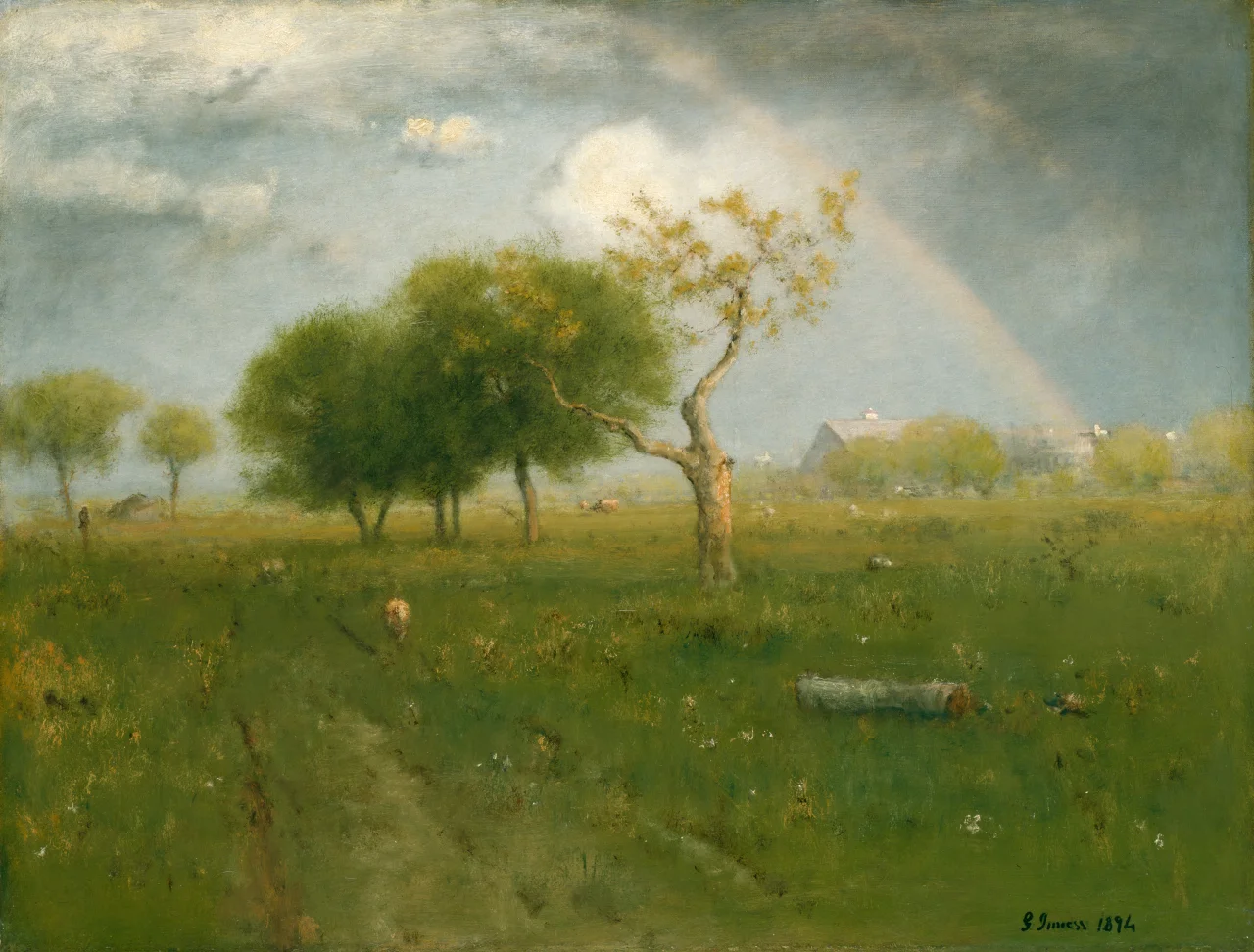
The grass comes first. In George Inness’s After a Summer Shower, 1894, the lower half of the canvas is a single field of green that does not sit still. Close to the bottom edge the color is thick and broken. Short, dry strokes of sage and olive lie over warmer ochre, and small flecks of yellow and white rise like flowers or lifted seed. A narrow path cuts in from the lower left, worn into the ground. Its pale track holds darker incisions where water ran or a cart passed, and on its margin a solitary sheep stands with its back to us, a light, warm shape against the cooler green. To the right of center a log lies on its side, bleached gray with a rust colored end, and a few darker stones collect around it. Nothing in this foreground is smooth. Inness lets the brush stay visible, so the field feels touched and re-touched, as if the air still holds moisture and the paint itself is damp.
Raise your eyes a little and the middle ground gathers into trees. At far left two small, thin trees stand apart, their canopies a dusty yellow green that reads as light before it reads as leaf. Just to their right a low, dark mound suggests a hayrick. Near the left edge a tiny dark figure keeps near a fence post, almost lost in the green. The central mass is more substantial: three or four trees grown close, their crowns a deep, rounded green that Inness has built with soft, overlapping touches. Their trunks are narrow and dark, set shallowly into the ground so that the field seems to rise to meet them. A few cattle, no larger than brushstrokes, dot the grass beyond them.
Against this darker mass a single tree leans. It is the picture’s hinge. Its trunk is pale, almost white where light strikes it, with passages of warm orange where bark is exposed, and it bends first to the right and then upward, as if it turned to follow the light. At the top its few branches carry sparse clusters of yellow, thin enough that sky shows through. The foliage is not dense. It is a cloud of small, flickering yellows held by a few dark lines, and it catches the brightness that opens behind it. That brightness is the sky’s clearest event. Almost directly above the leaning tree a large, soft white cloud hangs, thickest at its center and thinning at its edges, tinged at one low edge with a warm, impasto touch of cream. From its lower right a faint beam extends diagonally downward. In many reproductions the beam is barely legible. On the full surface it is a pale, warm veil, pink and peach at its core, gray at its borders, dropping toward the horizon on the right where a low barn with a white roof and a small red cupola sits among more yellow trees. The beam is a rainbow, a diffuse column of light that becomes visible because the surrounding blue remains heavy with rain.
The sky itself occupies the upper half with no single shape. To the left, darker gray greens press in. To the right, the same tone returns, but in the center the blue opens and pales. Near the top edge a broad, thin wash of whitish cloud stretches horizontally, and a few smaller, brighter spots, one pair near the center left built with thick impasto, punctuate the field. The transition from cloud to blue is not edged. Inness has worked the boundary with a dry, scumbled stroke, so one tone is dragged into the other. The result records how light behaves when water remains in the air: edges soften, distance loses certainty, and the brightest place is not sharp but suddenly open.
A late picture with a clear record
The facts around the painting are firm. The Art Institute of Chicago records it as After a Summer Shower, oil on canvas, 81.9 by 107.6 centimeters, signed lower right “G. Inness 1894”. It entered the museum in 1911 as part of the Edward B. Butler Collection. Michael Quick’s catalogue raisonne lists it as number 1140 and illustrates it, placing it in the final months of Inness’s life. He was seventy years old and at the height of a late style that critics had come to call Tonalist, though the term was applied more consistently after his death. In December 1894, a few months after he signed this canvas, Inness showed it at the Union League Club in New York, in an exhibition that included several recent landscapes. He died on August 3, 1894, in Bridge of Allan, Scotland, while traveling.
The provenance is straightforward, and the exhibition history is short, which helps keep the picture free of later narrative. Sold at the American Art Association in New York to Thomas B. Clarke in 1899, then to the collector Emerson McMillin, then to Reinhardt Galleries in Chicago, it came to Butler and then to the Art Institute. There is no dramatic rescue or rediscovery attached to it. It is a working picture from a man who painted more than a thousand works, a field study turned into a studio composition without becoming a demonstration piece. That plainness is part of why it rewards looking. It holds a familiar piece of ground under a specific, passing light.
Inness had spent his early career near the Hudson River School, painting clear, topographical views that earned him patronage. In the 1850s and 1870s he traveled in Europe and spent time in France and Italy, looking at old masters and at the painters of the Barbizon. There he encountered the writings of Emanuel Swedenborg, the eighteenth century Swedish theologian whose idea of correspondence proposed that natural forms answer to spiritual states. Inness, raised a Swedenborgian and later a serious reader of the theology, never made that doctrine into a set of symbols. He did not paint angels or emblems. In his mature work from about 1879 onward, the Swedenborgian pressure moved into handling. He described his aim as an effort to demonstrate the “reality of the unseen” and to connect the visible upon the invisible, phrases he used in notes that Adrienne Baxter Bell has collected and discussed. For Inness the unseen was not hidden behind nature but present within the act of seeing, and paint could make that presence felt by how it treats edge, tone, and atmosphere.
By 1894 that handling had become distinct. In his last five years Inness often worked with a limited, muted palette, building spaces from close valued greens and grays that could shift quickly toward ochre or cream where light struck. He thinned paint where distance required breath, and he loaded it where light required body. The surface could be at once vaporous and material, a quality that photographs flatten. In After a Summer Shower the handling carries meaning before any story does.
How the paint holds the weather
Return to the sky. The two small bright clouds near the center left are made with a loaded brush, the oil standing up from the surface. They are the most tactile marks in the upper half, and they sit near a thin, darker cloud that has been dragged with a dry brush so that its edge frays. Below them, the large white cloud behind the leaning tree is thicker at its heart and thinner at its rim, and Inness has left a narrow reserve of canvas or pale ground at its edge so that it glows without a hard outline. The beam that falls from it is painted with a broad, soft transition. He lightened the blue gray with a warm, semi transparent veil, allowing the underlying tone to show through, then barely warmed the center with a peach tint. Because the rainbow is not outlined, it depends entirely on the gray it interrupts. From a distance it is easy to miss. Up close it is a thin, deliberate veil of warm color laid just above visibility.
The same logic governs the field. Inness built a mesh of short strokes that vary in temperature more than in hue. The greens lean yellow in sun and blue in shadow, and the ochre beneath them shows at intervals, especially along the path. Where the path is most worn, the darker incisions are made with a thin, linear stroke that follows the ground’s slight rise. The sheep on that path is a single, warm, rounded mark with a suggestion of shadow on its underside. Its weight is exact. It anchors the path and gives scale to the trees, which otherwise could float.
The log on the right is a study in how Inness makes a thing present while keeping it within the field’s atmosphere. Its cylindrical body is a cool gray, laid down with a broad, level stroke. The cut end is a patch of rust, laid more thickly. Around it the grass is disturbed with smaller, darker specks that read as stones or clods. The log is the kind of leftover that a pasture holds after rain, and its horizontal stillness steadies the more vertical energies of the trees and the diagonal of the rainbow.
The trees themselves show three different modes of touch. The far left pair are thin and pale, their leaves indicated by a dry scumble that lets ground show. The central clump is denser, made with softer, overlapping dabs that merge at their edges, so the canopies feel like one mass seen through moisture. The leaning tree is the most linear and calligraphic: a firm, slightly serpentine stroke for the trunk, with a few darker lines marking fissures, and then a loose, almost flicked handling for the yellow foliage. The difference in touch keeps the trees from merging into a single decorative screen. Each group has its own rate of breathing.
Color follows the same restraint. The palette is dominated by greens that move toward gray or yellow without becoming strident, and by blues that move toward gray without becoming slate. The yellows are never pure. They are cut with white or ochre, and they appear most intensely in the leaning tree’s crown and in the far trees on the right, where late light would linger longest after a storm. The whites are mixed warm, never chalky, and the darkest note is a deep, transparent green black in the central foliage and in the small figure near the fence. Because the range is compressed, even a slight warming, like the peach in the rainbow or the orange in the bark, registers as an event.
Small figures in a large air
The human and animal presence is small for a reason. Inness could have staffed the field with a more legible narrative: a farmer, a flock in motion, a child. He chose near void. The dark figure at left is upright and isolated, too small to identify, and it is set against the palest part of the middle ground so that it reads first as a vertical mark. The cattle beyond the trees are no more than warm, recumbent ovals. The sheep on the path is the closest animate form, yet it is still less than an inch high on the canvas. Each of these marks does two jobs. They confirm that the field is inhabited, and they measure the space. Without them the distance to the barn would be harder to gauge, and the breadth of the pasture would be harder to feel. With them the field gains depth without needing perspective lines, which Inness has deliberately suppressed.
The barn on the right helps in the same way, but more subtly. It is painted so thinly that its white roof is little more than a pale horizontal against the hazy trees. Its red cupola is a fleck. He suggested its mass and allowed atmosphere to take it back. That decision keeps the horizon from becoming a line. The field meets the sky not at a boundary but at a diffusion, and the rainbow, which logically should touch the ground, fades before it arrives. The picture thus resists the kind of finishing that would make weather into illustration. The shower has passed. What remains is not puddles or dramatic clouds but a change in the way air carries light.
That change is easiest to see in how Inness treats the horizon across the whole width. To the left of the central trees the farthest green is almost indistinguishable from the pale sky, except for the faint, darker line of the two small trees. To the right of the leaning tree the distance behind the barn is a single, warm haze where tree, building, and sky share value. Only the leaning tree and the central clump insist on a sharp foreground. Everywhere else Inness has let edges dissolve just enough that the eye must adjust slowly. The painting rewards a longer look because it asks the eye to work at the speed of the light it records.
A shape for attention
Inness once wrote about painting as a form of attention that makes the unseen apparent through the seen. The phrasing can sound abstract, but the picture makes it concrete. The unseen here is the condition of air after rain, and the way that condition alters color and distance and feeling. Inness does not explain that condition. He re-enacts it in paint, so that the viewer experiences a small version of the same perceptual adjustment that follows a summer shower when clouds still hold but light returns in a broad, soft shaft.
That is why the rainbow matters while remaining faint. A stronger, more colorful arc would turn the picture into an emblem of hope or promise and would draw the eye away from the field. Inness keeps it barely there, a test of whether we are looking at tone or at line. Its diagonal contradicts the dominant horizontals of field and sky and the verticals of trunks. It is the only element that crosses from high cloud to low ground in one movement, and it does so with the least material. In that economy it behaves like an idea that becomes visible only when the atmosphere permits.
The leaning tree answers the rainbow without imitating it. Its trunk also moves diagonally, and its sparse yellow crown repeats the rainbow’s warmth at a higher saturation. Together they form a loose V that cradles the deepest green of the central clump. That V keeps the center from settling. The eye can rest on the dark green, but it is pulled slightly up and right by the tree and slightly down and right by the beam, so that the middle of the picture never hardens. The field stays open even where it is full.
Staying with the light
With late Inness it is tempting to speak of spirituality in large terms and to treat every muted landscape as a prayer. The painting is more precise than that. Its spiritual dimension lives in the decision to let a log stay a log, a sheep stay a small warm oval, and a barn remain a pale veil, while making the most of a slight peach gray that crosses the sky. Inness trusts that close attention to ordinary things under a specific light can hold a larger feeling without naming it. That trust is visible in how much he leaves unresolved.
The canvas was painted in the last year of his life, after decades of adjusting a style that critics at the time struggled to place. He worked between the realism of his early champions and the Impressionism then reaching American audiences through exhibitions. His late surfaces, with their compressed values and broken handling, were sometimes called indistinct or poetic by reviewers who preferred either sharper detail or brighter color. The quiet of After a Summer Shower would have been easy to overlook in a room with larger, more finished works. Yet the Art Institute’s decision to acquire it early suggests that someone saw how its quiet was constructed.
Today the construction is still legible if we give it time. In a digital image the rainbow can be missed entirely, and the field can look flatter than it is. The surface requires a few minutes at actual scale, when the eye learns to distinguish the thinly glazed distance from the more thickly scumbled foreground, and when the yellow of the leaning tree begins to hold against the gray. The reward is steadiness. The shower has passed. The ground is still wet. The air, for a short interval, makes light visible as it moves. Inness, seventy years old and in the final months of a long practice, found a way to keep that interval from disappearing.
That may be the most useful way to carry this picture forward. It takes a broad but modest pasture, the kind of ground that would not be named on a map, and it shows how much visual and emotional work such ground can do when light changes. The field, with its stones and log and single sheep, is ordinary. The sky, with its heavy clouds and its tentative beam, is also ordinary. What remains uncommon is the care with which paint registers the break after rain, the moment when the world seems both washed and lit from within. Inness holds that moment long enough for us to see it as a condition that belongs to sight itself, not only to meteorology.