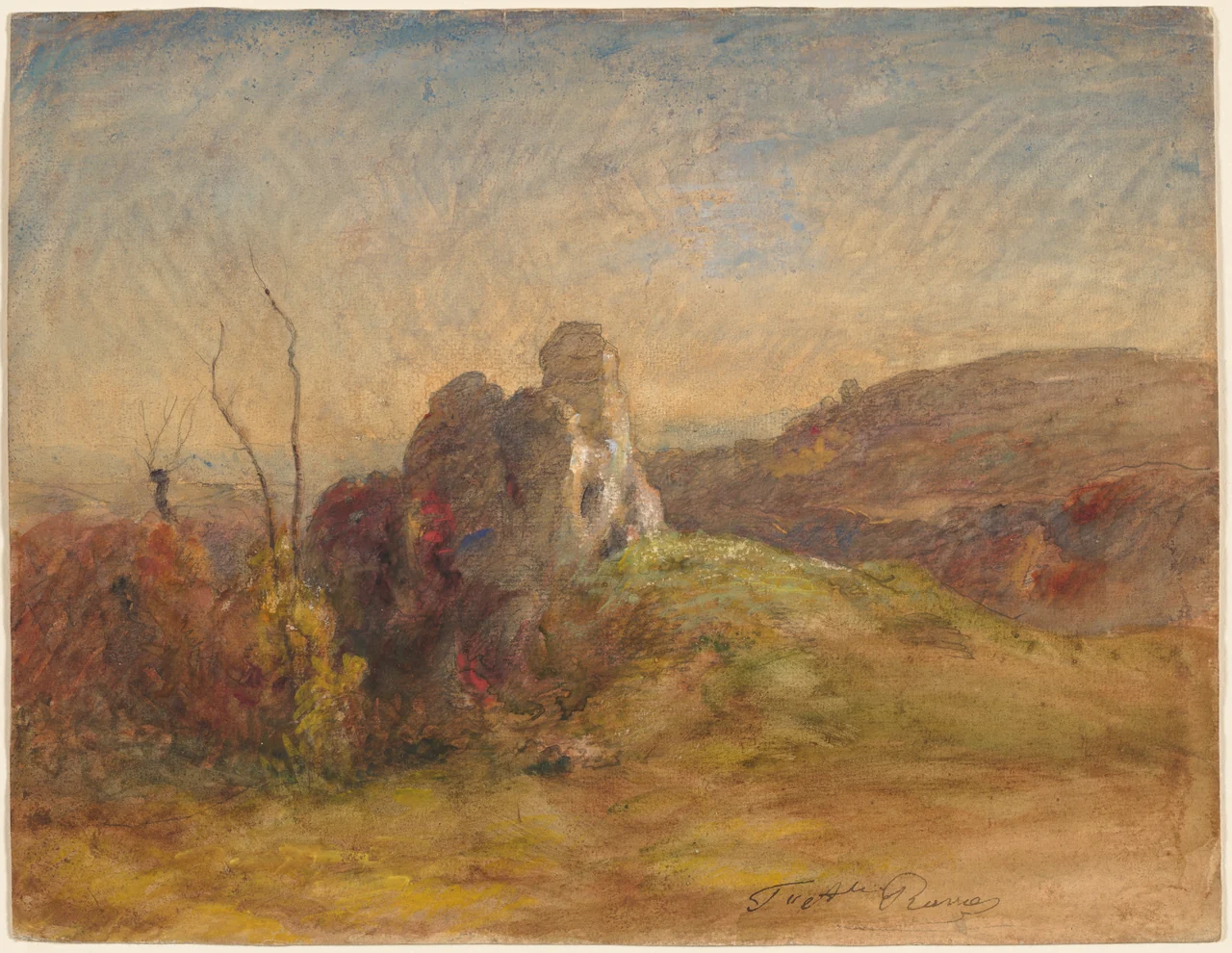
A ruin occupies the rise just left of center, low enough to belong to the hill and dark enough to interrupt it. Its broken walls gather into an irregular brown mass. One narrow face catches pale light, while a black opening cuts into it. Beside the masonry, two bare trunks extend into the sky. Their slight lines have almost none of the ruin’s weight, yet they give the eye a second measure of height. Without them, the building might settle into the red foliage and disappear.
François-Auguste Ravier made Landscape sometime between 1870 and 1884, on a sheet only 27.7 by 35.9 centimeters. The Cleveland Museum of Art records watercolor and gouache with graphite and traces of black chalk. That list matters because the landscape depends on different kinds of mark remaining active at once. Lines establish the ruin, trunks, slopes, and scattered branches. Color does not simply fill those boundaries. Brown, green, red, and yellow cross them, cover them in places, and allow them to return elsewhere.
The strongest darks cluster around the ruin and the vegetation below it. Red and orange collect in rough passages at the left, with smaller bursts on the distant right slope. Across the foreground, yellow-green strokes loosen the surface of the ground. Some marks follow the hill; others seem laid over it, as if the land had to be built by repeated contact rather than one continuous wash. The pale area on the ruin does something similar on a smaller scale. It brings the wall forward, then lets gray and brown pass back across it.
Graphite and black chalk belong to the sheet’s structure, but the visible lines never form a complete enclosure. A trunk thins as it rises. The ruin’s upper contour firms, breaks, and resumes. Fine branches become difficult to separate from marks in the air around them. Watercolor carries blue, gray, cream, and tan across the sky in broad horizontal and diagonal passages. Gouache adds opacity among a field that otherwise keeps showing the movement beneath it. The four recorded media do not divide the image into drawing and color. They let firmness and drift occupy the same place.
The sky takes nearly half the sheet, but it does not sit behind the land as a separate zone. Cream near the horizon enters the narrow space between the ruin and the right ridge. Blue reappears above the ruin in rubbed and broken patches, then gathers more firmly along the upper edge. Because no hard line closes the horizon across the center, the pale air presses down among the darker forms. The trees make this contact easiest to see. Their trunks cross from dense foliage into color that seems less placed than still in motion.
This method appears in other works Ravier made around Morestel. A related sheet of about 1868 in the Louvre uses watercolor and gouache in broad, superimposed touches with gouache highlights. Another Morestel landscape of about 1870 in the Musée d’Orsay combines watercolor over pencil with gouache. These works do not provide a recipe for the Cleveland sheet. They establish that Ravier repeatedly used drawing, transparent color, and opaque accents together, giving a modest sheet the density of sustained studio work.
Ravier lived at Morestel from 1867 until his death in 1895. Accounts preserved by Maison Ravier describe a practice divided between outdoor work at dawn or dusk and longer work in the studio during the day and evening. Rapid sketches and annotations could serve as reminders. Cleveland accordingly describes his watercolors as considered studio works distilled from remembered experiences in nature, and calls this one a highly worked view of the landscape around Morestel.
Memory here does not mean vagueness. The identity of the ruin and its precise location are not established, but the sheet keeps exact relations: the building sits against a lower band of foliage; the bare trunks rise from its left edge; a subdued ridge crosses the right; the foreground falls open below. These placements hold the view together while color alters its pressure. The arrangement could have been retained from looking without preserving every local fact. What remains exact is the way masses answer one another.
The paper’s visible edges make the construction plain. This is not an opening into an indefinitely receding world. It is a worked surface on which the foreground thins near the lower margin and the upper blue approaches the worn boundary of the sheet. Even the signature rests inside the brown ground as another dark line. The scene gains breadth without concealing the small object that carries it.
Ravier gives the distant ridge a continuous, muted profile. Against it, the ruin is dense and interrupted, a fixed thing already losing its complete shape. Above both, the sky moves in streaks that can read as cloud, light, or the activity of the brush. Near the bare trees, those passages seem to pass through the finest branches. The ruin holds its place because Ravier keeps returning to its dark contours. The sky needs no such boundary. It crosses the sheet until the lines that preserve the landscape also show how close it is to coming apart.