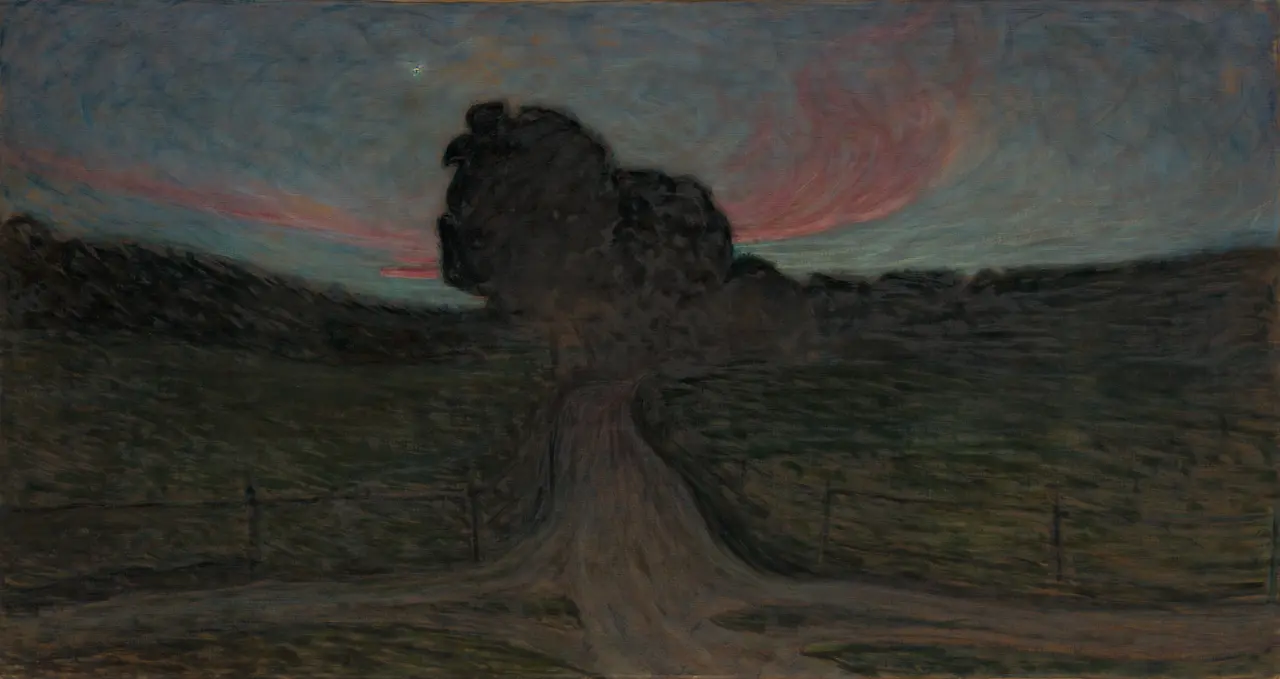
A small green white point hangs in a field of blue that does not want to let it go. In Eugène Jansson’s Evening Mood-Lidingö the star sits high and left of center, a single dab kept a little apart from the dark trees that anchor the picture. Below it the sky does not lie flat. Thick blue strokes curl and overlap in a slow vortex that tightens toward the horizon, as if the evening air were being pulled toward a drain behind the trees. At the bottom of the picture a pale dirt track divides. One branch angles to the left corner, one to the right, and both disappear before they reach you. Between road and sky the field lies empty except for fence posts that tick toward the center at even intervals. No figure stands on the path, no light burns in the trees. The picture is extremely wide, 90.1 by 168.6 centimeters without its frame, and its width makes the emptiness feel extended. You are placed on the ground, not above it, a few steps before the fork, looking along a perspective that moves quickly and then stops at a dark mass.
The Cleveland Museum of Art, which has kept the painting since 2005, describes the effect with precision: swirling brushstrokes and telescopic perspective converge on the dark mass of trees and dying sunset in the center. That sentence is spare, but it points to a specific technical choice. Telescopic perspective here rushes the foreground forward in wide, shallow steps and compresses the background behind a narrow slit of pink orange light. The fence posts do the measuring. Near the bottom edge they are spaced well apart and their verticals read as sturdy rectangles of dark against the pale track. A few dozen meters back their intervals shorten. By the time they reach the trees they have become a picket of thin ticks, and the blue field above them has tightened its curve so that separate strokes near the bottom, which travel in broad arcs, shorten and crowd near the horizon. The effect is like looking through a tube whose near end is wide and whose far end has been pinched. The dying sunset occupies that pinch as a horizontal bar not more than a finger high, a strip of rose and thin peach that keeps its color even as the blue around it deepens.
Look longer and the blue separates into decisions. Several blues lie side by side and one over another, the strokes remaining visible as physical trails. A medium dusty blue carries the main mass. A colder gray blue underlies it in the upper left and near the horizon, where Jansson has let a paler tone show between strokes. A slightly warmer ultramarine deepens the swirl over the central trees. Thin seams of the ground color, a warm off white, remain between strokes in the most agitated passages, so the blue appears to breathe even at night. Where a pink sunset streak cuts across, it does not blend into the blue. The pink sits as a separate set of short strokes that interleave with blue at their edges, a cool rose next to a warm rose, both distinct against blue. That separation keeps the sky from becoming a smooth twilight gradation. It stays worked, the way a plowed field stays worked, and the time spent making the surface remains legible.
The star interrupts that work without contradicting it. It is small, round, a touch green in its white, and it is placed where the swirl loosens rather than where it tightens. The strokes around it relax into a quieter clearing of pale blue that lets the point read. The color of the star matters. A cool green white holds its temperature apart from the rose of the horizon and differs from the warm yellow of a street lamp. By keeping that distance in hue as well as position, Jansson lets the picture hold two different times at once: the last warmth of sunset straight ahead, and the first cold clarity of night overhead. The melancholy the museum description names follows from the structure. A road that divides before you, a destination that narrows to a slit of color behind a dark block, a light that appears elsewhere and does not lead along the road you have been offered.
That structure belonged to a specific place and a specific way of living in Stockholm at the turn of the century. Jansson was born in Stockholm in 1862 and, unlike many Swedish painters of his generation who went to Paris, he stayed. He had trained at the Tekniska skolan and at Perséus’s private school and spent time at the Academy, but after those early studies he remained in the capital that supplied almost all his motifs. From the mid 1890s he lived on the heights of Södermalm, the poor southern district where rents were low and views were long. He lodged at Timmermansgatan, then Bastugatan 40, then Hornsgatan, each address a little higher, each window giving a wider sweep over Riddarfjärden and the islands beyond. Friends remembered him as shy, watchful, and given to long walks not to sketch so much as to remember. He was said to use his memory as a sketchbook, carrying the city in his head to the studio.
The city he carried was changing quickly. Stockholm in the 1890s was unevenly electric, full of paraffin lamps whose yellow light gave Jansson an early nickname among other artists: Paraffin Jansson, for the way his lit windows recalled the lamps in ordinary houses. Factories and rail led to denser districts and new leisure, yet Södermalm’s streets at the hours Jansson favored were often empty, a condition he did not invent but found and kept. The fields beyond the center, like the one at Lidingö shown here, were within walking or ferry distance from his door and still felt peripheral, places where town ended and open land began without a clear border. A field near Stockholm, the museum says, and the vagueness is accurate. Lidingö at this date was an island of farms and summer villas east of the city, not yet fully suburban, and its name here points less to a precise site than to a kind of ground: flat, damp, bordered by low trees, the sort of margin where a city can be felt behind you even when you cannot see it.
Jansson’s blue grew in that margin. The Thielska Galleriet, which now holds the largest single collection of his work, describes his characteristic Skymnings motiven as developing from around 1896, when his paintings took on shades of blue in every possible nuance and often crossing strokes. Over the years his pictures moved toward increasing simplification and abstraction, until at the end of the blue period little more than street lights and their reflections could be discerned in the blue. The gallery’s account names three permissions he borrowed and transformed. The first was Edvard Munch, whose work was shown in Stockholm in 1894 and whose ambition to explore psychological states rather than external appearances Jansson understood early, as the Cleveland text also notes for 1884. The second was James McNeill Whistler, whose nocturnes taught how little description a night picture needs to hold. The third was Vincent van Gogh, promoted in Sweden by Nils Kreuger, whose loaded stroke showed how a surface could stay agitated without describing wind.
None of those borrowings explains the swirl in Evening Mood-Lidingö directly, and that is part of its interest. Munch’s influence after 1894 is visible in the willingness to let a color carry a feeling and to compress depth, but Jansson’s vortex does not look like a Munch shoreline. Whistler’s nocturnes tend to dissolve edges in thin, horizontal veils, while Jansson thickens edges and lets them curl. Van Gogh’s sky can swirl, but his energy usually fragments into short, high contrast jabs. Jansson keeps a lower contrast inside blue and lets the energy run long, each stroke continuing across inches before it is crossed by another. The result is closer to a current than an explosion, a tide of paint pulled gently inward rather than a starry turbulence. What Jansson took from those painters was less a motif than a sanction: that a local landscape could be made from a limited palette, that a stroke could remain visible and still belong to a place, that a picture could be about a state of mind without adding an explanatory figure.
That sanction had a practical patronage that kept it in paint. In November 1898 the banker Ernest Thiel visited Jansson’s studio on the recommendation of Karl Nordström and bought three pictures. The sale lifted Jansson from chronic shortage, and Thiel went on to buy sixteen more, ultimately nineteen works that now form the core of the Thielska Galleriet collection on Djurgården. Thiel wrote later that Jansson returned repeatedly to a question phrased like a helpless plea, why, why do I paint, and that temporary reassurance always gave way to new doubt. The friendship matters for this picture because its history passes through it. The provenance recorded by Cleveland begins with the painter’s friend Richard Bergh, who received the picture directly, then Bergh’s son Adrian, then the Bergh family until the 1980s, then the Stockholm dealer Claes Moser, who sold it to Cleveland in 2005 for the Mr. and Mrs. William H. Marlatt Fund. A Stockholm field painted for Stockholm viewers traveled, after a century of private keeping, to an Ohio museum where Scandinavian modernism is an occasional guest rather than a host. That displacement helps explain why the work has remained little known in the United States, appearing locally only in storage presentations like Stories from Storage in 2021 and abroad in a focused loan such as Mystical Landscapes at the Art Gallery of Ontario in 2016.
The interval that makes distance
Return to the surface and the displacement becomes part of how you see the picture now. A viewer in Cleveland meets the field without the automatic context that a Stockholm viewer brings to the word Lidingö or to the sight of a low archipelago horizon. Information that might have been immediate, the quality of late summer light at latitude 59 north, the way a damp Swedish field holds sky, has to be learned through the paint itself. Jansson helps that learning by refusing shortcuts. He pares the scene to the minimum that still reads as place: path, posts, trees, slit of sunset, swirl, star. Everything else is relation.
Fence posts, brushstrokes, and color each measure distance in a different way. The posts grow closer together as they move toward the trees, so you feel how far the ground extends. The blue strokes crowd together where the air feels heavier and open where a little more light remains, so you sense how late the hour has become. The narrow pink bar stays thin between the dark trees in front and the deepening blue above, holding its warmth in a short length the eye can cross quickly. The star sits diagonally across the blue from that pink slit, a cool point that answers the warm one. Looking from one to the other carries your attention across the blue, and the time that crossing takes becomes part of the picture.
That traversal is where the painting earns the terms melancholy and loneliness that have followed it. The museum description is careful: feelings of melancholy and loneliness are relieved only by the appearance of the first evening star. The sentence attributes the feeling to the viewer, not to the painter, and makes the star the only relief. Visually this is accurate. The path that divides in the foreground offers a choice that does not help, since both branches lead out of the picture toward you rather than toward the center. No road connects the foreground to the trees. The field between is unbroken dark, and the trees themselves are a single mass without a gap. The only point that answers the eye at distance is the star, and it answers from a different register, above and aside rather than ahead. Loneliness here grows from the space itself, from a perspective that brings you close to branching ground and then gives you no passage forward except through a swirl that tightens toward a narrow rose line blocked by dark.
Jansson’s more familiar blue city nocturnes made from his windows over Riddarfjärden, pictures like Nocturne of 1901 or Hornsgatan of 1902, reduce the city to a suggestion of light where blue carries almost all the information. Evening Mood-Lidingö retains more land than those city pictures. It keeps the ground that a pure nocturne might erase. By keeping ground, it keeps a scale that lets the swirl read less as pattern and more as air. The city nocturnes often approach near abstraction, with street lamps and reflections reduced to flecks. This field stays legible as a field, and that legibility makes the vortex more unsettling, because it does not float free as a decorative swirl. It organizes a place you can imagine walking.
The paint itself stays equally legible as work. Oil on canvas, the catalogue says, and the surface shows why the choice matters. Canvas holds a thick stroke without sinking the way paper would, and Jansson uses that hold to keep each pass slightly raised, so that where strokes cross a small ridge forms. In the upper blue those ridges catch light when you move, a low relief that photographs smooth away but that a viewer in person feels as a faint shiver. The crossing is not random. Many strokes follow a broadly concentric direction, bending around the central dark, while a second set cuts across them at a shallow angle, often a little shorter, to keep the concentric motion from becoming a mechanical target. The crossing steadies the motion. It prevents the swirl from reading as a single gesture and instead makes it the accumulation of many.
A Swedish picture in Ohio
That accumulation also marks the moment in Jansson’s career. In 1900 he was still inside the blue period that would last until about 1904. After that, exhausted by the same questions Thiel recorded, he withdrew from exhibition for several years and then turned to a different light and a different muscle: the sunlit male nudes made around the navy bathhouse at Skeppsholmen. Those later works, with their pale flesh and hard shadows, look nothing like Evening Mood-Lidingö, but the museum’s later contextual writing draws a continuous thread: both sets of pictures are about urban places where men who loved men could meet, the empty night streets of the blue pictures and the bathhouse terraces of the later ones, at a time when such acts were illegal in Sweden until 1944. To invoke that history here is not to assign a coded narrative to the Lidingö field, which contains no figure to code. It is to note that the attention Jansson brought to transitional spaces, the edges where city meets field, street meets water, night meets day, was already an attention to where presence is uncertain and where an interval can hold a possibility without naming it.
Seeing the picture in Cleveland sharpens that attention in another way. American museums have collected Scandinavian painting unevenly, often favoring a few Munchs or a few Copenhagen interiors, and a wide blue field by an artist called the Blue Painter in his own country can read as peripheral until placed among its own kind. The Cleveland installation, when the work is on view, puts it near other modern European paintings of 1890 to 1910, where its width and its restricted palette make it conspicuous for the opposite reason that a colorful Fauvist hangs conspicuously. It holds the wall through sustained low blue, a field that stays quiet at first and then keeps attention once seen. Its quietness is a form of holding.
The picture also holds because it is technically conservative in a way that helps its innovation. Jansson uses conventional oil on canvas and a conventional horizontal landscape format, keeping a traditional tripartite division of foreground, middle ground, and sky. Within those conventions he adjusts only how direction and interval behave. That modesty is part of the work’s longevity. A later viewer does not need a manifesto to enter it. The path provides the entry, it divides, the eye chooses a branch, and the blue begins to move.
Follow one of those strokes with your eye as a final test. Start near the lower right where a mid blue arc leaves the edge, travel left and slightly upward as it crosses a grayer blue, see it dip to pass under a second stroke that moves opposite, then let it straighten as it approaches the horizon where the rose begins to interleave. The stroke stays blue the whole way, but its temperature shifts slightly as it passes over or under another blue and near the rose. That shift is enough to keep the passage from flattening into a single tone. The same happens across the whole sky: small shifts in temperature, spacing, and direction build distance without a change of hue or a drawn road. The picture teaches that difference does not require strong contrast. It can live in steady, slight adjustments that accumulate until distance appears.
At the center that distance ends in the dark trees and the thin sunset. The trees are the only mass that does not swirl. Their edges stay vertical and slightly ragged, a compact silhouette whose top is softer than its sides, as if the blue has begun to wear at it. Behind them the rose is thinnest at the middle and widens slightly toward the right, as though the last light were holding longest at a point just beyond the tree line. Jansson lets that widening be small. He does not make a display of the dawn or dusk that a more theatrical painter would enlarge. The drama remains compressed. That compression keeps the star necessary. Without the slit of rose, the star would be an ornament. With it, the star becomes a respondent.
It is easy to smooth these intervals into a single mood and make loneliness sound complete. The painting resists that smoothing. Its lanes remain apart, its blues remain separate strokes, and its path stays divided in the foreground without resolution. The relief it offers is single and small, a cold point of light that holds its place while blue moves around it. The field retains its posts, the dark trees, and the thin band of warmth, and standing before it puts you at the fork where the road divides and the blue continues beyond. The picture does not ask for a general feeling of melancholy. It places you where distance is made stroke by stroke and lets the feeling follow from how far the star is kept.