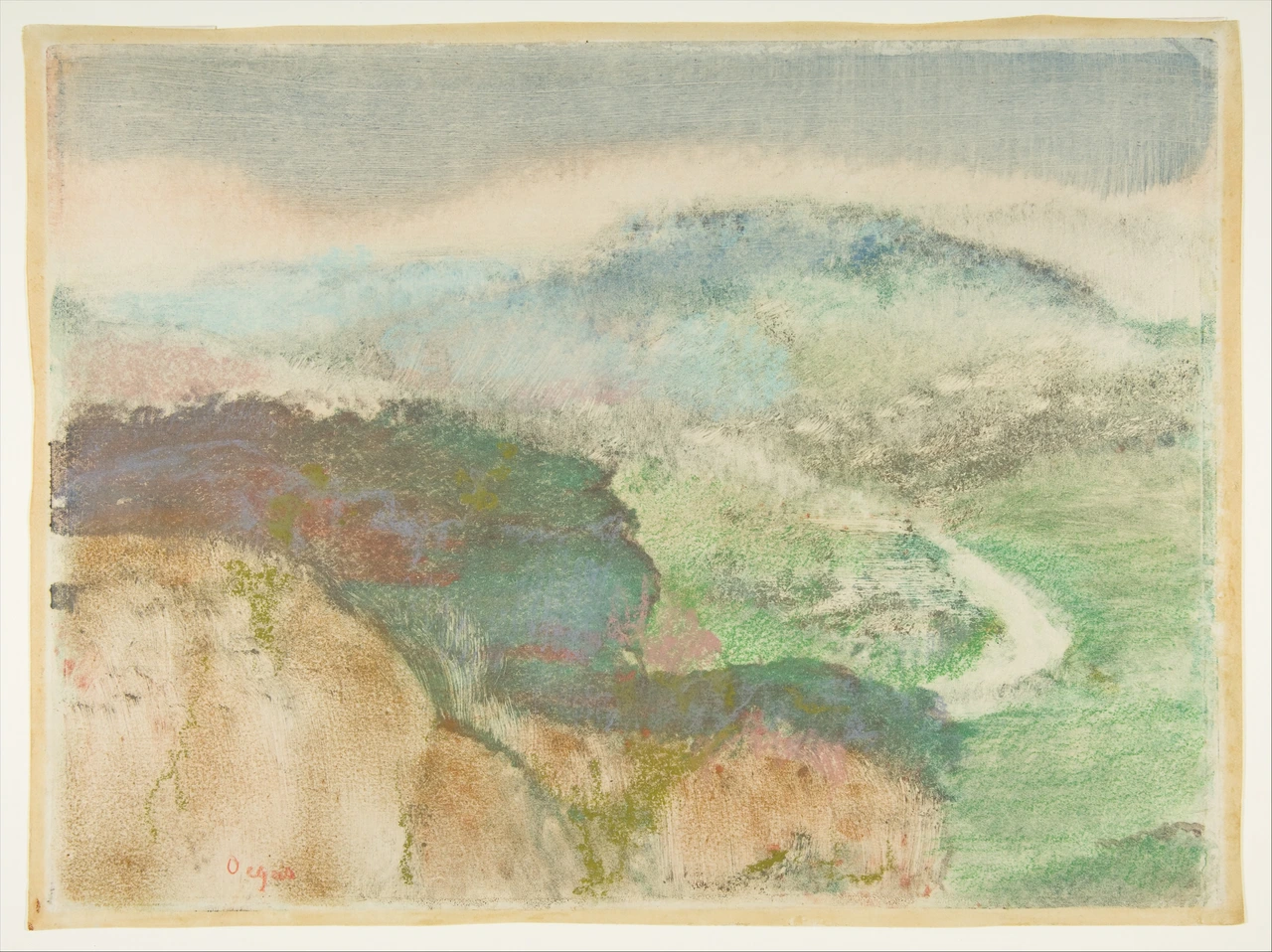
The sky on this sheet was dragged into place. Across the upper edge of Edgar Degas’s Landscape, a band of slate blue gray runs in long horizontal strokes, and the strokes themselves remain visible as fine parallel striations, the way paint looks when a wide tool pulls it once over a flat plate and does not come back. Toward the upper right corner the band thickens and cools, the strokes shortening into something closer to hatching. Moving left, it thins instead, losing opacity until it stops asserting itself altogether and the warm tone of the paper takes over. Nothing below draws a line against it. A broad hill in blue green rises through the middle of the sheet with a crest as soft as smoke. Sky turns into land through temperature and density alone; distance registers first as a change of color, then as location.
At lower left a pale ochre slope climbs steeply, grainy with stipple and scored by vertical drags, freckled with olive and warmed by small pink accents; it is the brightest thing in the picture. Against it, toward mid left, a dense bluff of violet brown, olive, and slate juts into the scene, and along its flanks little flecks of rose and red surface and vanish, the warmest notes anywhere near that cool mass. From the center a darker ridge descends diagonally toward the lower right, ribbed with vertical strokes, patched with pink. On the right a narrow cream band winds through brighter green, bending like a river or a sandy track, and it goes nowhere that the eye can follow. Scattered red pink touches recur over the whole field, tiny events against muted sage, slate, and tan. The word Degas sits in red at lower left, inside the printed area. No figure stands anywhere in this weather, and no building interrupts it. The sheet measures 25.4 by 34 centimeters. It is dated 1892, it is a monotype in oil colors heightened with pastel, and the Metropolitan Museum of Art bought it in 1972 with funds given by Mr. and Mrs. Richard J. Bernhard.
The Met’s description reads the image as a view of mountains partially obscured by mist, on the verge of abstraction. The mist is easy to confirm: forms lose their edges, distances close, the air seems to thicken between the ridges. To see where that veiling comes from, start with how the sheet was made.
One pass through the press
A monotype is the most contrary thing a printmaker can make. The artist paints or rolls ink onto a flat surface, usually metal or glass, lays paper over it, and runs the pair through a press. Whatever transfers, transfers once. There is no cut block, no engraved line, no stone to re-ink; the plate holds only the residue of decisions made minutes earlier, and it carries no design that could be printed again. Printmaking usually exists to multiply images, and the monotype keeps the press while giving up that purpose. The result sits strangely between categories, a print made the way a painting is made, or a painting that could exist only because it passed through a press.
Degas took to that contrariness with unusual appetite. He kept an etching press in his studio, and the Museum of Modern Art’s account of his printed work calls him perhaps the most prolific and innovative practitioner of the monotype in the nineteenth century, with several hundred compositions to his credit. Look at this sheet and the appetite becomes visible as surface. The long parallel streaks in the sky are transfer marks: broad ink dragged or rolled over the plate, then committed once to paper. Where the grain turns speckled, as on the green fields at right and along the ochre slope, ink sat unevenly on the plate or the roller skipped, leaving a stipple that no brush would naturally produce. The fine diagonal lines that cross the central hill arrived after the broad tone, cutting across it too regularly to be accident; whether they were ruled through something wet or laid down afterward in chalk, they are corrections of texture, the hand adjusting what the press delivered. And the dusty pinks that flicker along the bluff and the ridge sit dry on top of darker ink, chalk pressed over the printed film, warming it from within.
Monotypes sat inside a broader restlessness with printmaking that lasted most of his career. He copied Old Master etchings as a student exercise, made lithographs of café concert singers and backstage subjects, and planned a print journal called Le Jour et la nuit together with Mary Cassatt, Camille Pissarro, and Félix Bracquemond, a venture that never reached publication. The Modern’s account describes proofs scraped down, reworked, and printed again through many states, an appetite for revision that the unique monotype satisfied in concentrated form, since every change had to happen on top, visibly.
So the surface records two different kinds of time. One is the time of the press: fast, singular, irreversible, everything decided in the minutes before the rollers turned. The other is the time of the hand: slower, revisiting, adding the hatched lines, the pastel flicks, the red signature, adjusting relations that could no longer be undone underneath. Here both remain legible, layered in plain sight, and the picture’s peculiar liveliness comes from their disagreement. The press produced a world already in motion; the hand returned to decide what mattered in it.
Nobody stood in this weather
The circumstances of the series explain why invention runs through these sheets so openly. In October 1890 Degas visited the Burgundian estate of his friend the painter Pierre Georges Jeanniot, and the visit started something. Over the following two years he made about fifty landscape monotypes, a body of work the Museum of Modern Art links to a twenty day carriage trip through Burgundy. The Met’s text adds a caution worth keeping: this particular sheet is thought to reflect that experience of traveling through the countryside in a horse drawn carriage. His name for the group, by contrast, is on the record: both museums give the phrase as “imaginary landscapes.”
Read the sheet from that seat in a moving carriage and several features fall into place. The view arrives in stacked bands: dark bluff nearest, hill beyond it, sky above, with the ochre slope so close at lower left that it reads as terrain passing beside the road more than scenery arranged ahead. The winding pale band at right is seen from above and across a valley, the kind of angle a passenger gets looking down from a ridge while the road drops away. None of this proves Burgundy for this particular sheet, and the museum stops short of claiming it. It only suggests how much the picture assumes motion and height instead of a planted viewpoint, the habits of someone remembering a journey.
He came to landscape late and sideways, against every example around him. The painters he exhibited beside in the Impressionist years built their pictures outdoors, in front of the motif, chasing hours of light. Degas had made his name on the opposite material: rehearsal rooms, racecourses, cafés, millinery shops, the interiors where modern Paris performed itself. Landscape barely figures in his work before middle age. Then, in his late fifties, he began producing views of hills and weather that he did not go out to find, working them at his press from recollection and from the behavior of the materials themselves. Working loosely was the method itself: these sheets present the idea of a landscape, as the Modern’s text puts it, more than any particular view.
With nobody posted at a spot with an easel, nothing organizes the sheet around a single vantage. The ochre slope at lower left approaches as if you were near it; the winding band at right recedes as if you were far from it; the two conditions share a frame without reconciliation. Light falls from no direction, so nothing casts a shadow and no clock exists in the scene. Recollection behaves the same way: it stores temperature, a warm mass here, a cool distance there, a bright fragment of road. The sheet assembles landscape patch by patch, the way memory does, and the mist that the museum’s description notices fills the places where detail stops.
A private habit shown once
Almost none of this was made to be seen. Degas treated prints as a private laboratory: the Modern’s publication counts roughly sixty six printed compositions in his career and finds only four published in editions during his lifetime. Monotypes, unique by nature, he kept, gave away, or worked over, and he made the landscapes this way across two years while showing them to almost no one. That privacy makes the exception stand out. His public habit had been the group Impressionist exhibitions, where a printed hillside would have been an oddity among dancers and laundresses. In 1892 he went further and allowed a group of the landscape monotypes to be shown at the Durand Ruel gallery in Paris, the dealer who handled the Impressionists. The gesture has the flavor of a wager. An artist famous for observing modern life chose to show weather that nobody had witnessed, produced with rollers and plates far from nature. Richard Kendall’s study of Degas’s landscapes devotes a chapter to that showing, and Howard Lay wrote an entire essay on those Durand Ruel monotypes and their moment; the reception, then and since, has never quite settled on what to call them.
Time has been generous to the wager. The 1993 catalogue that accompanied the exhibition Degas Landscapes, seen at the Metropolitan Museum of Art and then in Houston in 1994 and organized by Colta Ives with George Shackelford, put the monotype group at the center of a story the field had long told through ballet dancers and bathers, and at least one reviewer used this very sheet to stand for the whole enterprise. Two decades later the Museum of Modern Art built an exhibition, A Strange New Beauty, around Degas’s monotypes themselves. A body of work made in semi privacy now anchors two separate reassessments of a canonical career.
Mist, manufactured
Go back over the sheet with all of that in hand and its organization clarifies without stiffening. Two dark masses face two light ones: the violet bluff and the central hill answer the ochre slope and the bright green fields, and the winding cream band slips between them as the only continuous line in the composition. The scattered pink flecks bind each dark mass to its surroundings, so the transitions never harden into outlines. Every shape loses definition exactly where a drawing would need it most, at the boundary where one form meets another, and the loss is even enough to feel like climate.
Paper tone shows through nearly the whole sheet, glowing behind thin color the way moisture glows behind haze, and the places where forms surrender their edges are the places where ink went down thin or was wiped back before printing. The veiling that makes the view read as weather is a record of the plate’s condition, thin in one place and cleared in another. When the Met’s description finds a mountainous landscape partially obscured by mist and verging on abstraction, the observation is exact as far as it goes; the explanation lies in the printing itself. Degas found procedures whose natural byproduct looks like atmosphere, then arranged the results until the resemblance held at a distance and dissolved under a close look.
Stand back and a humid mountain valley assembles, complete with a road, slopes, and weather coming in. Up close the valley comes apart into decisions: drag marks, stipple, hatching, chalk, the red letters of a name, some fixed forever when the rollers turned, others added afterward, unhurried, on top. The landscape tradition asked painters to go out and report on the weather. Late in his life, in a medium that permitted no revisions underneath, Degas discovered that the report could run the other way, and this sheet is what it looked like when the press, given hills and a river to suggest it, obliged with fog.