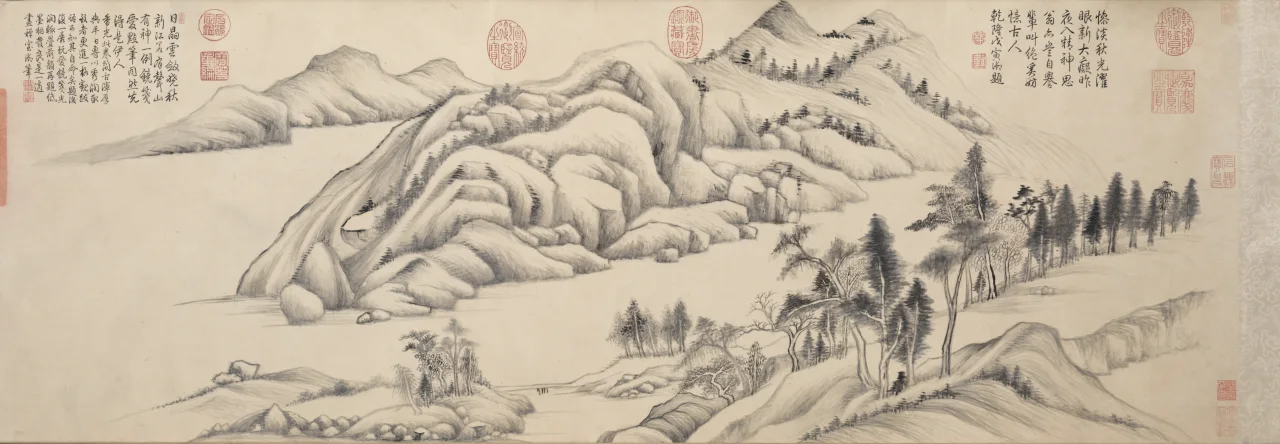
Before Dong Qichang painted a tree on this handscroll, someone tried to erase a royal document from its paper. The sheet had served in 1573 as an official presentation from King Seonjo of Joseon Korea to the newly enthroned Wanli emperor of Ming China. Its surviving text lists tribute that included horses and woven goods. Most of the writing was cleared or covered, while a large square impression remained. Its oil-based ink resisted removal, leaving the words “Seal of the King of Joseon” within the surface that Dong would use for a landscape about fifty years later.
The seal changes the nature of the blank paper around Dong’s ink. Open water, mist, and sky occupy a sheet that had already crossed a courtly border and carried an account of material exchange. The original support carries the faint document, the Joseon seal, the landscape, and Dong’s inscription; the complete mounted handscroll brings them together with collectors’ colophons that record gifts and remounting, and with later imperial seals. A handscroll reveals those histories through handling. Resting on a table, it opens from right to left in passages close to the span of two hands; the viewed section rolls away as another comes forward. River and Mountains on a Clear Autumn Day makes this measured disclosure part of its meaning.
The document becomes a painting
At the right, the painted encounter begins on a bank crowded with trees. Dark conifers form a loose rank behind pale, branching trunks, and the ground beneath them falls toward an expanse of untouched paper. A ridge rises behind the grove in long diagonal bands. Its contour carries the eye leftward, where the bank thins, water opens, and small groups of trees appear at wider intervals. The passage offers a route through changes of pressure and density before it offers anything like a continuous road.
The central mountain gathers rounded rock units into an ascending mass. Parallel strokes bend down their faces, repeat across adjacent slopes, and tighten around pockets of white. Lower forms advance from the water, middle forms turn inward, and a distant ridge rises behind them. These three distances give the composition momentum without fixing every part in a stable recession. One contour swells toward the paper’s surface while another recedes through pale ink. The mountain moves as a sequence of connected brush actions.
Those layered lines carried an earlier history for Dong. They derive from the “hemp-fiber” texture strokes associated with Huang Gongwang, the Yuan painter whose landscapes built earthen hills from long, softly worked strands. Dong straightened and simplified the pattern until it behaved like calligraphy. The strokes describe rock, then continue as rhythm: filling a concavity, wrapping a convex form, and leading into the next mass. A method once used to model terrain becomes the means by which the scroll advances.
Dong had studied Huang’s work closely and once owned Dwelling in the Fuchun Mountains. His field of reference extended through masters of the Tang, Five Dynasties, Song, and Yuan periods. Copying, in this practice, joined scrutiny to invention. A painter learned an old method through the movement of his own hand, then altered its scale, cadence, or structure inside a new work. The accumulated tradition was available as a set of living brush languages.
Across this scroll, trees change from saturated upright strokes to dry flickers; low shores stretch in fine horizontal lines; the central rocks collect repeated curves; the far peaks settle into broad, pale silhouettes. The transitions can be read as changes in terrain and as movement among inherited ways of painting terrain. Dong binds them through the diagonal rise of the composition and through recurring strokes that appear, disappear, and resume farther left. The journey proceeds by recognition transformed through use.
Near the end of the painted passage, the mountains loosen and descend. Dong’s own inscription follows them: “Huang Gongwang’s Autumn Day looks like this. I truly regret the master has not seen my work.” He signs with the name Siweng. The line extends the painted journey into an address across time. Huang is present in the texture of the slopes, and Dong claims the result as something the older painter would have needed to encounter in return.
The confidence of that sentence fits the landscape’s construction. Dong does not hide his sources inside naturalistic space. He lets the brush announce them, combine them, and move past their established use. Landscape and art history occupy the same passage. The river carries the eye between banks, while the marks carry a painter through methods learned from absent hands.
The painting becomes a gift
By 1690, the sheet had entered the collection of Gao Shiqi. When he had the scroll remounted, he added a colophon that identified the Korean paper and the traces of its first use. He could still see faint writing and the Joseon seal beneath the landscape. His note records both the material fact and the remounting that gave the object a renewed body. Sixty years after Dong’s death, another hand made the earlier document legible as part of the painting’s history.
Four years later, Gao carried the scroll while traveling north. At Wuchang, near Suzhou, the collector Song Luo brought wine to bid him farewell. They examined Gao’s paintings and calligraphy together, and Gao decided to leave this handscroll with Song, who owned no scroll by Dong. His inscription names the transfer as a parting gift and asks Song to add a poem so that their meeting will endure with the work.
Song’s long response preserves the social life of the scroll in unusual detail. He recalls paintings spread from bags and trunks, three days of rolling and unrolling, and the absorption that made conversation, sleep, and meals recede. He praises the silver sheen of the Korean paper, repeats Dong’s bold address to Huang, and records the difficulty of accepting such a generous gift. His poem does more than confirm ownership. It places the handling of art inside a friendship, with the scroll serving as the object passed between departure and remembrance.
The painted passage had already joined several historical brush languages. Gao and Song added another kind of continuity, made through custody, care, and exchange. Their words follow Dong’s inscription in the mounted scroll, so the imagined conversation with Huang gives way to a documented conversation between two later collectors. Reading moves from the authority of an old master to the intimacy of two people who had looked together.
The gift enters the imperial collection
Other owners continued the record. Shao Changheng added a colophon. The scroll then entered the Qing imperial collection, where the Qianlong emperor placed two inscriptions and fourteen seals upon it. A seal of the Jiaqing emperor and three seals of the Xuantong emperor followed. Red impressions now punctuate the landscape and its surrounding texts at several scales, turning acts of possession and judgment into visible parts of the object.
These marks do not all carry the same authority or purpose. The Joseon seal authenticated a diplomatic document before the landscape existed. Gao’s and Song’s seals belonged to connoisseurship and friendship. The Qing imperial seals placed the scroll within a dynasty’s collection. Their shared red color draws them into visual relation, while the handscroll’s sequence keeps their histories distinct. The Korean support passed through court administration and a painter’s studio, then continued within the mounted handscroll through private exchange and imperial custody without losing every trace of its earlier state.
Dong’s compact landscape is the scroll’s visual center, and its brushwork remains active enough to guide the hands from grove to mountain to inscription. The mounted object continues beyond that painted field. Colophons lengthen its duration, seals register successive claims, and the remounting preserves the paper that made all of them possible. By the time the final imperial marks were added, the landscape had become part of a larger record in which making, looking, giving, and owning each left a material form.