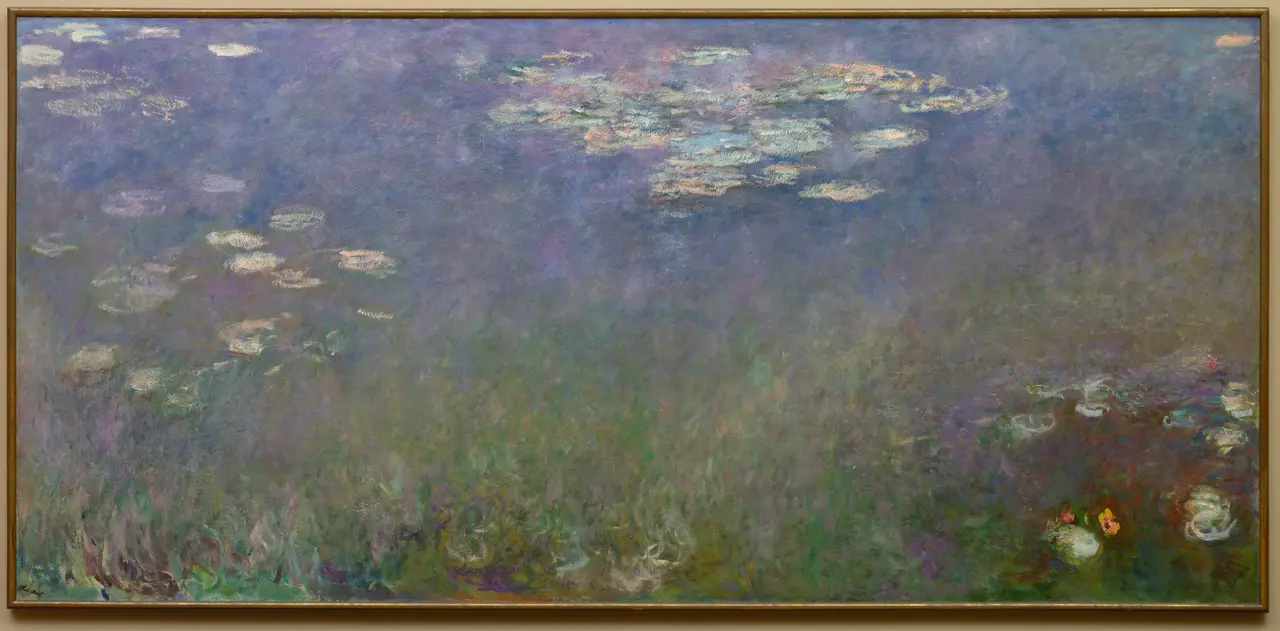
The straightest line in the reproduction is not in the pond. It is the narrow gold-brown frame around the canvas. That border makes Claude Monet’s Water Lilies (Agapanthus) look unusually obedient: one painting, one wall, one rectangle. The canvas has other habits.
No bank answers the frame. No horizon runs parallel to it. Blue and violet occupy nearly the whole upper field, while green strokes rise through the lower half as if water had become grass. Pale rafts of lilies gather near the top and left. White pads and small red, yellow, and pink blooms crowd into a dark knot near the lower-right corner. The pond continues in every direction that the wooden border forbids.
The painting is already too wide for an ordinary glance. Its unframed canvas measures just over two metres high and 4.25 metres across. Standing before it, a person must choose between seeing the whole arrangement from a distance and approaching closely enough for the water to break into strokes, scuffs, veils, and loaded turns of paint. Monet made that choice more difficult than this single width suggests. The canvas in Cleveland is the left panel of a three-part work almost 12.8 metres long.
The right edge is therefore both an ending and a join. Beyond it, the painted pond originally continued through a center panel now in Saint Louis and a right panel now in Kansas City. The three parts form the triptych Monet called Agapanthus. A museum frame can give each panel the manners of an independent landscape, but the work’s proportions belong to a different kind of encounter. It was a pond long enough to turn looking into walking.
A panorama without a viewpoint
Most panoramas reward the person who finds the correct position. From that point, a city, battle, or mountain range opens in convincing depth. Agapanthus removes the equipment needed for such mastery. There is no distant shore to orient the body, no sky placed safely above the water, and no path leading inward. The largest lily group floats high in the Cleveland panel, while the darker growth below seems to climb toward it. The eye can read the blue as reflected sky or as the water that receives that sky, and each reading reverses the apparent direction of depth.
Across the triptych, scale would not settle this uncertainty. It would enlarge it. The water could occupy most of the viewer’s horizontal field while refusing to disclose a stable position above, beside, or within the pond. Pale lily pads give brief evidence of a surface. Green and purple strokes complicate that evidence by rising through blue, sometimes like submerged stems and sometimes like gestures with no measurable depth. The picture does not construct a window onto Giverny. It distributes Giverny around a body that cannot take the measure of it all at once.
This ambition belonged to a larger undertaking. Monet developed 41 large-scale late panels, 22 of which are now installed at the Musée de l’Orangerie in Paris. He had a spacious studio built at Giverny, completed in 1916, where the canvases could stand around the walls while he worked. Period photographs show the panels sharing that room before museums separated them. Their physical setting was part of the problem from the beginning.
Agapanthus had a more particular destination in prospect. In 1920, Monet planned to give four series, twelve panels in all, to the French state. Louis-Bernard Bonnier designed a naturally lit circular building for them on the grounds of the Hôtel Biron, the new home of the Rodin museum. In that scheme, the warm field of Agapanthus would face the cooler blues of a triptych called Clouds. Two other sequences, Three Willows and Green Reflections, would complete the circuit.
That room would have made relations that no single reproduction can supply. Nearly thirteen metres of pond would have answered nearly thirteen metres of cloud across a circle. The panels were to hang low, so their painted surfaces would rise near the viewer rather than behave like elevated pictures inspected from the safe center of a gallery. Color, not a represented horizon, would establish the room’s opposing sides.
The building disappears
The Hôtel Biron project remained a design. By January 1922, Monet was considering the Orangerie instead, with a different plan for the panels. He then treated Agapanthus as a possible diptych, probably retaining the Cleveland and Saint Louis canvases and dropping the Kansas City panel. In April, he excluded the work from his final Orangerie arrangement. The famous oval rooms opened after his death with other expanses of water. This pond never reached the architecture once imagined for it.
Meanwhile, the paintings did not remain fixed. A photograph taken in February 1921 preserves an earlier state of the complete triptych. In the Cleveland panel, broad agapanthus leaves were visible at the lower left. Monet later covered them as he revised the composition. A full x-radiograph made from 84 sheets of film revealed the leaves beneath the final surface, and comparison with the partially examined companion panels showed that the Cleveland canvas was the most extensively reworked of the three.
The hidden plant matters here for a reason different from botanical detection. In 1921, both the room and the image had more explicit organizing features. The proposed architecture assigned Agapanthus a place opposite Clouds, while the painted leaves gave its title a visible anchor. The room vanished from the plan, and the plant vanished from ordinary sight. These events do not prove one motive or one coordinated withdrawal. They show how much of the work’s present experience depends on structures that no longer appear.
What Monet left visible does not look depleted. The lower left is busy with lavender hooks, green uprights, yellow-green flickers, and pale strokes that bend near the bottom edge. Covering the agapanthus exchanged a named plant for a more crowded kind of evidence. A stem can be followed for a few inches, then it merges with color. A curved mark can indicate submerged growth, then shed that duty and join the movement of the paint around it.
The same loosening occurs across the upper field. Lily pads remain distinct enough to locate water, but the blue-violet around them spreads with the breadth of air. Thin pink and cream passages cross cooler color without becoming clouds. The pond carries weather while withholding the line that would separate weather from its reflection. Revision did not push the work cleanly from landscape into abstraction. It made recognition intermittent, available in clusters rather than enforced from edge to edge.
Four metres in Cleveland
Today the triptych occupies three museums in three American cities. Its physical division gives each panel a new task. Cleveland’s left third must now provide its own beginning, development, and stop, even though its color was composed within a span that continued for another eight and a half metres. The dense flowers at the lower right can function as a local conclusion. They can also pull the eye toward the severed continuation just beyond them.
The photographed frame is part of this later condition, and it deserves more than irritation. It protects the canvas, records its life as a museum object, and lets a vast fragment occupy a wall as one work. At the same time, its firm perimeter makes Monet’s refusal of internal boundaries more apparent. Along the top, violet-blue paint runs almost uninterrupted beneath the wood. Along the bottom, plants press against the border without finding earth. The frame supplies the horizon the painting declined to paint, but it can supply it only outside the pond.
Water Lilies (Agapanthus) now holds several incompatible sizes at once: a framed object in Cleveland, one third of a triptych, and part of a circular installation that never existed. None is an imaginary correction to the others. Each belongs to the work’s history. The panel can be admired alone, yet its strongest spatial decisions keep pointing beyond solitude, toward companions in two distant museums and an absent room that would have turned their water into architecture.