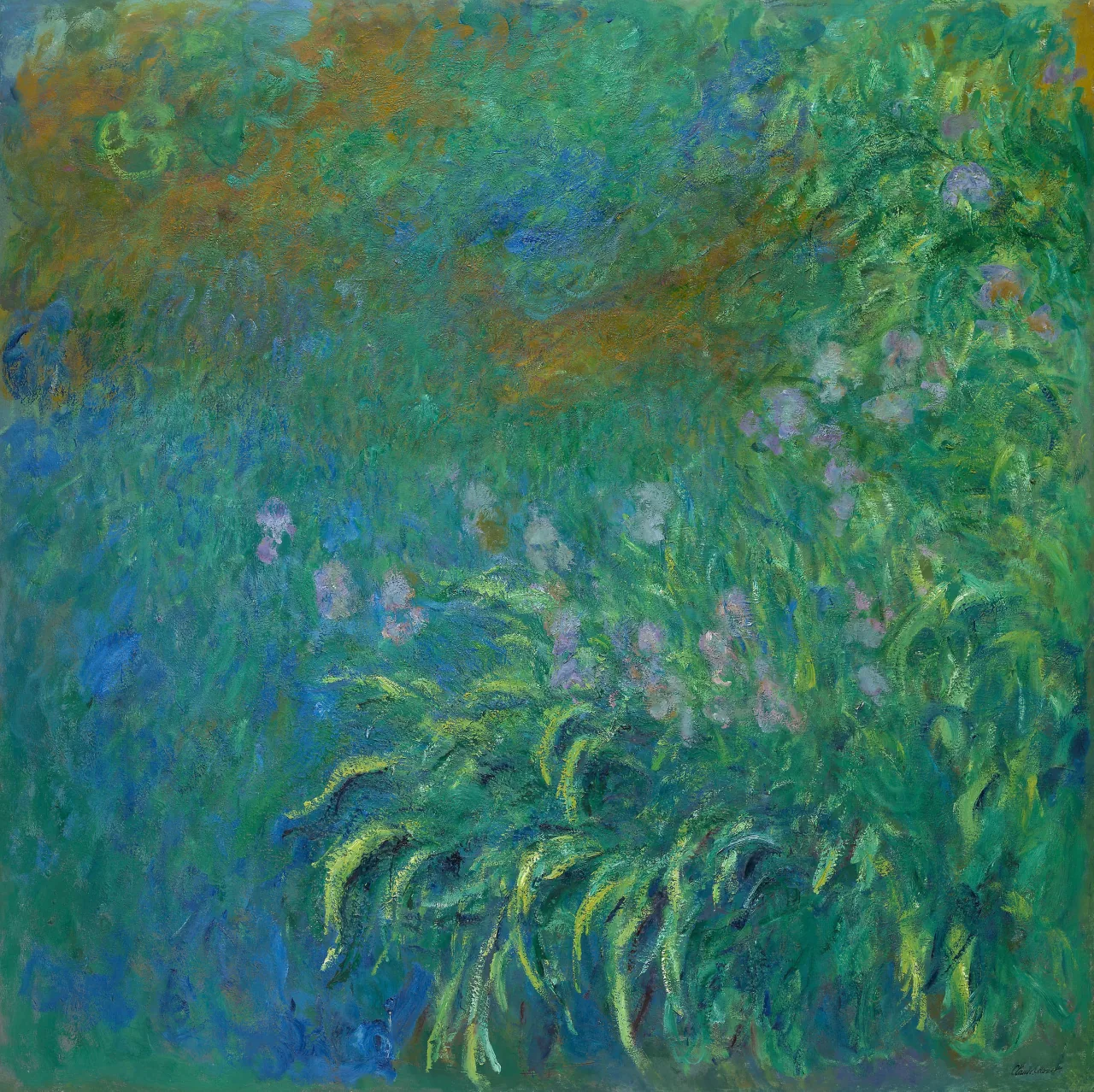
The irises in Claude Monet’s painting gather where the canvas becomes most crowded. Purple and pale blooms rise through curved leaves along the bottom, then climb the right side in a loose column. Several flowers can be followed from petal to stem. Their leaves bend in yellow-green hooks or stand as dark blades. Across the broad center and upper left, that certainty thins. Blue-green, violet, and russet passages overlap without settling into a bank, a pond, or a distant part of the garden.
This unequal distribution gives Irises its peculiar weight. The near-square canvas is two metres high and almost exactly as wide. It has the scale of a view that might surround the body, but its densest growth presses into the lower-right quarter. The upper left opens without becoming empty. Rounded green forms appear there, yet the field around them offers no horizon and no stable measure of depth. The eye moves from named plants into worked paint, then finds plants again.
Monet made the painting between 1914 and 1917, during his renewed work on enlarged treatments of the water garden at Giverny. He produced about twenty iris views in those years, many on canvases roughly two metres high. Some may have been studies for a larger decorative undertaking; some may have been considered as parts of it. The exact role of the Chicago canvas is unknown. The final cycle installed at the Musée de l’Orangerie contains water lilies, not irises.
That uncertainty keeps the painting close to the activity of the studio. It need not be assigned a missing architectural destination to hold together. Its visible organization is already exact: legibility accumulates at two adjoining edges, while the largest area resists classification. What looks open from a distance is thick with incident. Violet slips under blue-green, russet breaks through cooler paint, and a stroke that begins as foliage can lose its botanical duty before it ends.
Forms put down and covered
Technical examination shows that this instability was made through repeated work. Monet used a fine, pre-primed canvas and returned to it over multiple sessions. Thick layers lie one over another, with dry paint receiving later wet passages. The surface records accumulation rather than one continuous performance. Its density is the result of decisions made, covered, and reconsidered.
X-radiography and transmitted infrared reveal oval forms beneath the visible surface that are consistent with water lilies. Some earlier irises were covered as well. The examinations reveal only part of an earlier state: recognizable forms once occupied positions that Monet later worked over. They leave the first composition unreconstructed, and shape alone cannot identify every rounded mark now visible as a lily pad.
The painting’s broad center can therefore be seen as an area of active revision rather than an interval between flowers. Its difficulty is material. Layers have reduced the authority of individual objects while leaving differences of color, direction, and pressure in place. Near the bottom, a green curve can still declare itself as a leaf. Farther inward, similar movement joins a blue-green mesh where plant and water no longer separate cleanly. Revision carried structure away from outline and into density.
The hidden forms give the word unfinished a material specificity. An untouched area can suggest that work stopped before the painter reached it. In Irises, the least resolved passages carry superimposed layers, and some of the clearest motifs cover earlier ones. The uncertainty on the surface comes with evidence of sustained labor.
No final declaration
Monet kept Irises in his studio. He did not give it an autograph signature or date, and he did not exhibit or sell it during his lifetime. After his death in 1926, estate stamps were placed on the canvas. Those facts withhold several ordinary signs by which a painting enters public life as complete, yet they do not disclose what Monet would have changed or whether he regarded the work as a study, a decoration, or something between those categories.
The estate stamps do not close the history of its making. In places near the corners or edges, paint crosses one of them, so that paint must have been applied after the stamp. The examination cannot identify the person who applied it or support a claim of extensive posthumous alteration. This small sequence matters because the painting’s physical surface and its authorship do not end at exactly the same documented moment.
The canvas remained with Monet’s family and was with the Paris dealer Katia Granoff by 1956. That year, Art Institute of Chicago curator Katharine Kuh acquired it for the museum. Her compact description, “very late very free very large,” named the qualities that made such work newly consequential in the United States. Monet’s late paintings were then being reconsidered by American institutions after years in which they had held a less secure place in accounts of his achievement.
Scale and freedom can make the surface seem to anticipate later painting, but Irises does not need that borrowed future. Its looseness belongs to a specific garden and to Monet’s long decorative work. Flowers remain important because they are neither mere pretexts nor evenly preserved subjects. He let some hold their names and worked others back into the field. The result depends on that uneven survival.
The museum acquisition fixed the painting’s public status. Irises acquired a title, a date range, an accession number, and a place in a collection. Its surface retains another order. Along the lower and right edges, flowers and leaves keep offering clear points of entry. Across the center, thick revisions limit the reach of those points.
The painting’s history permits the word unfinished when it describes status instead of judging achievement. Monet did not sign or date the canvas, and he did not exhibit or sell it. No evidence recovers a final intention. The layered surface records finished actions: forms laid down, passages covered, paint allowed to dry, and new paint pressed over it. The historical record cannot determine whether those actions had reached the point Monet considered final.