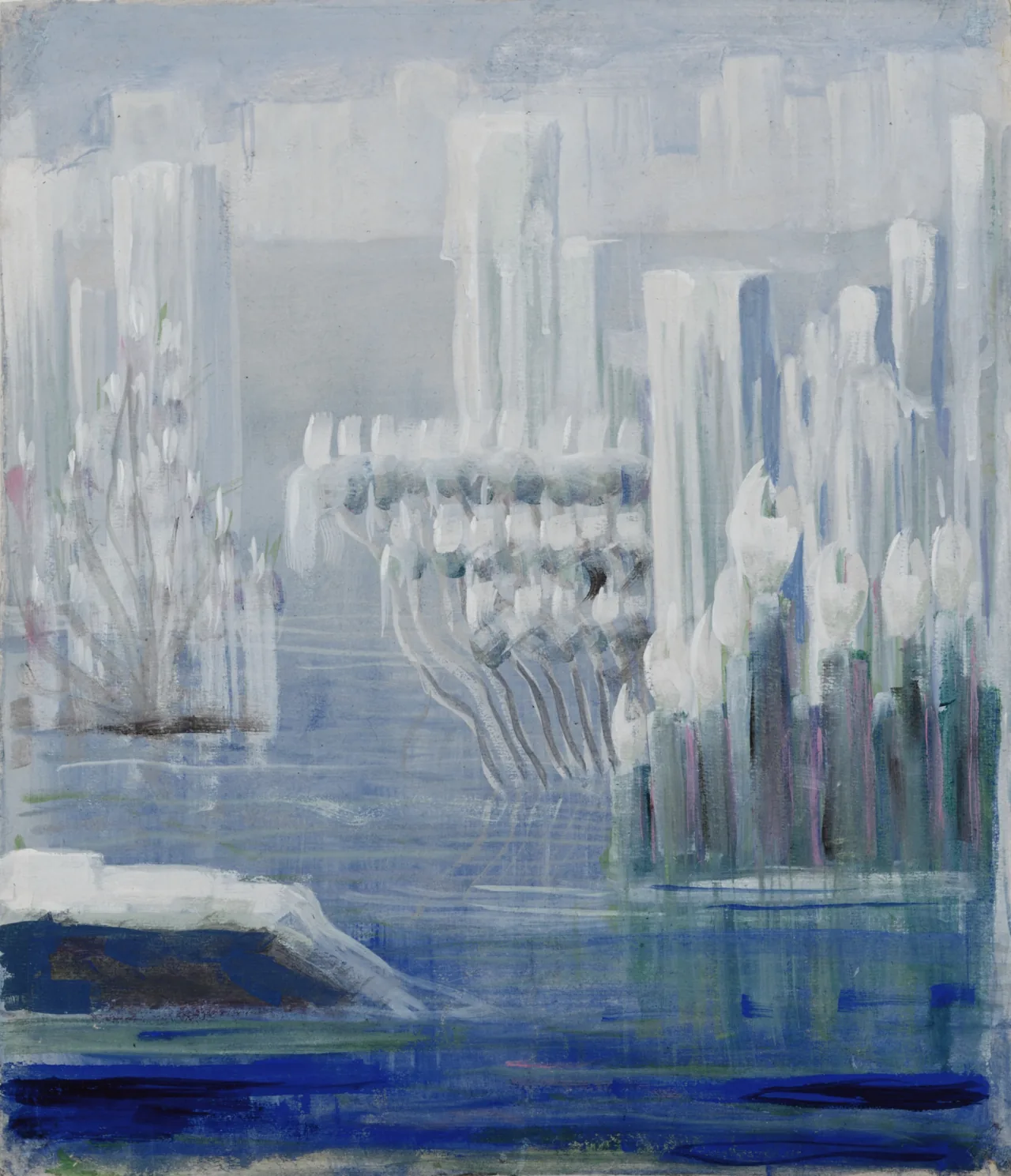
Suppose the first objects in a new world are already ruins. A white slab sags over a dark cavity at the lower left. Near the middle, a larger structure stands on five thin, curving supports, its upper level punched with black openings. Across the water, tall pale blocks crowd together as if an entire district had been bleached by weather. M. K. Čiurlionis called this scene Creation of the World. VI. It looks like an excavation conducted before history has officially begun.
The resemblance is strongest in the central structure. A broad white platform extends from the left bank and stops over blue. Small uprights line its top. Underneath, a row of dark squares alternates with pale divisions, giving the mass the regularity of a viaduct, dam, or quay. Then the engineering becomes wonderfully suspect. Its supports bend like roots pulled by a current. Two end halfway down. The longest narrow as they approach the water and seem to continue as reflections, pipes, or poured paint. This apparatus has been designed for a law of gravity that changes by the inch.
Below it, the blue field carries fine horizontal strokes and broader translucent bands. Three deep cobalt bars sit near the bottom edge. They have the blunt proportions of beams set in a trench, although nothing joins them to the architecture above. A green line runs behind them. Pink flickers through the blue in places. The foreground reads less like open water than a flooded work site whose plans have been lost.
No visible worker, citizen, or deity claims the place. The absence matters because so many marks seem to have jobs. Columns bear weight. Ranks establish boundaries. Openings imply passage. Horizontal bands level the ground. The picture offers the evidence of organized labor while withholding every laborer. Its city, if it is a city, may have constructed itself.
The little sheet encourages this disproportionate fantasy. Čiurlionis painted it with tempera during 1905–1906, using a piece of paper only 36.3 by 31.5 centimeters. A person could hold its whole territory between two hands. Within the image, nothing provides a reliable scale. The central platform might cross a narrow pool, or it might span a gulf. A white point can be a bud close by or a tower on a remote shore. The modest support gives Čiurlionis room for architectural enormity because the world contains no body against which enormity can be checked.
The right side is the most populous area, if forms can count as a population. Thin green, violet, blue, and black uprights stand packed together. White ovals rise from them, each split or pointed at the top. Some look ready to flower. Others resemble covered windows, sails seen head-on, or the bright roofs of narrow halls. Behind this front rank, taller blue-and-white columns climb into the pale upper field. The district has grown according to both botany and zoning.
Calling it a city reveals something that a list of possible objects does not. Architecture makes the scene old. Repetition suggests a building practice; broken repetition suggests that time has acted on it. The left side carries this feeling most strongly. Pale verticals fade into the blue ground. A few white points survive between them. A mauve patch clings to one edge. The place appears less unfinished than worn down, as though wind and water had been working before the paint arrived to record the damage.
The surface produces that age without depicting a conventional ruin. White paint passes from opaque blocks to dry, thin strokes. Blue shows through many of the pale structures, weakening their edges and sometimes entering their interiors. Long vertical marks are crossed by washes that make them disappear and resume. At the top, a wide blue-grey band covers the scene like a ceiling of weather. What seems archaeological at one distance becomes an account of layered tempera at another. Erosion and painting use the same evidence.
The title supplies a chronology, though a peculiar one. This is the sixth of thirteen numbered paintings in the cycle. All share the 1905/6 date, paper support, and tempera medium in the museum’s records. The number places this realm among other acts of creation, yet thirteen sheets do not map neatly onto the seven days of Genesis. Čiurlionis gave a more useful account while the project was still underway.
In a letter to his brother Povilas dated 4 April 1905, he called the unfinished cycle “not our world, as in the Bible, but the creation of another, fantastic world.” He imagined continuing to one hundred paintings if enough ideas came. The surviving cycle stopped at thirteen. His description does not decode the pale structures in VI, but it establishes invention as the project’s ground. This world was allowed its own contents and, just as importantly, its own order of arrival.
A fantastic creation need not begin with innocence. Čiurlionis could place apparent weathering inside the act of making because the new realm did not have to wait for our sequence of seed, tree, timber, building, abandonment, and ruin. On this sheet those categories operate together. The supports beneath the central platform are built members and trailing roots. The settlement at right germinates. Water resembles a stack of transparent floors. The world enters as a system of relations rather than a delivery of finished species.
This reading gives the painting a history, but only an imaginary one. No evidence identifies an actual city, flood, or civilization behind the image, and Čiurlionis did not explain panel VI shape by shape. The ruin belongs to looking: regular marks imply construction, interrupted marks imply duration, and the lack of figures pushes that duration beyond human memory. The painting makes those implications available without turning them into a coded story.
It also keeps the invented archaeology slightly comic. The central platform is too delicate for its load. The dark openings under it look solemnly functional, but lead nowhere that can be traced. The right-hand towers wear buds. At lower left, the white slab resembles a monumental collapse until its blue shadow turns it into a piece of melting ice. Every discovery survives long enough to revise the site, then becomes material for the next one.
Archaeology usually works backward from remains toward a lost whole. Creation of the World. VI moves in the other direction. Its fragments do not certify a completed past; they allow the new world to expand beyond the one small sheet. A broken bridge suggests both the unseen bank it once reached and the inhabitants who might one day mistake it for a root. A row of pale towers implies streets that never enter the frame. The ruin is a device for generating more world.
By the upper edge, the apparent city has thinned into atmosphere. Large rectangular ghosts remain inside the blue-grey band, close enough to architecture to extend the settlement and pale enough to pass as cloud. Čiurlionis lets the fantastic realm acquire distance, weather, and age in the same strokes. Creation here does not clear a pristine site. It leaves structures standing, water moving through them, and enough missing history for the world to feel larger than its beginning.