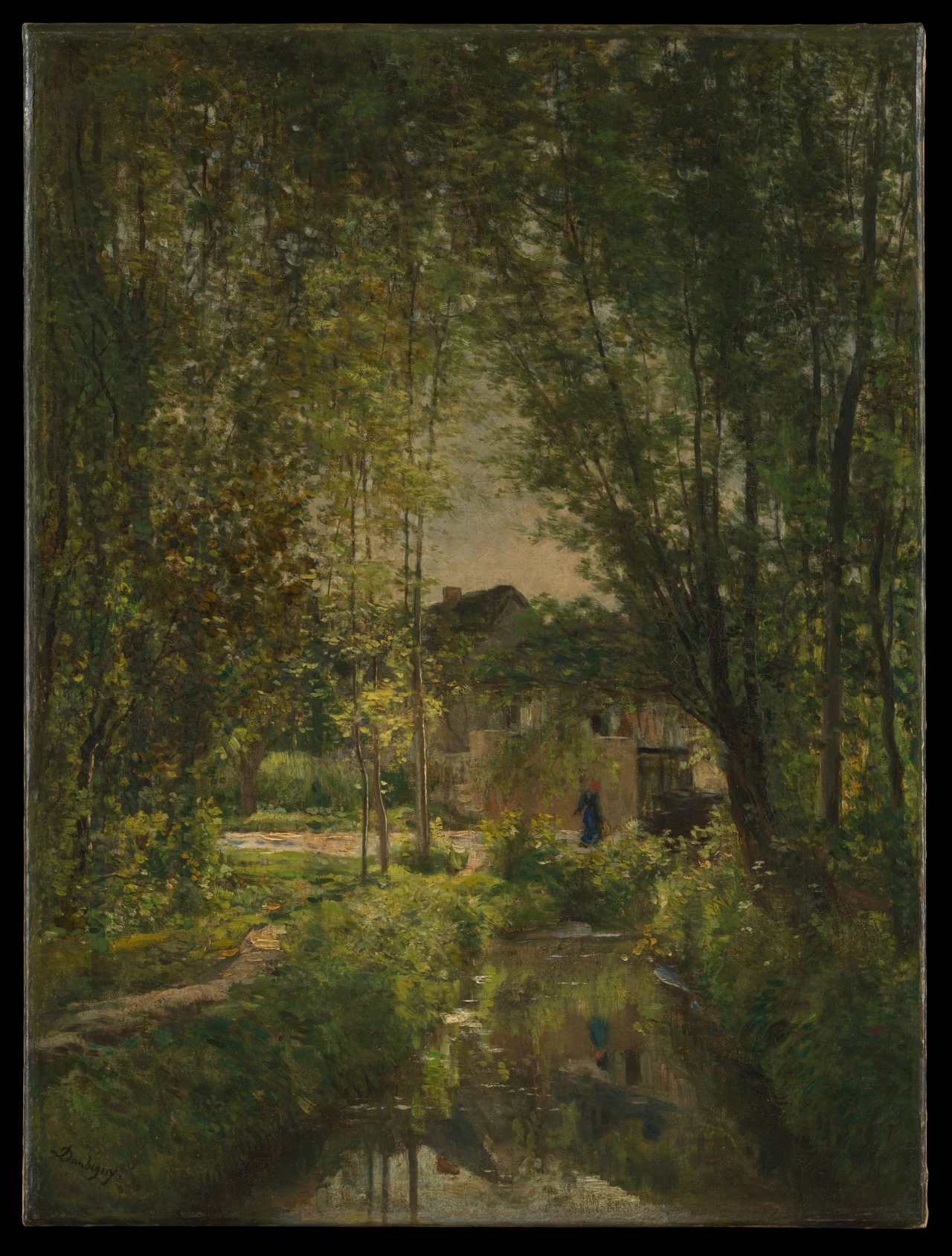
A small red mark hangs near the center of the stream. Blue trails above it, then breaks against a brown-green passage. These colors belong to a reflection, although the person who casts it stands much higher in the picture, beside a low building. Charles-François Daubigny separates the two versions by a stretch of ground and water. The reflected person can register first as an isolated stain. Once it finds its source, the whole lower part of Landscape with a Sunlit Stream changes. What looked like another dark piece of woodland declares itself as a surface capable of making images.
The person above is scarcely more secure. A red head covering and a dark blue garment gather into a body near the building’s right side. The pose suggests movement, but the destination and identity are unknown. Below, the reflection reverses the bright accents without preserving the figure’s outline. Red loosens into a short vertical stroke. Blue descends in a narrow, interrupted column. A dim duplication would have confirmed the stream as a mirror. Daubigny gives it a less obedient task. The water takes a recognizable body and changes its proportions, edges, and orientation.
This act of remaking extends beyond the figure. Slender tree trunks reappear as wavering pale uprights. A light opening in the canopy enters the water as cream and gray-blue. The low building contributes warmer patches that merge with shadow. Each reflected element loses some local information and gains a place in a second arrangement. The stream also records the changing width of the illuminated opening overhead. It does not merely show what stands around it. It edits the woodland into a narrow vertical picture within the larger one.
Its boundary remains difficult to hold. A pale strip curves down the left side of the foreground, while dense growth pushes toward it from both banks. Green and ochre marks occupy land, low plants, and reflected foliage with few hard separations. The channel widens toward the bottom, yet it does not announce that widening through a continuous contour. A gray-white patch at the front can appear to be exposed ground until the upright reflections around it establish the behavior of water. Daubigny asks direction to do work that outline has declined.
The canvas’s vertical shape intensifies this uncertainty. It measures about twenty-five by nineteen inches, and trees occupy nearly all of its height. No broad horizon divides earth from sky. The largest trunk rises at the right, splits, and leans inward. Thin trees climb through the middle. A wall of foliage fills the left. Between these masses, a pale opening descends toward the roof, crossed repeatedly by branches and trunks. The opening offers depth, but never emptiness. Woodland continues inside the light.
The upper half has few conventional markers of recession. There is no road narrowing toward a vanishing point, no bank diminishing into distance, and no far hill reduced by atmosphere. Depth collects through overlap. A dark branch passes before a lighter cluster. One trunk cuts through the pale opening while another dissolves into it. Yellow-green touches come forward against gray, then sink when crossed by deeper green. The woodland is not arranged as a succession of clearly separated planes. It thickens and thins, making distance a local negotiation among marks.
Many of Daubigny’s better-known river paintings spread sideways. A River Landscape with Storks of 1864 is less than ten inches high and nearly eighteen inches wide. The Seine: Morning of 1874 is fifteen inches high and more than twenty-seven inches wide. In such pictures, the format can accommodate a long bank, low sky, and extended reach of water. Landscape with a Sunlit Stream turns that familiar geometry upright. The river painter gives most of the canvas to trees, and the water enters as a compressed passage at their feet.
The change is more than a preference for enclosure. A horizontal riverscape can place water between near and far banks, making it an interval through which distance opens. Here the stream runs into the canvas from the foreground and disappears near the building. It occupies depth rather than spanning it. The surrounding trees rise in the same direction as their reflections descend, so the painting develops two vertical movements around a shallow middle zone. Trunks climb from the earth. Their watery versions point toward the bottom. The little person stands close to the hinge between them.
That position gives the figure unusual authority for so small a form. Daubigny does not need the person to furnish a story or to demonstrate the scale of grand scenery. The red and blue accents provide a coordinate. Once they are matched above and below, the distance between body and reflection measures the stream’s reach. The colors also distinguish water from the similarly dark bank. Human presence becomes useful to the landscape because cloth reflects differently from leaves, stone, or sky.
The building works by a quieter version of the same method. Its roof forms an uneven dark wedge below the pale central opening. Walls emerge as muted brown and cream planes, interrupted by foliage. A dark rectangle on the right suggests an entrance. Warmer verticals nearby could be shutters, boards, or parts of the wall, but the image does not support a more exact identification. Architecture introduces right angles and planar surfaces, then the woodland covers enough of them to keep the structure embedded. The house is recognized through fragments that resist becoming a complete elevation.
Sunlight behaves in fragments too. The title may prepare the expectation of a brilliant channel, yet much of the stream lies in shadow. Illumination reaches it as small strokes and cloudy patches. Brighter yellow-green touches settle on plants near the building and along the left. Cream catches sections of ground and wall. Higher up, gray and pale gold spread through the central gap without clearing the foliage from it. The sunlight has no single shape because every surface receives and redirects it differently.
Calling the stream sunlit therefore names an event rather than a condition. The water does not become a uniformly bright ribbon. It catches enough of the opening above to alter selected passages, especially where cream and muted blue interrupt the brown-green channel. The title directs attention toward those intervals. They reveal how illumination travels through obstruction: between leaves, past trunks, onto ground, and finally into reflection. Sunlight reaches the stream already divided by the place it has crossed.
Daubigny painted the work around 1877, near the end of a long career devoted largely to landscape. He had exhibited regularly at the Paris Salon since 1838 and achieved substantial success by the early 1850s. Water became one of his persistent subjects. In 1857 he adapted a small ferryboat as a floating studio, an arrangement that let him work along French rivers from a low position close to their surfaces. That history explains his sustained knowledge of reflection and current, but it does not locate this stream or prove that this particular canvas was painted outdoors or from a boat.
Such caution helps the painting retain its peculiarity. The studio boat can easily turn Daubigny into a familiar historical role, the useful predecessor who supplies an outdoor method to younger painters. His relations with Claude Monet and Camille Pissarro were real, and his later palette and handling developed through contact with their work as well as theirs with his. The Met connects this canvas’s lighter color and flickering marks with those exchanges. Still, the painting is not interesting because it points forward. Its decisions are complete inside its own narrow field.
One of those decisions concerns finish. Critics had complained about Daubigny’s loose handling well before the Impressionist exhibitions. By the late 1850s, when his reputation was secure, some reviewers described his pictures as casually composed or insufficiently finished. In 1861 Théophile Gautier treated the sketch-like appearance of a Daubigny landscape as a failure to carry a true feeling for nature into adequate detail. The complaint assumed that clarity should accumulate evenly, so a finished landscape would resolve its trees, banks, figures, and atmosphere to an accepted degree.
Landscape with a Sunlit Stream proceeds by unequal degrees of resolution. The figure is two colors and a posture. The building has enough planes to stand but not enough information to be identified. Some trunks hold as firm dark columns, while foliage breaks into small touches that can serve leaf, gap, or flicker. The stream becomes certain through reflections even where its border remains uncertain. Finish here is distributed according to function. A detail receives what it needs to affect the rest of the picture, then stops.
The painting’s modest physical size sharpens that distribution. From farther away, the red and blue accents lock together, the building gathers into a central block, and the stream reads as one dark channel. Closer inspection breaks each of these forms into deposits and intervals. The person nearly comes apart. Trunks expose surrounding color between strokes. Water divides into upright echoes and short flashes. Neither distance supplies a final, superior view. The composition depends on travel between the coherence of the whole and the unsettled evidence of its parts.
A technical examination of another Daubigny painting, the National Gallery’s River Scene with Ducks, makes the charge of simple haste especially doubtful as a general account of his art. Conservators found thin paint layers built carefully over time. In its water, smooth horizontal strokes alternate with vertical marks for reflections and disturbances. The artist varied his greens and let the color of the prepared support affect the final result. Those findings belong to that specific painting, not automatically to this canvas. They establish, however, that an appearance of speed in Daubigny could come from sustained decisions about layers, stroke direction, and exposed ground.
The visible marks in Landscape with a Sunlit Stream reward the same attention to direction. Tree trunks hold the upper section with long uprights. Branches cross them at rough angles. Short touches cluster densely in the canopy and loosen in the central light. On the stream, vertical strokes lengthen reflected trunks, while brief lateral flashes interrupt them. A mark gains identity through its neighbors. Upright cream amid dark water can become a reflected trunk. The same color set sideways can become a glint or disturbance.
This directional grammar keeps the paint shared without making the depicted world uniform. Leaves and reflections may both be broken touches, but gravity and placement separate them. Wall and water may both carry warm brown, but one gathers into a plane and the other stretches downward. The canvas sustains difference through behavior. Each material receives a related painterly vocabulary, then bends that vocabulary toward a distinct action: foliage accumulates, masonry blocks, light filters, water repeats and distorts.
In Landscape with Ducks, painted in 1872, Daubigny used small bright flecks to define women near a wide, still river. Vertical strokes disturb the broader horizontal handling of its water. That picture offers space around its figures and lets the river extend laterally. Five years later, the sunlit stream concentrates comparable resources within a wooded corridor. One person supplies the brightest concentrated colors. The water carries those colors downward, turning a small incident into the axis of the whole canvas.
The reflection also complicates the person’s relation to place. Above, the blue garment separates from the brown wall and green growth. Below, blue and red enter the woodland’s liquid copy. The figure is both a discrete visitor and pigment redistributed by the stream. Nothing in the image establishes who the person is, whether this is home, or why the person has paused there. The painting needs none of that information. It makes presence consequential through optics rather than narrative.
Red appears nowhere else with comparable force. Blue occurs in small cool notes through the woods and water, but the figure concentrates it beside the warmer head covering. The reflection pulls that rare pairing into the foreground. This doubled accent prevents the person from being swallowed by scale, and it prevents the stream from remaining a generalized dark zone. Daubigny uses the most limited color event in the painting twice. Its second appearance carries more structural weight than a larger, more descriptive figure might have done.
Daubigny’s signature sits in the dark growth at the lower left, close to the stream but outside it. It is one of the few passages that must be read as writing. Nearby, the bank loosens into patches whose identities are less fixed. The contrast is useful. A name holds its sequence of letters while the surrounding paint remains available for several natural roles. The finished picture accommodates both kinds of legibility, the firm sign and the shifting resemblance.
Near the bottom, the stream carries only pieces of the world above. A trunk reaches down without its crown. Pale sky arrives without an open horizon. The red and blue person returns without a body that could stand. A light patch spreads near the front, crossed by darker verticals and edged by green. The water has gathered these incomplete parts into an image that belongs to no stable viewpoint on land. Daubigny ends the channel where reflection becomes most visibly an act of painting: placing color below color, changing its direction, and letting the second landscape form in the current.