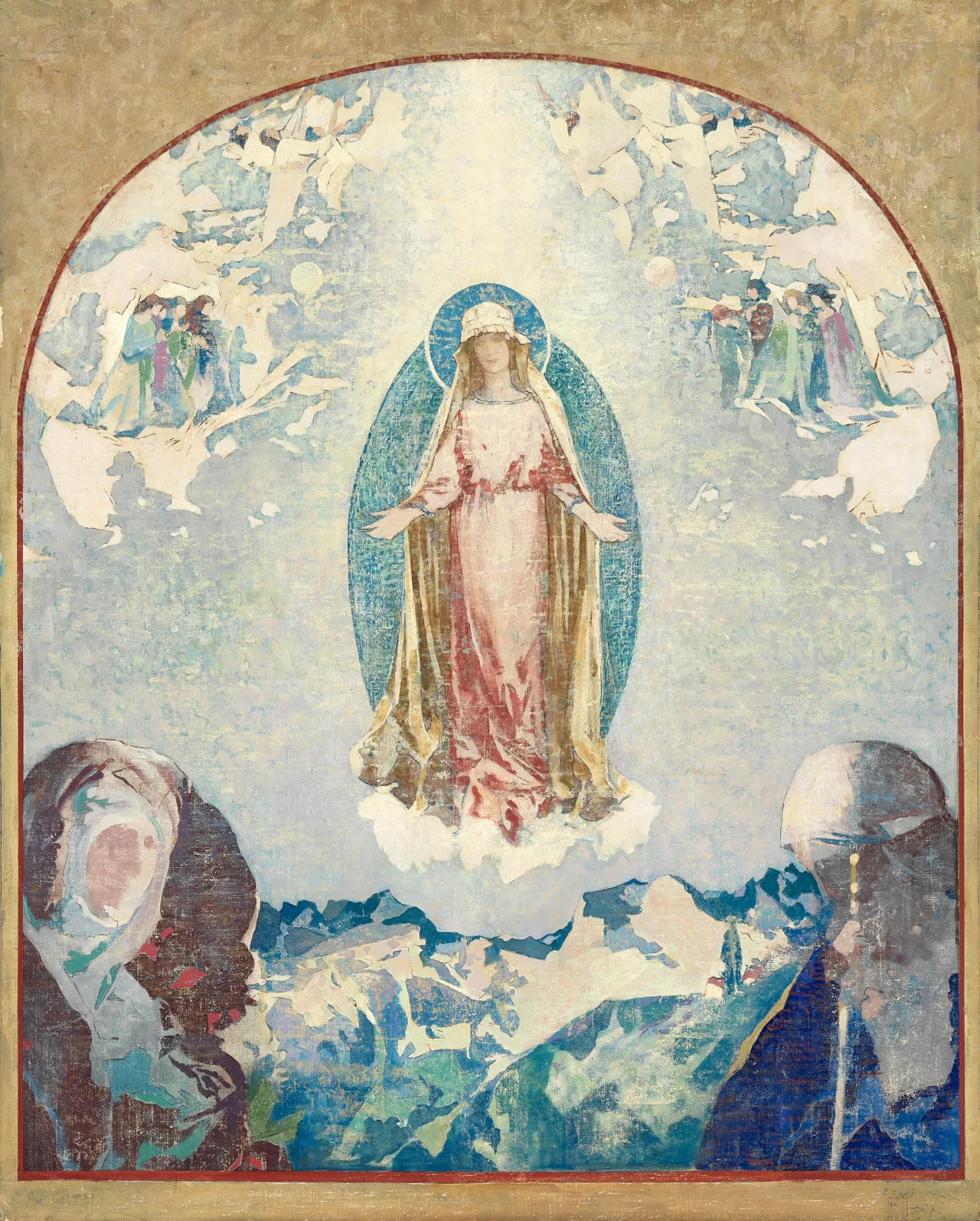
The picture is organized by a pale arch that contains a second, thinner oval. In Augustus Vincent Tack’s Rosa Mystica, a large vertical painting with an arched top, a woman stands full length on a billowed cloud, frontal, still, and pale, enclosed in that thin pale blue oval inside the arch. She wears a pink robe that is close to rose and a heavier tan cloak that falls in broad, simple folds. Around her head a smaller blue halo repeats the oval’s color at a tight radius. Below her feet the picture does not descend into a meadow or a street. It breaks. A range of jagged blue mountains lifts in sharp, angular planes, cold and faceted as if the rock had been cut rather than weathered. At the extreme lower left and lower right, two small dark figures stand with their backs partly to us, silhouettes pressed against the blue. High in the upper left and upper right, among a mottled sky of cream, pale blue, and faint pink, even smaller groups gather in the clouds and look inward. The surface measures 151.8 by 122 centimeters, oil on canvas on wood, and the scale makes the central figure close to life size. Tack keeps the central figure and the broken ground as separate systems without blending them.
The Cleveland Museum of Art holds the picture and describes it plainly: a vertically oriented oil with an arched top, a woman with light skin looking outward while standing on a cloud with arms extended, pink dress and tan cloak and blue halo inside a blue oval, jagged blue mountains below, two dark figures in the foreground corners, small figures gathering in the upper corners against a mottled sky. The description names what is actually there rather than what a devotional title might lead a viewer to supply. Rosa Mystica, or Mystical Rose, is a Catholic title for the Virgin Mary. Tack does not translate that title into a bouquet or an emblem held in a hand. He lets the rose appear in the color of the robe itself, so the relation between a stable vertical and a broken field carries the meaning that a separate symbol would otherwise carry.
It helps to know where Tack stood in his own work around 1923. He was fifty three, born in Pittsburgh in 1870, moved to New York as a boy in 1883, trained at the Art Students League in New York until 1895, and believed to have frequented the studio of the painter and stained glass designer John La Farge, whose portrait he painted about 1900. He kept a New York studio from 1894 for the rest of his life, showed regularly at Kraushaar Galleries where he had his first solo exhibition in 1896, at the Worcester Art Museum, at the Carnegie International, and at the Pennsylvania Academy. He taught at the Art Students League from 1906 to 1910 and at Yale from 1910 to 1913, and for a time he shared a Deerfield studio with the painter Will Hutchins. Around 1914 to 1915 his work came to the attention of the Washington collector and critic Duncan Phillips, who became his close friend and chief patron. Phillips and Tack collaborated on the Allied War Salon of 1918, and Phillips would collect Tack’s more abstract paintings for decades. In 1925, on the recommendation of the late architect Bertram Grosvenor Goodhue, Tack was selected to paint wall and ceiling murals for the Governor’s Suite of the Nebraska State Capitol, a commission that drew on his established reputation for traditional portrait and mural work.
Tack’s portraits and murals were traditional in handling and legible in subject. After about 1910 his landscape and spiritual pictures moved toward mystical semiabstraction and found little commercial success. He continued to make conventional portraits and classically inspired murals. His most original later work remained the semiabstract landscapes, many inspired by photographs of the American West and made almost exclusively for Phillips. Time and Timelessness (The Spirit of Creation) of 1943 to 1944, a Phillips Collection picture, shows where that later abstraction went, with abstract passages set against more recognizable forms such as clouds.
Rosa Mystica sits at the hinge between those two identities, and that hinge explains its oddness. A large Marian altarpiece with an arched top was not an obvious next step for a painter increasingly known for dissolved western landscapes, nor was it a simple return to mural convention. The subject asks for legibility, frontality, and a degree of flatness that gives the figure an older, hieratic presence. The era favored invention, and Tack’s patrons had come to value his capacity to let land and sky soften into near abstraction. Tack let both demands stand. He painted a Virgin who is deliberately unmodernized in drawing and placed her above a landscape that is fully modern in its fracturing. The picture was shown in New York in early 1923 and acquired that same year. The Bulletin of the Cleveland Museum of Art reproduced it on its cover for November 1923 and discussed it on pages 155 to 156. Later it appeared in anniversary exhibitions in Cleveland in 1936 and 1937 and elsewhere, before entering the longer, quieter life of a large religious picture not on view.
The figure that stands still
Look first at the central figure because Tack wants you to start there and because the painting’s construction places her there. She is centered, symmetrical, and lit without a visible source. Her face is pale and broad, with dark hair parted in the middle and drawn close to the head, eyes directed outward rather than upward or downward. The pink of the robe is the most saturated color in the picture. It is not a bright modern pink but a muted rose with a little warmth toward salmon and a little coolness toward mauve, laid in smooth passages that show little impasto. The tan cloak over it is heavier in tone and broader in its folds, ochre where it catches light and deeper brown where it turns. Its edges are kept clean against the cloud and against the blue oval, so the silhouette stays legible at distance. The arms are extended slightly from the body, palms open, in a stance of presentation that keeps the frontal plane intact rather than modeling a more articulated blessing. The cloud she stands on is soft and billowed, painted with rounded volumes in white and pale gray that form the only fully atmospheric shape in the lower two thirds, a form that supports her weight and holds her above the ground while keeping a gentle, rounded presence.
The blue oval that encloses her is the painting’s second most insistent shape. It is a mandorla, the almond form that medieval and Renaissance pictures used to mark a sacred apparition, here stretched and thinned into an oval that follows the arch of the panel. Tack paints it as a simple band of pale blue, slightly more saturated at its outer edge and more diffuse toward the figure, with no gold, no inscription, no inner pattern. The smaller halo around the head repeats the hue at a closer radius, a flat disc of the same blue that sits on the pink of the hood without modeling. The two blues tie the figure to the sky and to the mountains below while keeping the figure separate from both. They are the only elements in the upper two thirds that share the cool of the distant peaks, and their flatness marks them as signs rather than air, while the mottled sky around them reads as air.
That sky repays attention because it is painted differently from the mandorla and from the figure. The oval and the robes are kept smooth and even. The sky is mottled and uneven, a field of cream, pale blue, and faint pink laid in small broken variations that suggest cloud or vapor without describing any single cloud. The brushwork is low and fused, not broken into the separate dashes of Neo-Impressionism or the filaments of Divisionism, but it still keeps the surface active. The mottling gives the upper zone a sense of depth that the figure refuses. Behind the dark blue mountains the sky reads as atmosphere that recedes. Behind the Virgin the same sky reads as a ground that is pushed flat by the oval. Tack leaves that tension in place, and the oval holds a discontinuity between a sacred zone that is flat and a world zone that has weather.
The small figures in the upper left and upper right complete the sense of a world that surrounds the apparition without sharing its mode. They are tiny, a few dark and light strokes that gather in the clouds and turn inward. The Cleveland description calls them small figures gathering in the upper corners, and at close viewing they read as groups of witnesses or angels, not modeled individuals. Their scale makes the central figure larger through contrast, and their inward orientation makes the composition turn toward the center, yet nothing touches the center. A gap of mottled sky keeps each group at a remove, so the periphery feels populated but not crowded and the center retains its isolation.
Where blue breaks
Drop the eye below the cloud and the picture changes register. The blue mountains are the most abstract passage and the most modern. They rise as a jagged field of planes, facets of blue that vary from a cold near white where an edge catches light to a deep slate where a face turns away. The facets are hard and angular, with straight edges that meet at sharp points. Some planes read as snow lit by a low sun, others as ice or as rock seen through thin air. The field holds the lower third together through repetition of angle and hue rather than through perspectival construction. The central figure is modeled with smooth blending. The mountains are assembled from distinct facets that keep their edges.
The two dark figures at the lower left and lower right sharpen that contrast. They are silhouettes, small enough that a viewer can miss them at first in a reproduction, and they are placed exactly at the foreground corners where an altarpiece might set donors or saints in adoration. One on the left appears to stand or kneel with a dark cloak and a head turned toward the center. One on the right is similarly dark and slightly more upright. Their mass is minimal, a few vertical strokes of brown black that read as bodies because they interrupt the blue. Their darkness ties them to the mountains rather than to the cloud above, so they belong to the broken ground. Their inward turn ties them to the upper small groups, so four peripheral zones, two below and two above, answer one another around a still center. The witnesses have no attributes, names, or expressive faces. They mark the foreground as inhabited while keeping the human scale tiny against the apparition.
Color does the work that drawing alone cannot. The rose pink of the robe is the only warm saturated note that holds across a large area. Elsewhere warm color is kept low and contained. The tan cloak is warm but muted, the mottled sky holds only hints of pink, the whites of the cloud are cooled with gray. Against the cold field of blue peaks, the rose reads as heat that has not been dispersed. That chromatic isolation makes the title visible in a direct way. In Catholic devotion Rosa Mystica names Mary as the Mystical Rose, a rose understood as an identity rather than a flower held in a hand. Tack makes that identity a matter of chroma, one large area of rose that persists without being repeated elsewhere, while the blue halo and oval pick up the blue of the mountains and the cloak picks up the warmer flecks of the sky.
The technical support helps that holding. Oil on canvas on wood gives a smooth, stable ground that can carry both the blended passages of the figure and the crisp edges of the facets. The arched top reinforces the altarpiece association, and Tack respects it without cropping the oval or letting the figure break the arch. The outer shape allows the painting to be divided, and a rectangular field would have asked for a horizon that unifies sky and ground, while an arched field allows a figure to appear above a world and to remain distinct from it, as apparitions appear in older models.
Tack’s hand is less gestural than many modernist peers, so differences in handling can be missed. In the robe and cloak the brush follows the large folds, laying color in broad, even planes with softened transitions. In the cloud the brush rounds, making volumes with blended whites and grays that model gently. In the mountains the brush hardens, laying plane against plane with a thinner, more linear touch. In the sky the brush mottles, working a field of small variations that keep the atmosphere from settling. No zone shows conspicuous impasto or scraping. The surface is kept low and close to the panel, which lets the color relations do more than texture. That evenness is part of why the picture can be mistaken for academic pastiche at a glance. The zones remain separate instead of resolving into one space or one atmosphere.
What 1923 asked of a devotional picture
When the Bulletin reproduced Rosa Mystica on its cover in November 1923, the museum presented a contemporary American altarpiece acquired in the year it was painted. The choice says something about what Cleveland wanted its collection of American painting to do in the early 1920s. The museum had been building American holdings since its founding in 1916 and was beginning to support living painters through annual exhibitions. A large devotional work with a legible figure offered a counterweight to the more fragmented modernisms appearing elsewhere in those shows. It could be read by a general visitor without a guide, yet its handling of color and space placed it in conversation with modern concerns about flatness and field.
Tack’s own circle clarifies why he could paint this subject without it reading as a simple retreat. Duncan Phillips had begun buying Tack’s increasingly abstract landscapes because they carried spiritual suggestion without church iconography. Phillips admired pictures that could be both timeless and contemporary, and he placed Tack among Americans whose abstraction came through sustained attention to place rather than through Cubist analysis. Rosa Mystica tests whether that sense of timelessness could carry an explicit religious figure. By keeping the Virgin flat and frontal while letting the mountains become a faceted field, Tack preserves the stillness he had learned from western landscape photographs and long looking, but he relocates it, so the standing figure holds a different order of time than the broken world below. Phillips showed Tack in Washington and included him among Americans who mattered, and Cleveland’s purchase gave the altarpiece a public home outside that private patronage, a sign that at least one Midwestern museum believed a modern devotional picture could belong in a civic collection.
Later history complicates that belief. Tack never became a central figure in the accounts of American modernism that hardened after 1945. His later abstractions, increasingly concerned with light and with large, simplified forms, remained largely within the Phillips Collection where Phillips had gathered more than two dozen of them, and his portraits and murals continued along a separate, more public track. The Nebraska Capitol murals and the portraits of political and military leaders he would paint in Washington after establishing a studio there in 1941, including Eisenhower and Truman, kept him visible in official settings but not in the story of abstraction that came to run through Stieglitz, the Arensberg circle, and then Abstract Expressionism. A posthumous survey at Deerfield Academy in 1968 and the later scholarly monograph with Furth, Chew, and Scott in 1993 kept the work available for study, while museum presentations such as the 1977 traveling exhibition Perceptions of the Spirit in Twentieth Century American Art placed it again in a spiritual lineage. Even so, Rosa Mystica is rarely reproduced at scale and is not on view. Its arched panel and explicit Catholic subject put it outside the preferred formats for modern survey walls, which favor the rectangle and the secular.
The Rosa Mystica title belongs to the older litany tradition in which Rosa Mystica names Mary as the Mystical Rose. The Montichiari apparitions that later popularized the name were reported in the late 1940s, more than two decades after this painting. The picture does not include the roses, the sword, or the youthful seer that later imagery added. Tack’s rose is the garment itself. He paints a figure recognizable across Catholic and Orthodox traditions as a Virgin and lets the landscape behave as a modern field.
The relation to his later work becomes clearer from that angle. In Time and Timelessness the abstract passages are set against more recognizable forms such as clouds, letting a large horizontal landscape move between dissolution and recognition. In Rosa Mystica the same movement is vertical. The abstract passages are set below the figure as a faceted ground, and the more legible forms remain above. The painting anticipates the later logic without needing to dissolve the icon. It shows that Tack already understood abstraction as a way to mark different orders of experience rather than simply as a style.
For a viewer now, the picture offers an alternative model for how American abstraction might be rooted. Much canonical American abstraction is told as a lineage from European Cubism through Precisionism toward field painting, a story that rewards geometry, hard edge, and the erasure of the figure. Tack’s line is different. It runs from nineteenth century idealism through mural painting and stained glass color toward an abstraction that remains hospitable to the figure and to explicitly sacred subject matter. The Cleveland picture makes that line concrete. The Virgin stays frontal and flat in a way that recalls mural hierarchy. Color operates as a devotional instrument rather than a formal exercise, and the divided space lets the sacred stay still while the world fractures around it.
The hard edge of the oval, the saturated rose against cold facets, and the separate handling of cloud and sky keep the zones distinct.
Return to the two dark figures at the bottom. In many apparition pictures the witnesses are foregrounded as individualized donors whose presence validates the vision. Tack reduces them to silhouettes. Their anonymity strips away anecdote and leaves only the act of looking. They function as markers for any viewer who stands where they stand, at the lower corners, looking up past fractured blue toward a rose colored robe that does not move. The small groups above echo them, so looking happens on four sides while the center stays steady, and the zones of mottled air and hard facets keep the center and periphery from meeting too easily.
The picture rewards staying because its simplicity at distance opens into precise relations up close. The blue of the mandorla is adjusted by a few degrees of saturation so it holds against the sky without matching the mountains. The tan of the cloak is cooled where it meets the cloud and warmed where it meets the rose, so the figure turns without modeling. The whites of the cloud are kept at distinct values, the brightest at the crest that supports the feet and dimmer at the lower billows that drift toward the peaks. The jagged peaks themselves are not random. Their points align in a loose rhythm that repeats every few inches, a rhythm steadied by the horizontals of the cloud above. These are small decisions, but together they form the substance of the picture’s argument about how a color holds and a shape contains.
To see that is to understand why Cleveland acquired it when it did and why it can speak now. In 1923 an American museum could still believe that a large altarpiece belonged in a collection of contemporary painting and that a painter known for portraits could also paint an icon and a field in one panel. Today the painting meets a viewer who has seen much more explicit abstraction and much more explicit iconoclasm, and who may expect a modern religious picture to either play with its subject or dissolve it. Tack keeps the Virgin legible and the mountain field fractured and asks the viewer to look long enough to see that the gap is intentional.