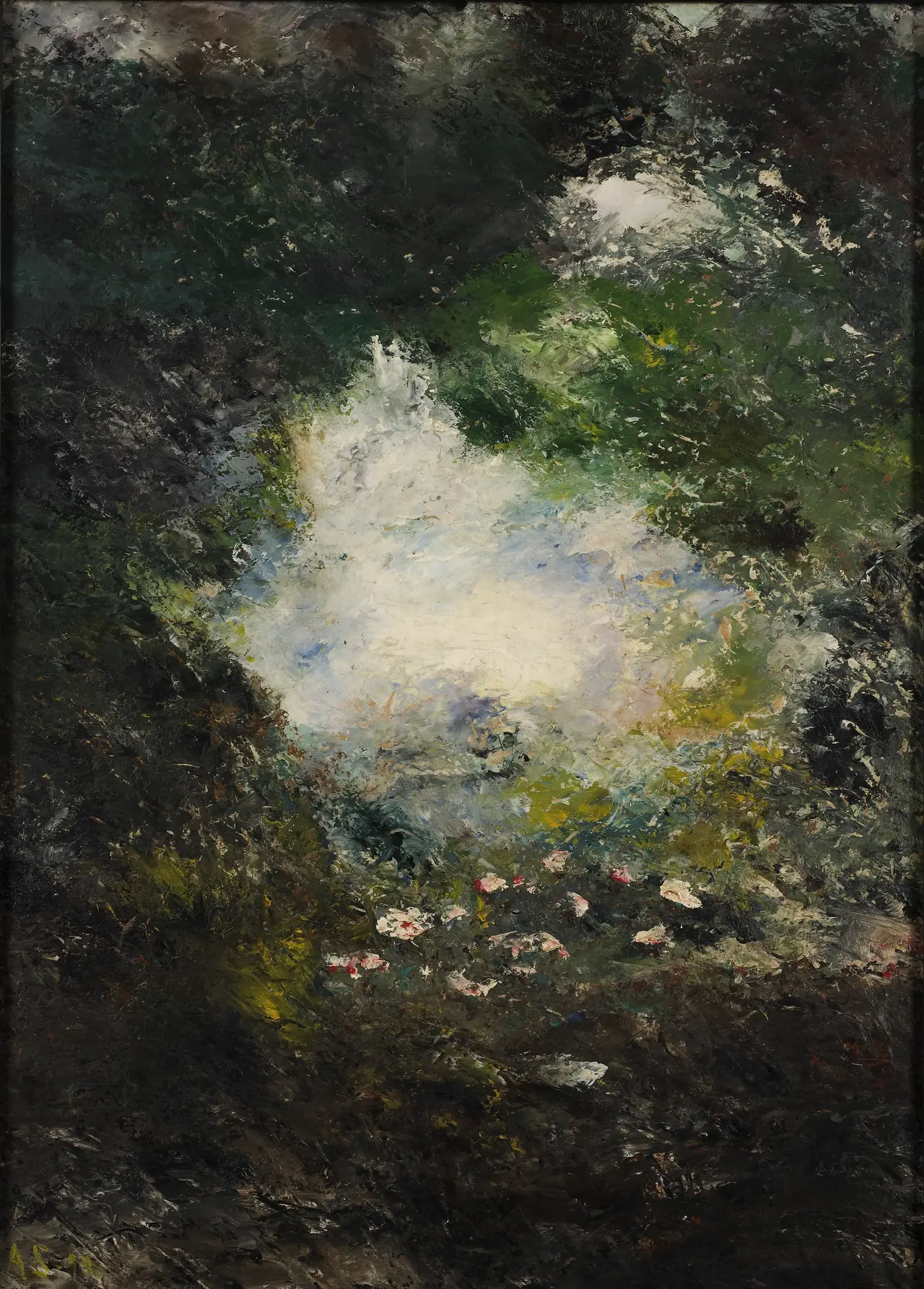
According to August Strindberg, the roses in Wonderland took two seconds. A white and pink spot had appeared above an area that he had just decided was a pond. He waited, recognized a rose, and put the palette knife back to work. Almost at once, one uncertain mark became a flower bed.
The speed is funny because the flowers are among the painting’s most legible things. Small dabs of white and pink, some touched with red, cross the lower edge of a broad pale field. Dark green and black press around them. The surrounding paint can turn into rock, foliage, water, or the roof of a cave, but the flowers keep asserting their modest identity. They look spontaneous. They are also the part Strindberg most clearly admits making on purpose.
He told the full story in an essay on chance in artistic creation, published in French in November 1894. Wonderland, signed that year, was his chief painted example. Nationalmuseum catalogues it as oil on cardboard, 72.5 by 52 centimeters. Strindberg called the support a panel and said that he preferred a board he could cover while inspiration lasted, usually within two or three hours. His first idea was a shaded forest interior with the sea visible at sunset.
He claimed to own no brushes. With a palette knife, he spread and mixed colors directly on the support. The opening at the center began as the sea’s horizon. Branches and crowns appeared in groups of color until the surface was covered. Then Strindberg stepped back. The sea was gone.
What he found in its place was much better material for a story. The light had become a deep pink and blue distance occupied by floating, bodiless beings. The forest had changed into a subterranean cave blocked by brambles. Foreground paint resembled lichen-covered rocks. At the right, the knife had made the surface too glossy, so the patch looked reflective. Strindberg promoted it to a pond. The unexplained spot above it became the first rose.
Chance enters his essay in this manner again and again, less like a law of nature than a gifted accomplice. Strindberg considers patterns found in a kaleidoscope and pictures made from palette scrapings. He detunes a guitar until it produces an Arabian melody more convincing to a theater director than the authentic tunes. A blow delivered in irritation turns his failed clay supplicant into a weeping child. A coat and lunch packet left on a plough become, in rapid succession, a cow, two embracing farmers, a tree trunk, and an outdoor breakfast party. Correct identification ends the pleasure. Misrecognition keeps producing.
The essay itself behaves like one of these demonstrations. It leaps from bamboo sounding in the wind to Beethoven on a randomly tuned piano, from parrots to sculpture, then arrives at painting. The argument gains force through Strindberg’s delight in the examples, not through the restraint of a laboratory report. He makes chance entertaining by taking the role of its quickest interpreter.
That role matters more than the accidents. A glossy patch did not have to remain in the picture, much less become water. Strindberg inspected it and gave it a use. After adding the roses, he worked with his fingers. He blended colors that resisted one another, fused some passages, thinned others, and removed tones he found jarring. Then he declared the painting complete. Chance supplied options. Taste chose among them, strengthened a few, and decided when the supply should stop.
The surface keeps those unequal decisions visible. Across the upper half, dark masses clot and scrape into one another. A burst of white at the upper right could be an opening, spray, pale stone, or paint dragged over black. The larger light in the middle spreads in cloudy layers of cream, blue, pink, and yellow. Its edge breaks repeatedly against green. Space appears there without a firm horizon, shoreline, or cave wall.
The roses operate differently. They do not resolve the cavern, but they organize the confusion around a local fact. Once a white and pink daub has become a flower, the pale area behind it can behave as water. The dark lower paint can become a bank. A few marks begin to recruit their neighbors into a scene. Strindberg’s two seconds were enough because he was not painting each blossom from observation. He was making his first reading harder to dislodge.
Then another reader arrived and improved the extravagance. In Strindberg’s account, his wife saw the cave from Tannhäuser. His floating beings became a large serpent sliding toward wonderland. His roses became mallows reflected in a sulphurous spring. She did not merely rename one patch. She connected the patches into scenery, action, and myth, giving the improvised landscape a theatrical plot.
For a week, he wrote, she admired the picture as a masterpiece, valued it at thousands of francs, and said it belonged in a museum. Eight days later, during what he described as another period of hostility between them, she called it “pure garbage.” The episode arrives as a marital barb and must be read as Strindberg’s version of the quarrel. He included it to ridicule the idea that art possesses a value independent of circumstance. In doing so, he made judgment look as volatile as the paint had been.
Her two verdicts are opposites, but Strindberg’s story gives both a practical effect. Praise turns the cave into a masterpiece and assigns it a price. Hostility discards it. His own acts of recognition work on the same smaller scale. The slick patch becomes useful when called a pond; the spot survives when called a rose. A name does not reveal the one true object hidden in the paint. It tells the next hand, eye, or imagination what can happen there.
The picture’s later history gave the joke an ending that neither spouse could have arranged. Nationalmuseum records that when Wonderland sold at Bukowskis in 1990, it became the most expensive Swedish painting yet auctioned in Sweden, a distinction it held until 2010. Two years after that record sale, the work appeared at Stockholms Auktionsverk in a forced sale. Karl Otto, Elisabeth, Pontus, Eva, and Åke Bonnier bought it and gave it to Nationalmuseum.
Auction price did not prove that the week of praise was perceptive or that the later insult was foolish. It changed what could happen to the object, just as “pond” and “rose” had changed what Strindberg did with the paint. The work that his story promoted to museum quality and reduced to garbage within eight days entered the national collection in 1992 as a gift from its five buyers.