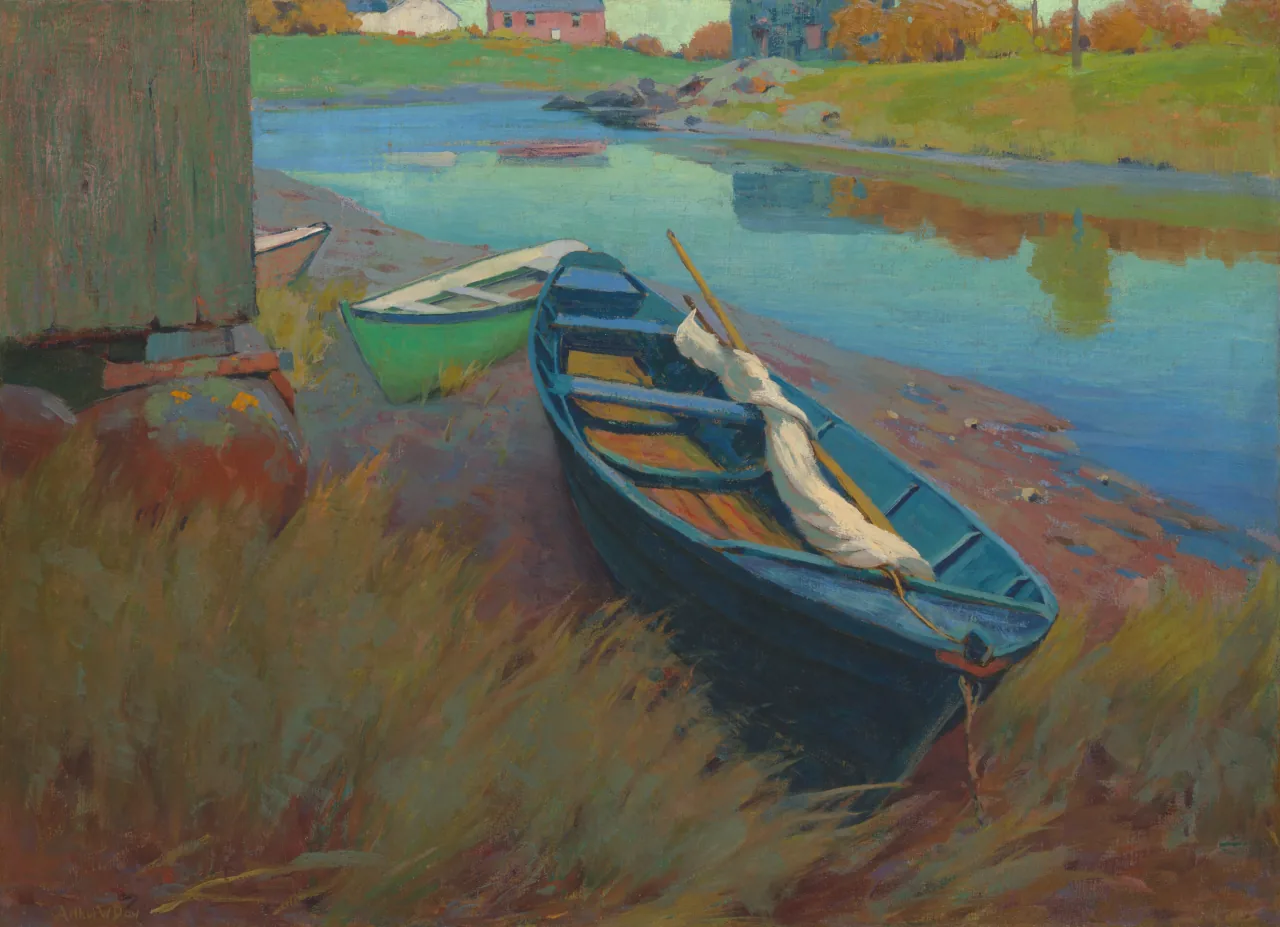
The largest boat in Arthur Wesley Dow’s Boats at Rest points into the harbor, while its parts set out several bearings at once. Its blue hull advances from the lower right toward the center. Ochre seats cross that long diagonal. A loose length of pale cloth or sail falls over the side, and an oar rises toward the water. The beached boat gathers these lines into one broad blue shape.
Dow builds the shore from similarly distinct pieces. A green rowboat beside the blue one turns slightly away from it. Another boat enters only as a fragment at the left edge. Behind them, a dark wooden structure fills almost a quarter of the picture. Boat, building, bank, and water meet as irregular areas, each made clearer by the color and edge beside it.
The elevated viewpoint brings water, opposite bank, grass, trees, and low buildings upward in shallow strips. The canvas ends among the roofs and autumn trees, above a narrow band of grass. Far boats lie on the water as slender marks, close in pictorial weight to the bands of color around them. The blue-green harbor occupies most of the upper half and becomes the largest area in the arrangement.
Color carries those connections across the gaps between things. The green boat reappears in the far bank and in the water. Rust and ochre move from the foreground earth to the houses and autumn trees. Blue runs through the large hull, the harbor, and the distant roofs. Reflections repeat pieces of the shore without forming a full mirror. Each return links one part of the painting to another, so that distance becomes a relation of colors as much as a measure of space.
Dow keeps the structure visible. The dark wall is a broad vertical mass. The water and banks are horizontal bands. The boats supply diagonals and areas of blue, green, cream, and ochre. Across that clear scheme, the oil paint stays tactile. Strokes remain visible in the water, hulls, grass, and wall. Colors meet through scumbled and broken edges, giving every area a surface with its own pace and density.
Boats at Rest, painted around 1895, belongs to Dow’s sustained attention to the landscape near his native Ipswich, Massachusetts. By then, he had studied in Paris and had begun a serious engagement with Japanese art. The Art Institute of Chicago connects the canvas’s abrupt cropping, raised viewpoint, and compressed depth with that engagement. In Dow’s harbor, these choices determine how the local buildings, boats, earth, and water cohere on a rectangle.
His later book Composition, first published in 1899, gives useful names to the relations visible here. Dow described composition through line, the massing of light and dark that he called notan, and color. Because the book came after this painting, its terms do not establish what he consciously intended four years earlier. They clarify a direction in his mature thought: every shape, interval, and color gains its force through the others around it.
That account also needs its historical limits. Dow developed his ideas through a selective reading of Japanese prints and painting, shaped by his own period and by his exchange with Ernest Fenollosa. Notan belonged to Dow’s teaching vocabulary rather than serving as a complete or timeless key to Japanese art. In Boats at Rest, the term has a modest and exact use. It identifies how the dark wall, bright cloth, blue hull, green boat, and pale water register as related masses within a harbor scene.
A rope drops from the bow. Rocks break the far bank. The cloth sags unevenly across the boat, and the long oar rests at a practical angle. These particulars keep the arrangement attached to used things and uneven ground. Their placement also gives each fact a formal task. The pale cloth divides the blue hull; the oar carries its ochre into the water; the rope joins the bow to the shore.
At the bow, blue paint meets a small rust-red tip, then a dark rope descends into the ochre bank. Above it, the white cloth and oar cross the hull and lead toward the green water. Across the harbor, the same blue, rust, ochre, and green appear again in roofs, trees, grass, and reflections. The working parts of one rowboat have become the color relations of the opposite shore.