Anna Boberg’s first trip to Lofoten went wrong as an itinerary. In the summer of 1901, she stayed in the Norwegian archipelago after her husband, Ferdinand, left for home. He bought supplies in Trondheim and shipped them north. Boberg later reduced her wish to three words: “paint, paint, paint.” She returned in winter, beginning about thirty journeys north across the decades that followed.
The repeated verb can sound like romantic frenzy. It also describes a practical arrangement. Lofoten gave Boberg mountains, fishing settlements, open water, snow, midnight sun, and aurora under conditions that would not remain available for inspection. She travelled in summer and winter and worked outdoors. Her mobile easel was her own design; it fixed the painting support to her body at a usable distance. In later life she called herself a “polar researcher.” Paint was the instrument she knew how to take into the field.
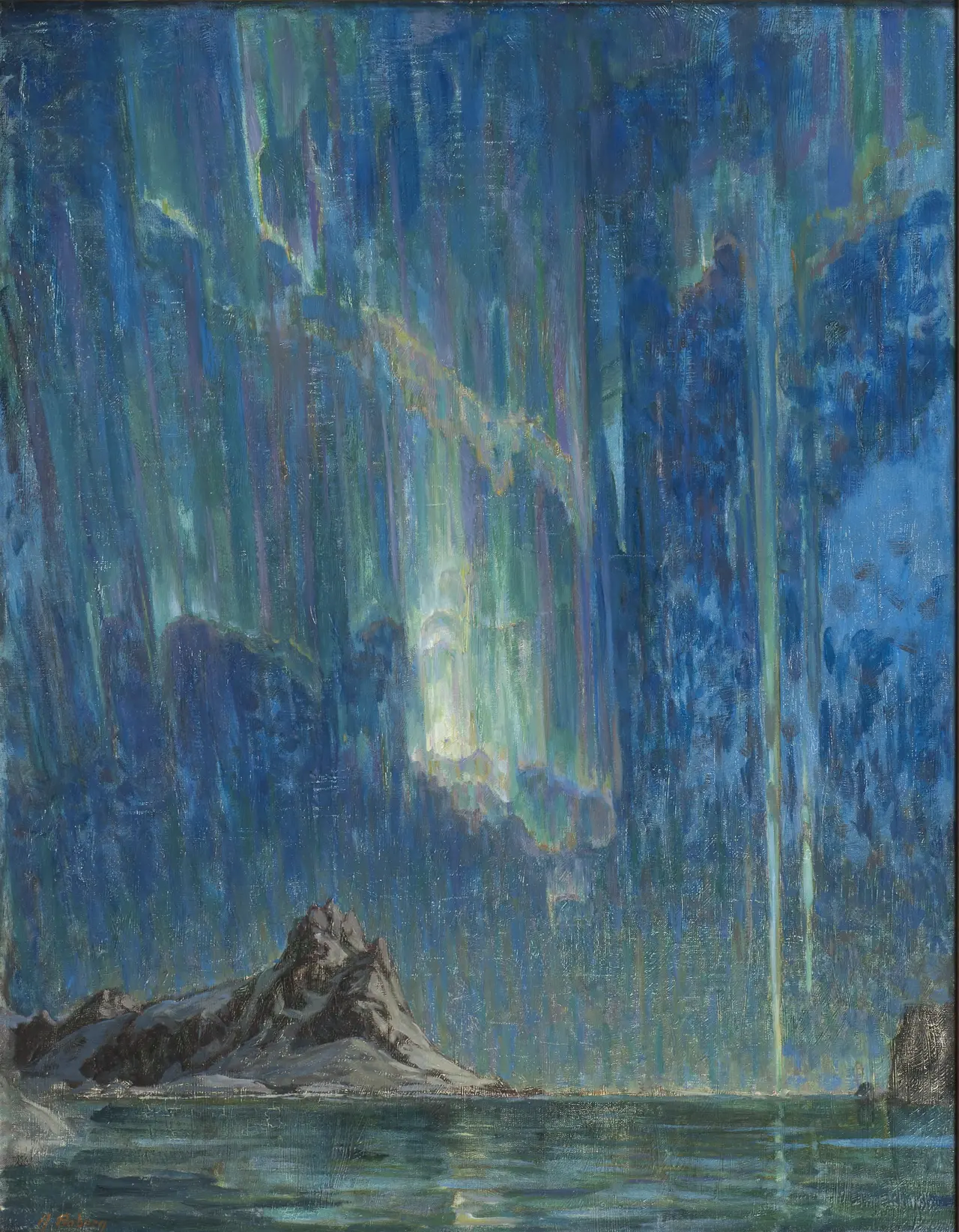
Northern Lights. Study from North Norway shows what that instrument could record. Nationalmuseum owns it as an undated oil on canvas, 97 by 75 centimeters. The word study usually prepares us for something small or provisional. This canvas is nearly a meter high. Its scale turns study from a rank beneath finished painting into an active kind of attention. Boberg gives most of the surface to an event that has no fixed contour and reserves the lower strip for the land and sea that make its size legible.
A dark, snow-striped mountain rises at lower left. It has one sharp summit and a shoulder that drops toward the water. Boberg states it with compressed, angular strokes, then moves on. The water receives a few long horizontal bands and short reflections. These elements establish distance quickly. Above them, the canvas becomes a record of adjustments.
Turquoise, deep blue, violet, green, and chalky white descend in strokes of unequal width. Some run almost from the top edge to the horizon. Some weaken into the blue around them. Broad passages have been brushed across narrower marks, leaving interrupted seams and rough changes of pressure. Near the center, pale green and white accumulate around a flare that looks dense enough to touch. At far right, two thin bright strands travel almost unbroken toward the water.
The aurora also bends. A pale, wavering band crosses the upper half from left to right, dipping through the vertical paint before it rises again. A second, dimmer fold appears above it. Those diagonals keep the sky from becoming a striped textile. They suggest a sheet turning in depth, although every stroke remains plainly attached to the flat canvas.
This is where Boberg’s instrument becomes unusually good. A camera can preserve the distribution of light at the instant of exposure. Boberg’s layered marks preserve a sequence of decisions. One brightness was dragged downward; another required a loaded patch; a dark blue passage covered part of an earlier color; the curved band asked the hand to change direction. No literal timeline can be extracted from these marks, and the work’s exact making is undocumented. Its surface still makes duration visible. Different acts of looking remain present together.
That accumulation suits the aurora better than polished illusion would. The phenomenon appears to occupy depth while having no ordinary mass. Boberg lets oil paint perform both conditions. Thin blue veils seem remote, while opaque pale strokes sit forward on the weave of the canvas. The white-green center reads as light in the sky and as pigment gathered on a surface. Neither reading cancels the other. Material thickness becomes one way to describe immaterial brilliance.
The mountain plays a precise role in this experiment. It does not control the composition or supply a heroic destination. It supplies scale. Its snow catches enough blue to belong to the weather, and its small summit gives the falling bands something to exceed. The aurora occupies roughly four fifths of the painting. Boberg makes a landscape in which the most solid form functions like a calibration mark near the bottom of an instrument.
Thirty journeys, fifty-seven answers
No record securely connects this undated canvas to one trip, one night, or one continuous outdoor session. Boberg’s general method helps without settling the question. She painted in front of the Lofoten landscape, and some outdoor works later served as bases for larger compositions. Nationalmuseum notes that many of her northern paintings and sketches were made on paperboard. This one is a substantial canvas. It can carry the urgency of field observation without being treated as a transcript made in a single exposure.
The longer campaign matters more than a missing date. Boberg returned to the same region under different light conditions because familiarity could sharpen attention without making the weather repeat itself. The mountain range might persist. The useful procedure changed with fog, storm, winter darkness, or a low sun. In Northern Lights, the procedure consists of vertical drags, cross-brushed cover, small opaque deposits, and long bends. Another condition would demand another set of actions.
Her early audiences noticed this variability before they agreed on its value. When twelve Lofoten paintings appeared in Stockholm in 1903, reviews ranged from harsh objection to praise for her color, strong composition, and energy. Most were positive, but critics repeatedly found the technique strange. Some mentioned her use of a palette knife in other compositions. Boberg did not turn that response into a settled house style.
Two years later she showed 57 Lofoten landscapes in Paris. Reviewers remarked on how markedly the paintings differed from one another. A Nationalmuseum scholar describes the impression as if Boberg had approached each composition as a particular problem rather than as another chance to display a recognizable manner. That observation clears away a common misunderstanding of serial work. Repetition did not narrow her options. It multiplied the visual problems available within one place.
The same openness appears in the title. Nationalmuseum holds another oil painting catalogued in English as Northern Lights. Study from North Norway. It is a separate object, horizontal rather than vertical and less than half the area of this canvas. The duplicate wording does not claim that the works are interchangeable. It places both inside a continuing inquiry whose important distinctions reside in the paint.
Boberg’s three urgent words in 1901 became decades of method. The Lofoten campaign did not produce a single perfected sign for northern light. It produced changes of direction, density, support, scale, and color, each answer fitted to a new encounter. On this canvas, weather is not only the subject recorded by the instrument. It is the force that keeps making Boberg redesign the instrument while she uses it.