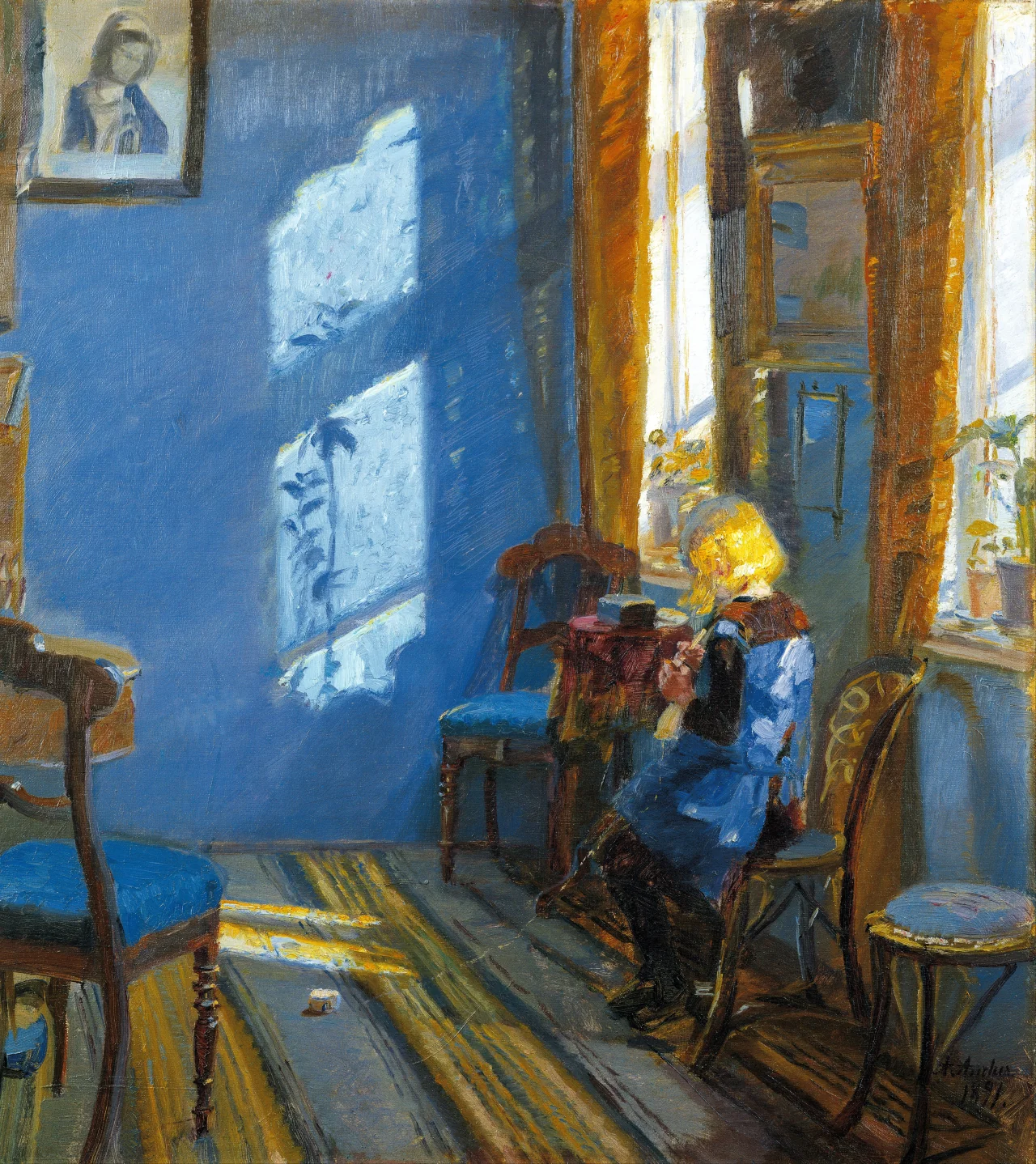
The catalogue of Skagens Museum describes this scene in one compact line: Helga Ancher at her crochet in her grandmother’s room. The sentence admits three generations into a painting with one visible body. The grandmother possesses the room. Anna makes the picture. Her daughter Helga makes something small between her hands.
Each has a different claim on the place. The room stores a life in furniture, fabric, potted plants, and a framed religious image. Helga occupies one chair while working with thread. Ancher converts the whole accumulation into oil on a canvas only 65.2 centimeters high. What might have settled into a family anecdote becomes an unusually lively question of authorship: who is arranging whom?
Sunlight is the most glamorous occupant. It pays no attention to the furniture. It enters through the windows at right and takes possession of the blue wall in three pale blocks. Shadows of window bars and leaves travel inside them. A bright strip crosses the woven rug at an angle, laying a second pattern over its long stripes. This visitor has made a room of its own, with temporary walls and a floor plan that ignores every chair.
The actual furnishings are less decisive. At least four seats crowd the canvas, and they face different directions. One blue chair pushes in from the lower left, cropped so hard that its back becomes a dark bracket. Another stands empty against the wall. Helga’s chair offers carved curves and a narrow perch. A round upholstered seat waits at the far right. Between them sit a small table, plant pots, ledges, curtains, and the upright divisions of two windows. The room supplies many places for a body and no commanding center.
This is how a used interior behaves. Things arrive at different times and remain because somebody still needs them, or once did. Their lack of coordination gives the blue room its credibility as the grandmother’s domain. It has not been cleared for Helga, and it has certainly not been cleared for the painter. Ancher works with the obstruction.
The left half offers her one immense release: a wall with almost nothing on it. The framed image in the upper corner is cut off, the furniture stays low, and blue opens across the remaining surface. The projected window shadows turn that apparent vacancy into the picture’s busiest act. Glass, crossbars, leaves, and the sun meet elsewhere, then arrive on the wall as a flattened report of their meeting.
Ancher gives this report physical weight. The pale shapes are built from thick, visible strokes of white, blue, yellow, and touches of pink. Their boundaries tell us that the effect will pass; their paint insists on staying. Some strokes sit like flakes on the wall, while others merge with the blue beneath. Light has acquired a surface rougher than the plaster it describes.
The treatment belongs to a painter who understood the room intimately and still had reasons to see it afresh. Anna Brøndum grew up in the family that operated the inn later known as Brøndums Hotel. She trained during the winters of 1875 to 1878 at Vilhelm Kyhn’s school for women in Copenhagen, then studied in Paris in 1889. The blue room joined those experiences without becoming a demonstration of either provincial authenticity or imported modernity. Ancher could test radical color and compressed space in a place whose habits did not need explaining to her.
Blue and orange conduct the test. Blue spreads through the wall, upholstery, Helga’s dress, and the rug. Orange climbs the curtains in rough, heated strokes and gathers in the wooden furniture. Yellow flashes along the rug and window ledges. These colors establish affiliations that practical use never would. Helga’s dress belongs pictorially to the wall, her hair to the curtains and sunlight, her dark stockings to the chair legs and floor.
Her body also occupies the seam between Ancher’s two versions of the room. To Helga’s left, wall and light expand. To her right, windows, curtains, plants, table, and chairs press into a narrow vertical band. She sits where spacious color meets household congestion. The chair back curves around her without enclosing her, and the table crosses in front of her hands. Nothing provides the clean silhouette expected of a formal portrait.
Helga does not need one. Her lowered head and close elbows make attention visible. The collection record calls the work crochet, a process in which one active loop is worked at a time. Very little of the material can be seen, yet her fingers give the painting a unit of measure. The large areas of wall and window are understood against an action conducted by inches.
Crochet makes space through repetition. A loop catches another loop; a pliable line gains width and structure. The comparison with painting can go only so far, but Ancher places the two procedures close enough to matter. Helga builds an object she can hold. Her mother builds an interior from short strokes, each mark joining a surface that exceeds it. Neither activity requires a performance for anyone else in the room.
The grandmother’s part is quieter because it has already happened. Her presence survives as arrangement: the assortment of chairs, the rug, the devotional image, the plants kept at the windows. This is ownership expressed through use rather than display. Helga’s crochet adds a new object in progress, although the painting never tells us what it will become. Ancher records both the inherited setting and the unfinished addition.
Seen this way, the famous sunlight does more than animate color. It loosens the authority of the room’s existing order. The projected window makes a broad pale shape where no object hangs. Its leaf shadows place the plants on two surfaces at once. Across the floor, the sun cuts the rug’s patient parallel lines with a white diagonal. For a short interval, inheritance has to share its surfaces with accident.
Ancher does not choose between the accumulated room and the invading pattern. She gives each enough force to alter the other. Without the furniture, the pale blocks could drift into an elegant study of color. Without those blocks, the furniture could close around Helga as family description. Their coexistence keeps the painting alert. Domestic familiarity supplies resistance to formal experiment, while formal experiment prevents familiarity from becoming merely sweet.
There is humor in the scale of the contest. Helga’s crochet may fit in one hand. The sun takes most of a wall. The room is full of chairs, yet the child sits as if no place could be more private. Ancher lets these disproportions remain. She has no need to make Helga monumental when color can register the intensity of her attention.
The painting’s signature appears at the lower right: A. Ancher 1891. It lies in the brown, crowded zone beneath the spare upholstered seat, far from the great pale shapes that make the work instantly recognizable. Ancher puts her name among the room’s contents, another small, durable thing set down where the sun has left the paint dark.